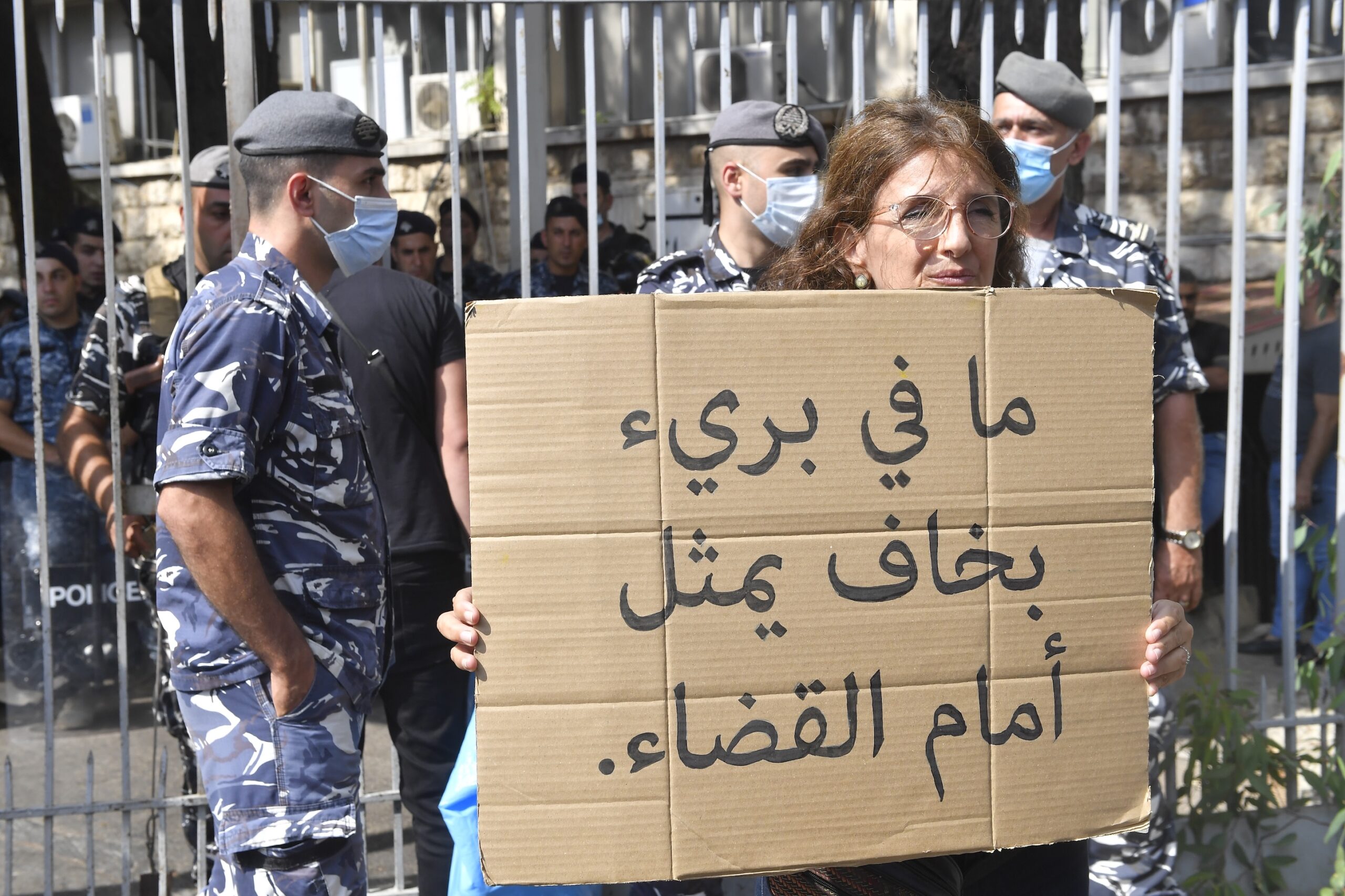
On October 8, 2025, Lebanon’s Minister of Justice Adel Nassar appointed 11 investigative judges to work on cases of political assassinations or attempted assassinations that occurred between 1978 and 2008. For the Lebanese context, this decision may appear out of place in a country that has long favored impunity in the name of preserving civil peace, despite mass crimes and hundreds of political assassinations.
The country’s civil war ended with a General Amnesty Law adopted in 1991, by a parliament whose members were partially elected in 1972 and partly appointed by the government at the time. This law pardoned crimes committed before March 1991, with the aim of erasing the abuses committed by the different political factions to avoid any accountability. The law even exerted pressure on the hundreds of families of those who disappeared during the war to cease their demands for information regarding their loved ones in the name of “keeping the peace.” Since 1990, four amnesty laws have been adopted. This persistent pattern of impunity continued after the civil war, and extended to the Beirut Port blast and the financial collapse that has devastated the country, as victims still await any semblance of accountability.
The minister of justice’s decision could, at first glance, indicate the end of an era of impunity and the re-emergence of accountability
In a context where calls for accountability are routinely met with claims that they threaten civil peace, the minister of justice’s decision could, at first glance, indicate the end of an era of impunity and the re-emergence of accountability. This move aligns with the presidential oath and the ministerial declaration, both of which contained promises to pursue accountability. Signaling more than just an era of accountability, this decision shows the will of the minister to mark the end of a period of political crimes, particularly those linked to, or committed by, the Assad regime and its Lebanese allies such as Hezbollah and other groups.
Which cases were re-activated by the minister’s decision?
The decision concerns 11 cases for which investigative judges were appointed to, presented in chronological order.
- The earliest case in the list is the assassination of Tony Frangieh—the son of former President Suleiman Frangieh and grandfather of current MP Tony Frangieh—along with his wife and daughter, and 30 of his supporters, in the town of Ehden in North Lebanon on June 13, 1978.
- Former President Camille Chamoun was the object of a car bomb assassination attempt on March 12, 1980. This was followed by others in 1985 and 1987. The minister of justice appointed a judge to investigate the 1980 attempt.
- Sheikh Ahmad Assaf, former director of the Islamic Center and an opponent of Syria’s military control over Lebanon, was shot and killed on April 26, 1982. His case was referred to the Judicial Council on May 19, 1982.
- Mustafa Maarouf Saad, an MP and head of the Popular Nasserist Organization, survived an assassination attempt on January 21, 1985. The attempt was believed to be linked to his anti-Israel political stance.
- In January 1998, clashes took place in Baalbek between supporters of Subhi Al-Tufaili, former Secretary-General of Hezbollah who later defected from the party, and the Lebanese army, following the killing of a captain of the Lebanese army. These events were referred to the Judicial Council on February 6, 1998.
- Commander in the Lebanese Forces and former minister Elie Hobeika was killed in a car bomb on January 24, 2002, a few days before he was scheduled to testify in a tribunal in Brussels regarding the Sabra and Shatila massacres, which he was widely known to have overseen. His assassination was referred to the Judicial Council on January 28, 2002.
- Journalist and historian Samir Kassir was a prominent opponent to the Syrian regime and a key figure of the Cedar Revolution that was ignited in 2005 after the assassination of former Prime Minister Rafik Hariri. He was killed in a car bomb on June 2, 2005. His case was referred to the Judicial Council the following day.
- Gebran Tueni, the editor-in-chief of Annahar newspaper, an MP, and another vocal critic of the Assad regime, was assassinated in a car bomb on December 12, 2005. His case was referred to the Judicial Council on December 23, 2005.
- Pierre Amine Gemayel, an MP and minister from the Kataeb Party and son of former President Amine Gemayel, known for opposing the Syrian occupation, was shot and killed on November 21, 2006. His case was referred to the Judicial Council on December 12, 2006.
- Antoine Ghanem, a member of the Kataeb Party, was murdered in a car bomb on September 19, 2007. He also opposed the Syrian regime and its affiliates in Lebanon. His case was referred to the Judicial Council on November 2, 2007.
- Druze Sheikh Saleh Aridi, a cofounder of the Lebanese Democratic party, was assassinated in Baissour on September 10, 2008. The Lebanese Democratic party is considered close to the former Syrian regime. His case was referred to the Judicial Council on September 19, 2008.
While the appointment of investigative judges is necessary for accountability, it is not sufficient to ensure that the investigation leads anywhere, especially regarding cases that occurred decades ago.
An inefficient and highly criticized court
The 11 cases in question had all already been referred to the Judicial Council, for some, decades ago. The minister of justice therefore did not open new cases or new investigations, but merely appointed judges in those 11 ongoing cases.
The Judicial Council is an exceptional and highly political court, competent only for certain types of crimes, such as those pertaining to state security, sectarian strife, or involving firearms and explosives, and only regarding cases referred to it by the Council of Ministers. The Council is presided by the First President of the Court of Cassation, the highest court in the judicial order, in addition to four judges from the Court of Cassation who are appointed by a decree signed by the Council of Ministers. In other words, the Council of Ministers plays a fundamental role in appointing judges as well as referring cases to this Council, violating the principle of separation of powers and the right to an independent tribunal.
In recent years, the Council of Ministers referred two cases to the Judicial Council. The first case is the Beirut port blast, in which hundreds died and thousands were injured. For years the investigation has been stalled due to the obstruction efforts of multiple political parties. The second case is the Tleil explosion, during which a fuel tank seized by the army exploded in the northern district of Akkar on August 16, 2021, killing 30 people and injuring a hundred. Prior to that, the Council of Ministers referred the 1982 assassination of President Bachir Gemayel to the Judicial Council, which resulted in the conviction and sentencing of Habib Shartouni in October 2017.
Cases referred to the Judicial Council have taken years to be investigated and have been heavily obstructed due to a myriad of factors.
Cases referred to the Judicial Council have taken years to be investigated and have been heavily obstructed due to a myriad of factors. In the Beirut Port blast probe, investigative judge Tarek Bitar faced more than 25 complaints that stalled and blocked the investigation. In the Tleil case, the investigative judge was able to finish his investigation and issue an indictment, but proceedings were halted because a member of the Judicial Council was appointed as Public Prosecutor to the Court of Cassation in February 2024, meaning that the Council could not legally convene as long as a replacement was not nominated. It was only in September 2025 that judicial appointments were completed.
Beyond its inefficiencies, the Judicial Council has long been criticized for its lack of independence, as all of its five judges are appointed by the Council of Ministers at the recommendation of the minister of justice, leaving it vulnerable to heavy political influence. Furthermore, the procedures in front of the Judicial Council lack guarantees of due process, particularly when it comes to appealing its decisions or its investigative judge.
One question that could be raised at this point is whether the 1991 amnesty law could block investigations into crimes committed before it was adopted. However, the law specifically excludes cases referred to the Judicial Council before “the law [came] into force.” Because the assassinations of Tony Frangieh and Sheikh Ahmad Assaf, and the attempted assassinations against former President Camille Chamoun and Mustafa Maarouf Saad had already been referred to the Judicial Council before the amnesty law was adopted, perpetrators of these crimes should not be protected by it.
Impact of the fall of the Assad regime
The decision by the minister of justice to appoint these judges was also possible following the change of regime in Syria, as judicial cooperation has been one of the main discussion points between the two governments after the fall of Bashar al-Assad. These discussions mainly cover the transfer of prisoners from Lebanese prisons to Syria and the fate of Lebanese citizens who disappeared during the civil war. The Lebanese government has also asked the Syrian authorities to provide information regarding political assassinations involving the Assad regime, and the Syrian authorities appear willing to share available information. They have, for instance, arrested former Syrian intelligence officer Ibrahim Huweija, who is suspected of several assassinations, including that of Druze leader Kamal Jumblatt in 1977.
Whether these 11 investigations lead to proceedings against perpetrators or not, the minister’s decision to reactivate them by appointing new investigative judges demonstrates his intention to contribute to ensuring accountability for crimes committed in Lebanon, which could help restore the public’s trust in the judiciary and facilitate social peace. But accountability for political crimes will not be enough: the minister, and the government in general, should do everything in their power to ensure justice and accountability for all the crimes committed in recent years, including corruption and financial crimes.
Shehrazade El-Hajjar is a Nonresident Fellow at TIMEP focusing on accountability and legal reform in Lebanon.