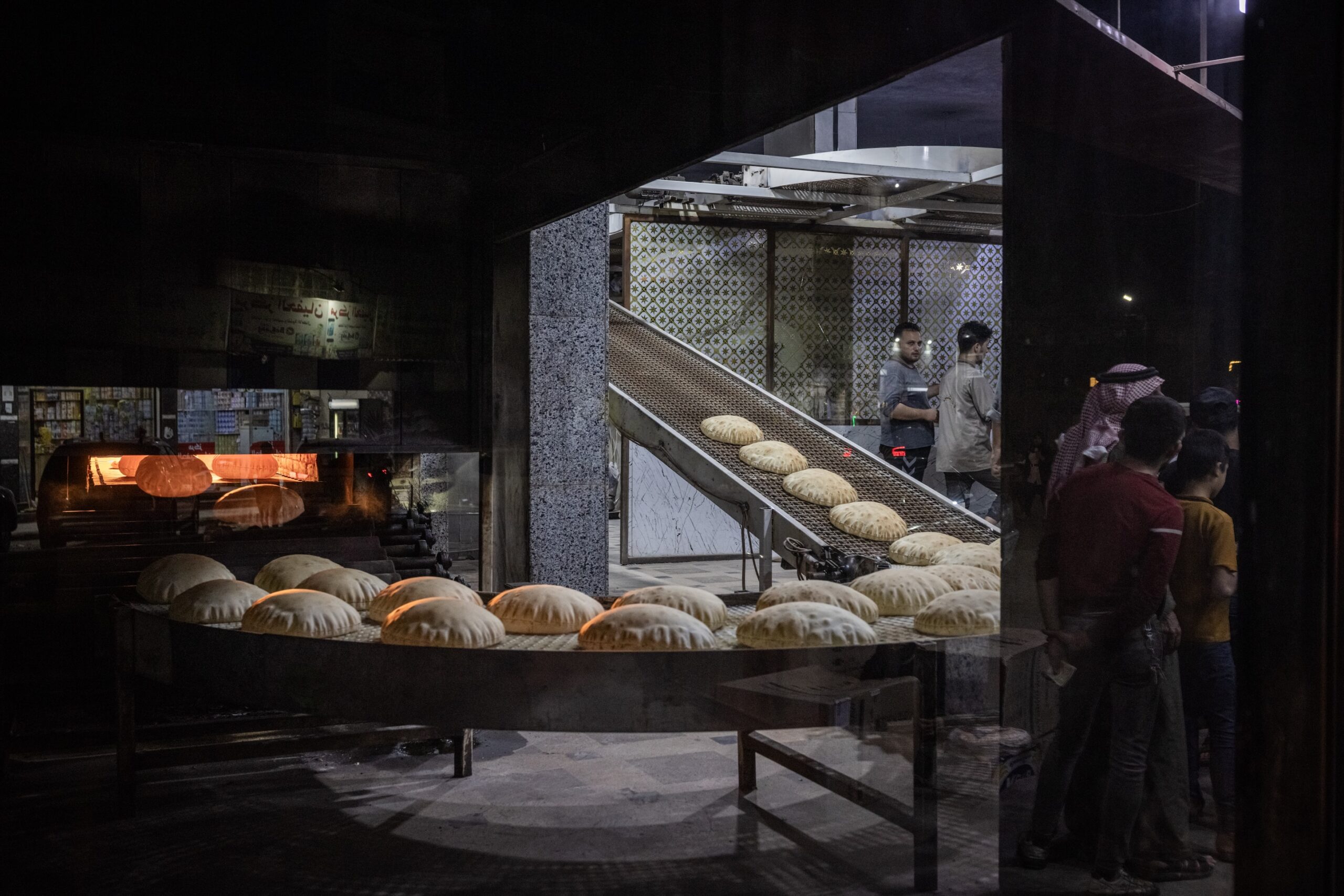
In May 2026, the United Nations World Food Program in Syria suspended its bread subsidy program and reduced its emergency food assistance by 50 percent due to critical funding shortfalls. The program supported 300 bakeries and served as a vital lifeline for up to 4 million people each day in the most vulnerable areas.
The collapse of the bread program is one example of the fragility of social support structures in today’s Syria. Much of what would ordinarily count as social protection, such as subsidized food, water provision, and cash assistance and support to farmers, is delivered not by the state but by UN agencies, international NGOs, and Syrian national organizations, financed by donors whose commitments are shrinking globally and in Syria.
The state has not filled the gaps, rather, it has moved to relinquishing its role as provider of support for its population by actively dismantling subsidies that the majority of Syrians rely on. It has not pursued a state led and financed shock responsive social protection system, but prioritized the signaling of fiscal prudence to seek credibility with investors. If such policies continue, millions of Syrians will remain one donor shortfall away from losing the support they rely on.
Social protection refers to a system of policies through which a state protects people from poverty and life-cycle risks through the provision of social security, assistance and services. Unlike needs-based humanitarian aid, social protection establishes the state as the duty bearer and coverage as an entitlement for all, rather than discretionary or temporary assistance.
The government’s economic strategy
Syria’s transitional authority has centered its approach to the country’s post-war recovery on restoring stability and reviving the economy, treating social protection as a byproduct of growth rather than a priority in its own right. Minister of Finance Yisr Barnieh has framed subsidy cuts as part of the effort to reduce debt and build fiscal credibility. This sits within a wider reform package which also includes currency redenomination and budget restructuring. Officials have credited these measures, along with the repeal of the Caesar Act, with removing barriers for investors and rising investor confidence. That credibility is meant to generate resources for the government that will eventually make social protection fiscally viable.
This approach aligns with the government’s stated aversion to external borrowing and to IMF-style debt reliance, where the state accepts conditions of spending and repayment in return for financing. These conditions have traditionally included subsidy cuts, not so different from what the Syrian authorities are currently undertaking. Instead, authorities are cutting government spending while covering the deficit by raising debt at home, and accepting foreign grants rather than relying on foreign borrowing. Damascus has, for instance, secured $491 million in World Bank grants since Assad’s fall, and is seeking more.
These policies came into full view in September, when the government sharply raised fuel prices, triggering widespread demonstrations across the country. The hike was the latest in a series of subsidy cuts across 2025 and 2026. Among the most consequential was the 2025 removal of subsidies on key agricultural inputs, including fertilizer, fuel, and seeds, which left smallholder farmers without support. The prices of basic and services have risen as well, with the price of subsidized bread rising almost tenfold, exacerbating the food crisis, while water and electricity have also become more expensive.
Vulnerable Syrians have no other state-provided protection to fall back on, which is precisely the problem, as it feeds a loop in which social protection stays on the backburner behind stability and growth.
Fiscal choices to social protection in Syria
In this context, the task of protecting vulnerable Syrians has fallen to external actors, in a country where 90 percent of households lived below the poverty line in 2025. UN agencies, international organizations, and local NGOs deliver the humanitarian response, including farmer support and water rehabilitation.
This arrangement is precarious and was fragile long before the current crisis. Syria’s Humanitarian Needs Response Plan was funded at 52 percent in 2022, 33 percent in 2023, and 36 percent in 2024, showing chronic underfunding that predates this government. The 2026 plan now seeks $2.9 billion to reach 8.6 million of 15.6 million in need and provide them with life-saving assistance. The plan has received $943 million, or 33 percent of its target, so far.
Nonetheless, the government has moved to regulate the work of non-state aid and protection providers. In October 2025 the Ministry of Social Affairs and Labor required NGOs to obtain approval before accepting foreign funding, and in March 2026 the Ministry of Foreign Affairs required prior approval for memoranda of understanding with Syrian counterparts. In other words, the state is more than willing to regulate who delivers welfare than to fund and provide it directly itself, setting a dangerous precedent of relying on unsustainable donor-funded project cycles that would jeopardize the welfare of millions of Syrians when funds inevitably dry up.
Meanwhile, the government launched a three-year social protection strategy in March 2026, but it remains short on funding. The National Strategic Plan for 2026–2028 is designed to move beyond fragmented, limited-impact interventions and toward a more integrated national system linking social protection, labor-market regulation, institutional governance, and economic empowerment. Its concrete objectives include building a national social registry, expanding social insurance coverage, promoting decent work, and economic inclusion of women. The International Labor Organization trained around 50 ministry officials to implement it, and the ministry began building the registry in February and launched a Cash Plus transfers program with UNICEF in August, targeting roughly 40,000 households and 200,000 people. But the plan does not frame protection as a right: registration and selection for targeted assistance is not the same as an entitlement, and 200,000 people is a fraction of the quarter of Syrians living in extreme poverty. Nor did the announcement say who is financing it, raising questions about its sustainability.
Minister of Social and Labor Affairs Hind Kabawat has acknowledged that funding is the biggest obstacle, and that electricity and water come first, with social protection to follow. The constraint is real, the state spent $3.7 billion against $2.7 billion in revenue in the first half of 2026, prompting the September spending-cut order that exempted wages and core services.
What’s next?
Syria is coming out of a 14-year war, its institutions are weak, and its current government is actively cutting protections due to fiscal constraints. Even so, the current arrangement cannot last given the contraction in donor financing. The state will need to gradually take back its role as duty bearer and provide for the welfare of its citizens through its institutions and mechanisms.
The government is not starting from scratch. Historically, the Syrian state framed basic social services as constitutional rights, with a developed legal framework for social insurance, though these protections deteriorated over time under Bashar al-Assad’s rule, and are currently further being eroded. Targeted cash transfers introduced after 2006 had limited impact and pushed the poorest Syrians toward civil society instead, a lesson for today’s targeting-first approach. Syria’s main provider of social insurance, the National Social Security Institution, still covers 27 percent of the labor force and 17 percent of those over 60, but faces liquidity constraints and covers none of the 83 percent of Syrians now working informally.
To fund social protection sustainably and strengthen social security systems, Syrian policymakers should look beyond a revenue strategy that relies on customs, proceeds from hydrocarbons, and one-off fees like telecom licensing, while leaving businesses profiting most from new investment deals that are largely untaxed or are taxed at low rates as per Syria’s 2025 investment law. Taxing profits generated from these deals while investment in Syria continues to remain of interest would raise revenue to fund building state capacity and the social protection floor. This is the basic social security guarantees offered for everyone, throughout their life, regardless of employment status, income, or where they live. Donors, in turn, should condition continued investment facilitation on visible progress in funding this social protection floor.
International donors and INGOs should shift from parallel service delivery toward funding that builds institutional capacity and state accountability, with a clear and concrete plan to transition to state-run services rather than open-ended project cycles. The state, for its part, should stop treating protection as a cost rather than an investment, especially since cash-based assistance and social security programs build human capital and stimulate domestic demand. It should also allocate fiscal space to universal programs, health, and education, not only public-sector wages and pensions. Concretely, the government should move toward codifying social protection as a legal entitlement rather than a discretionary program, for instance through a national social protection law establishing enforceable minimum guarantees on income and access to services.
Finally, civil society organizations also have a very important role to play in advancing the voices of local communities and bringing them to policymakers. Working closely on the ground, civil society organizations are more aware of the needs of local communities and their concerns, and are well placed to establish channels that hold the state accountable to its citizens.
Cynthia Saghir is a policy and social protection researcher and specialist and has worked extensively in the fields of socio economics, public policy and labor market dynamics, and advocacy and influencing initiatives and projects in the Levant.