You can read this article in Arabic here.
In South Lebanon, the room to live normally is shrinking by the day. Israel continues its near-daily attacks, while its army occupies around 60 villages beyond the so-called “Yellow Line.” There, the demolition of homes and destruction of other structures continue unabated, leaving residents with dwindling prospects of returning to an ordinary, dignified life.
Life in Lebanon was already difficult. Since 2019, the country has been gripped in an economic collapse that wiped out people’s savings and eroded their purchasing power. Then came the war which began on October 8, 2023 and has continued at varying intensity ever since, upending people’s lives, especially in the south.
Israel has destroyed homes, shops, and agricultural land, forced residents to leave their homes, and imposed restrictions on movement by land and sea. Economic activity has contracted sharply, while vital sectors such as agriculture, fishing, and tourism have been brought to a standstill.
Despite it all, residents in towns and villages outside the “Yellow Line” are trying to adapt and earn a living in a changed reality. Yet livelihood options are increasingly limited, pushing many to take whatever work they can find to meet their families’ basic needs, while others rely heavily on family and community support networks.
A crippling maritime blockade
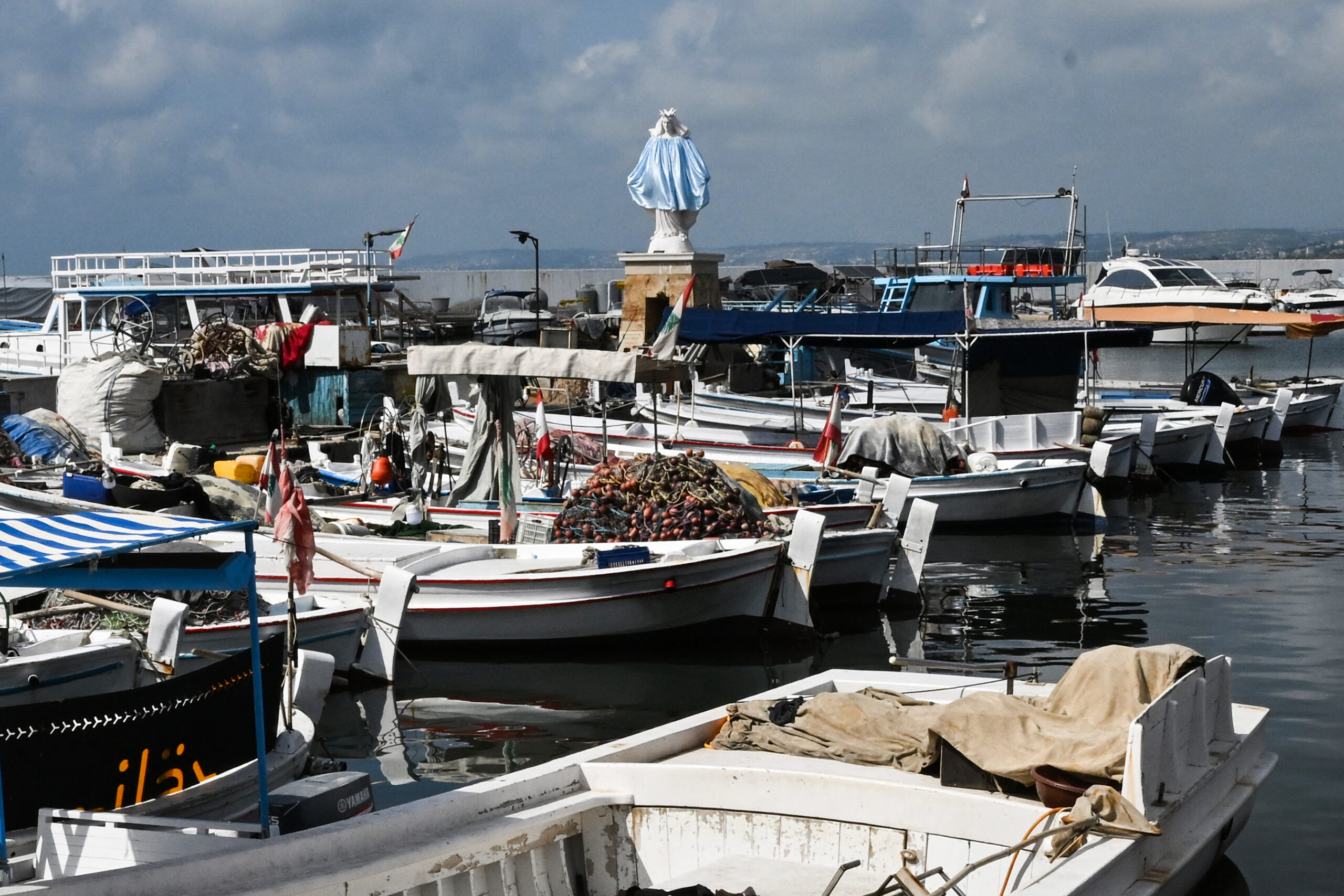
For 30 years, Taha* worked as a fisherman at the port of Tyre, about 80 kilometers south of Beirut. He never owned a boat of his own, but worked under a profit-sharing system common among local fishermen. Under this arrangement, the proceeds from each fishing trip are divided into five shares: one for the boat owner, one for the owner of the fishing equipment, and three for the fishermen on board. Before the war, Taha earned between $20 and $50 a day.
As fighting intensified in September 2024, fishermen were barred from taking their boats out to sea for 66 days. Israel later confined fishing to a smaller geographic zone, considerably reducing catches. At the same time, the rising cost of diesel fuel and declining consumer purchasing power further weakened demand for fish.
For Taha, who’s now in his sixties, the war changed everything. During that period, he went out on just two fishing trips within the permitted zone, which had become crowded with fishermen, and returned empty-handed both times. He ultimately decided to find another way to make money.
Taha began selling diesel fuel to fishing boats. He pours the fuel into plastic water containers and delivers it to vessels on request, earning a profit margin of about $1 per gallon. On an ordinary day, Taha sells between 40 and 60 gallons, rising to more than 100 gallons during the summer. After three decades at sea, he now earns more supplying fishermen with fuel than he ever did fishing himself.
Limited capital
A short distance from the port where Taha works, another sign of how life in Tyre has changed appeared on the sidewalk. There, three young women turned a stretch of pavement into a makeshift vegetable stall. Roula Ibrahim is a civil engineer; her sister Reem worked as a graphic designer; and the third is their cousin Mona.
Roula and Reem’s father had owned Elyanoor, a flower shop in the city, for 30 years. During the 2024 war, Israel struck the building housing the shop, severely damaging the business. Despite the destruction, Roula managed to repair it fairly quickly. But during the 2026 war, Israel struck the building again, reducing it to rubble.
By that time, the sisters had also lost their jobs as the war raged. They were forced to look for alternatives. “In wartime, people look for basic necessities, that is why we thought of selling vegetables,” Roula says. “It is also a small business that fits the limited capital we had.”
Their day would begin at dawn, when they headed to the city’s wholesale produce market on the outskirts of Tyre to buy goods. Rather than working in shifts, all three women remain together at the stand until late in the afternoon.
Their venture, however, has not been without setbacks. They first opened the stall on May 27, 2026, but were forced to close it just eight days later, after Tyre was heavily targeted by Israeli strikes, and Roula and Reem’s mother was wounded by shrapnel. The family briefly fled the city and returned once the situation had somewhat calmed, and the three women reopened their stall.
The city’s municipality also attempted to remove the stand, but the women resisted. As security conditions improved, all three eventually returned to their previous professions. Still, they kept their business which was moved into a small shop in one of the city’s alleys.
“Sales have dropped considerably because we are now in a location that is not easily accessible, but the rent is low,” Roula says. “We are still looking for a better location at an affordable price. But what matters most is that the war does not escalate, because if it does, every option will become difficult.”
No work
While Roula, Reem, and Mona were able to remain in their city and continue working, conditions were harsher for Nader*, a resident of Yarin, a town along the border with Israel. He fled with his wife and two children just days after the war broke out in 2023, and they moved between several locations before eventually settling in a shelter in Beirut.
Before the war, Nader worked in olive and tobacco farming, but he has been unable to find work in Beirut. “I have spent my entire life working in agriculture,” he says. “I do not know how to do anything else.”
Nader now depends on the limited in-kind assistance provided at the shelter, including daily meals and personal hygiene supplies, as well as a small income from occasional odd jobs. Yet this money is nowhere near enough to cover the family’s basic living expenses.
Nader’s two children have continued their education remotely since their displacement, but he says the conditions inside the shelter make it difficult for them to study. He contrasts their current situation with the life they left behind, recalling with pride their 260-square-meter home in Yarin. Now they share a single room with another family.
“We used to live a quiet life in a close-knit village. Most of the residents were relatives, and most worked in agriculture. But since then, we have become displaced, and no one pays any attention to us.”
Nader visited his village in 2024 and found it completely destroyed after Israel booby-trapped and demolished buildings. The agricultural land had been bulldozed, and the olive trees burned.
Yarin’s fate was not an exception. Similar destruction has affected large areas of agricultural land across South Lebanon, particularly in occupied villages, with losses to the agricultural sector estimated at more than $1 billion.
Putting food on the table
Ali Bazzi, a man in his thirties from Tayr Debba, near Tyre, was studying graphic design before the war started. He paid for his studies by trading currency in the city, a line of work that had flourished since the onset of Lebanon’s economic crisis in late 2019.
The war, however, upended all his plans. He stopped his studies, while currency trading became less profitable with tourists and expatriates no longer visiting, and the exchange rate stabilizing. He decided to stay in Tyre rather than flee because he could not afford the costs of displacement. Instead, he moved to the city’s old quarter, a predominantly Christian neighborhood that, in his words, offered him “a degree of safety.”
In the months following the latest all-out war in March 2026, Ali and his cousin opened a small food cart. The menu depended largely on whatever ingredients they were able to obtain, including shish taouk, kofta, and sausage sandwiches.
Ali says food prices rose sharply because of the war, with the price of a kilogram of meat reaching $20, up from $13. “We sold sandwiches at a moderate price, around $3 each, and demand was extremely high because we were the only ones operating in the city.”
“A lot of people ate for free,” he adds. “During wartime, people have to support one another. We did not mind it, because our goal was simply to make enough to get through the day, not to make a large profit.”
Tyre is now seeing a partial return to normal life, although it is overshadowed by the daily attacks and large-scale demolitions of homes in the nearby town of Mansouri, sending columns of smoke into the air that can be seen from the city.
Ali decided to close his food cart once restaurants began reopening. And while he has since resumed his graphic design studies, his life has not returned to normal. “We are living through a period of deep uncertainty. War could erupt again at any moment,” Ali says. “At the same time, prices are rising and job opportunities are shrinking. It feels as though everything happening around us is pushing us toward a single path: emigration.”
*Pseudonyms.
Mahdi Krayem is a Lebanese journalist and activist.