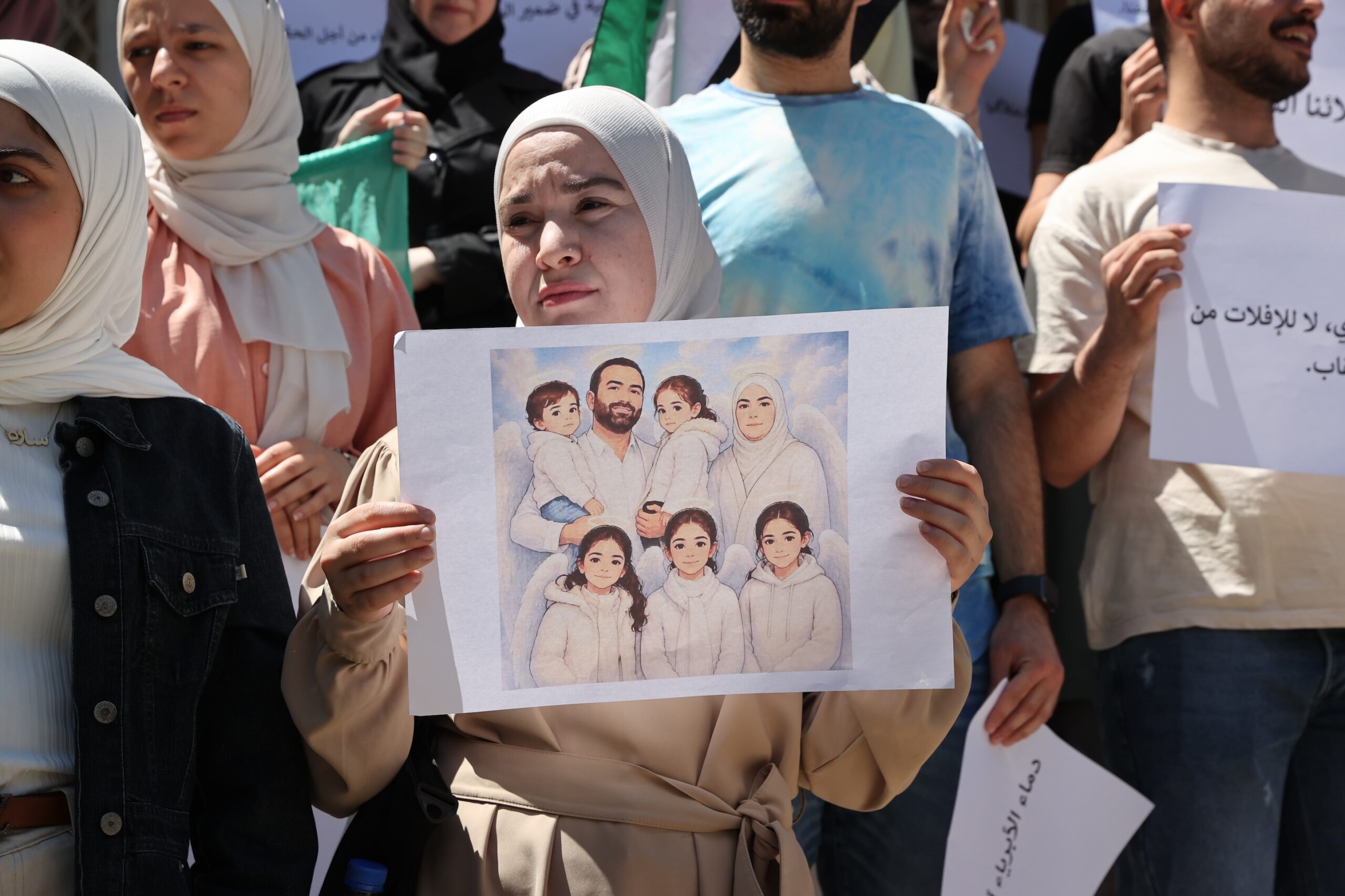
For 13 years, the family of Syrian dentist Rania al-Abbasi searched for her, her husband Abdul Rahman, their six children, and Rania’s secretary Majdoline Al-Qady, ever since they were forcibly disappeared in 2013. They followed leads, contacted institutions, and pursued information that repeatedly proved inconclusive. Their search continued even after the fall of the Assad regime in December 2024.
The search entered a different phase after the arrest of Amjad Youssef, a former warrant officer in Assad’s Military Intelligence Branch 227 and a key figure in the 2013 Tadamon massacre in Damascus. The arrest renewed the family’s suspicions about video footage, filmed by Youssef himself, documenting executions in Tadamon. In May 2026, the family learned that all six of Rania’s children had been killed, after identifying them in the video showing their final moments.
The way the family learned of the children’s fate raises a broader question for Syria’s emerging missing persons process: How should institutions inform families about the fate of their loved ones while respecting their dignity? A family-centered approach requires more than communicating a finding. It must also consider how families are prepared, how evidence is shared, when information is made public, and what support is provided afterward.
Institutional coordination and the rights of families
For years, Syrian families have led efforts to document enforced disappearances, search for their loved ones, and demand answers. As Syria develops its missing persons institutions following the fall of the Assad regime, family groups and civil society organizations have called for clear protocols, better institutional coordination, and meaningful participation. The al-Abbasi case illustrates why these demands are particularly urgent.
According to Naila al-Abbasi, Rania’s sister, about a month after Youssef’s arrest, the Syrian Ministry of Interior and the National Commission for Missing Persons (NCMP) contacted the family and began collecting information about the children, including their ages, photographs, clothing, and the circumstances of their arrest. Established in May 2025, the NCMP is mandated to investigate the fate of missing and forcibly disappeared persons in Syria, document cases, and provide legal and humanitarian support to their families.
As Syria develops its missing persons institutions following the fall of the Assad regime, family groups and civil society organizations have called for clear protocols, better institutional coordination, and meaningful participation
Naila was later asked to travel to Damascus but was not told that the authorities had obtained the video footage, which the family suspected might show Rania’s children. Had she known, she said, she would have found a way to travel.
Her brother Hassan was pursuing the footage through a separate route. According to Naila, Hassan’s efforts to obtain the footage eventually led to its handover to the Independent Institution on Missing Persons in the Syrian Arab Republic (IIMP), the UN entity established in 2023 to determine the fate and whereabouts of all missing persons in Syria and support their families. Then IIMP later contacted the family and set up an online meeting with them, during which Naila and Hassan were shown numerous times the video that included the bodies of five girls and a boy, until they managed to identify the children. There was no information on the fate of Rania, her husband, and Majdoline.
After viewing the footage, Naila asked that it not be leaked because she did not want her parents or siblings to see it. “Since the day I saw the video, it replays in front of my eyes every night,” she said.
Despite the IIMP telling the family they could decide when to announce the news of the children’s death, the NCMP publicly announced the news before Naila and her siblings managed to find a way to tell Rania’s parents. Calls of condolence began arriving before they had told them.
The right to know is more than the final answer
For Naila, seeing the children in the footage and knowing that they had been killed was part of the truth, but it was not enough. When and where were the children killed? Who was responsible? What evidence did investigators hold? Where are the children’s remains? And what happened to the others?
All these questions that remain unanswered show that notification does not necessarily resolve a missing person’s case and does not mark the end of the family’s right to know the truth. Naila has asked to remain involved in the investigation. “Include us step by step,” she said, arguing that families should not simply provide information and then wait outside the process.
The same concern appears among families that have not yet received an answer. Human rights activist and former detainee Bayan Rehan’s brother, Khalil, disappeared after he was arrested in Douma in Eastern Ghouta by Assad regime forces on December 17, 2012. The reasons for his arrest and his fate remain unknown. Although Bayan believes he was killed, the family is still searching for answers about the circumstances of his death and the whereabouts of his remains. She said her family had to follow up with official institutions in search of information instead of receiving regular communication about his fate. She also learned that the NCMP had held several discussion sessions with families of missing persons in Douma only after they had taken place, raising questions for her about how families are reached and included.
When a mass grave was discovered near the Al-Rayhan Junction Checkpoint, where her brother had been arrested, Rehan contacted the NCMP. She said she was asked to provide the exact GPS location of the grave so that the official could determine whether it fell within their responsibility. Rehan also said that despite having seven missing relatives, no member of her family had been invited to participate in the discussion sessions.
Notification must adapt to families, not the other way around
A family-centered process begins before a decisive finding: families need to know where their case sits, how to remain in contact, and how they can participate as information emerges.
A family-centered protocol needs safeguards without imposing a single method of notification. Naila and her brother’s experience was shaped by displacement. They were both abroad when the footage became available. For Naila, the flexibility to get the news in a remote setting was essential. “Protocols should be for our benefit,” she said. Rehan’s preference is different: she would want an in-person visit at home, with a family doctor and mental health professional present because of her parents’ age and health and the presence of her brother’s children.
Advisers to the IIMP Moumana al-Haj Ali and Jalal al-Hamad told TIMEP that families should be prepared in advance to receive sensitive findings, with psychosocial support available during notification. They stressed the importance of verifying information, assessing risks, respecting families’ privacy and preferences, and providing appropriate technical and legal support.
A NCMP representative told TIMEP that the Commission follows notification protocols as well, with a case officer and psychosocial support attending notification meetings with families. The NCMP requires informed consent before publishing certain findings, and has kept information from being shared publicly when families do not consent to share this information.
Similarly, access to evidence should not become an obligation to view traumatic material. Al-Haj Ali argued that families should not be forced to view images or remains and should have time and space to absorb difficult information.
Certainty without silence
Another challenge is deciding what information is reliable enough to communicate. The Commission representative described three stages: confirming a case as one of a missing person after documentation and checks; determining identity or fate through documents and archives; and, when remains are found, identification through DNA and forensic examination.
This matters because truth often arrives in fragments. IIMP’s Al-Hamad argued that unverified information should not be communicated to families as fact because repeated uncertainty can deepen distress. But there is a difference between unverified information and verified but incomplete information. If one element has been firmly established, he argued, families can be told without waiting for the entire case to be solved.
Notification can be devastating even when handled carefully. It can also trigger new legal, psychological, practical, and investigative needs
Rehan explained she prefers confirmed information, while recognizing that families themselves may sometimes help verify identity, for example by recognizing a relative in unclear photographs or footage.
Notification can be devastating even when handled carefully. It can also trigger new legal, psychological, practical, and investigative needs. The National Commission representative said the NCMP provides psychological and legal support, maintains a platform for families to follow case developments, and is developing a broader referral system. Al-Hamad and Al-Haj Ali stressed the importance of continued support after notification as well, with a designated point of contact and written information where possible, while respecting families’ preferences regarding follow-up.
For Naila, follow-up means something else as well: continuing access to the truth-seeking process. Notification on what happened to the children was not the end of their case; it changed the questions the family needed answered.
From recipients to participants
Across the interviews, one principle recurs: families should not enter the missing persons process only when institutions need information from them or have a result to deliver. Their participation should not be selective or symbolic, it must be central. The IIMP advisers stressed the importance of continuous consultations with families, drawing on Syrian civil society organizations to broaden participation and involving families in designing notification procedures, determining their support needs, and establishing mechanisms to challenge findings or correct mistakes.
Families need clear and continuing channels of communication; preparation before sensitive findings are delivered; flexibility over how notification occurs; explanations of evidence and uncertainty; time before public disclosure; choices over viewing traumatic material; and continued support and investigation afterward.
Having a notification protocol is not enough. Its procedures need to reflect families’ experiences and be adjusted when they do not meet families’ needs
Existing notification protocols should accommodate the circumstances and preferences of individual families. Institutions should protect families from speculation while clearly explaining what has been established, what evidence supports it, and what remains unknown. And to avoid repetition and retraumatizing families, the institutions in charge of this file should properly coordinate. Although the NCMP and the IIMP are separate institutions, both signed a Joint Declaration on the Principles of Cooperation in November 2025, alongside the International Committee of the Red Cross and the International Commission on Missing Persons. Coordinating notification procedures should form part of translating these commitments into practice.
Having a notification protocol is not enough. Its procedures need to reflect families’ experiences and be adjusted when they do not meet families’ needs. For Naila, learning the fate of Rania’s children did not close the family’s case. For Rehan, who is still waiting, dignified notification begins long before a final answer arrives. Their experiences point to the same principle: families should be participants in finding, understanding, and receiving the truth, and in determining what comes next.
In Syria, learning how to tell families what has been found must be treated as part of the search for the missing, not as what happens after it is over.
Kholoud Helmi is a Nonresident Fellow at TIMEP focusing on centering survivors in Syria’s justice and policy debates. Her mandate explores how the voices and experiences of survivors can inform more inclusive policy approaches. She is also the institute’s 2026-2027 Mohamed Aboelgheit Fellow.