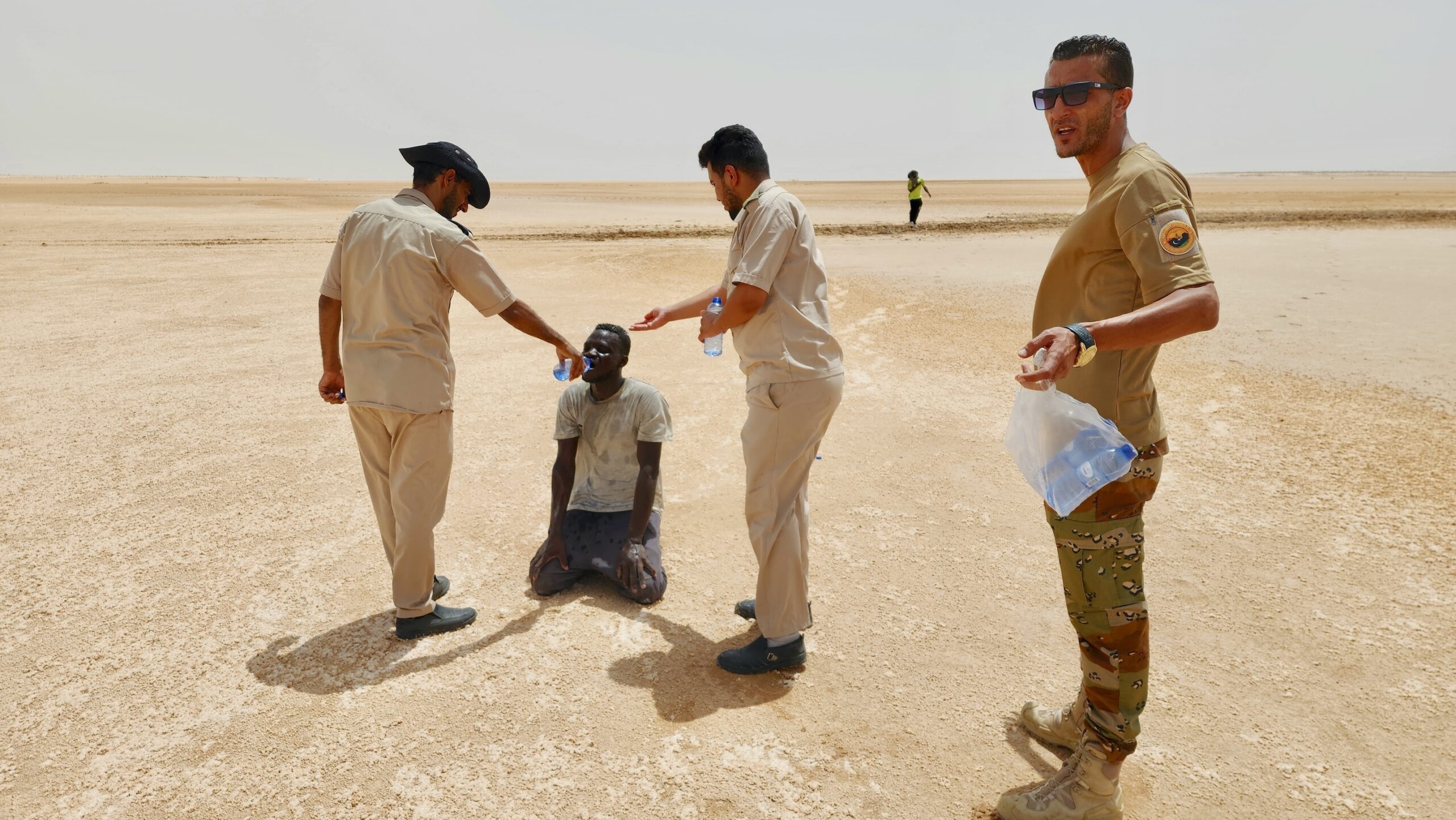
In the scorching heat of the Sahara Desert, Lamine, a young man from Guinea, found himself abandoned by the very forces meant to protect him. He was one of tens of thousands of migrants left to suffer due to operations carried out by North African governments and funded by the European Union aimed at curbing the number of people trying to seek refuge in Europe. The EU’s strategy, which prioritizes border security over human dignity, has led to worsening human rights conditions for migrants, with North African governments enacting measures designed to deter migration, even at the cost of human lives.
This harsh reality is a consequence of the EU’s externalization migration policies, which have particularly devastating impacts for migrants in Tunisia, Libya, Morocco, Egypt, and Mauritania. Externalization is an EU strategy of delegating migration management to neighboring third countries. By outsourcing border control to these North African nations, the EU has effectively enabled them to ignore human rights abuses to reduce migration. With over $5.2 billion spent in those externalizing agreements, the result is the increasing numbers of detention, ill-treatment, and even deaths of migrants. While migration into Europe from the central Mediterranean has decreased by 59 percent in 2024, these numbers obscure the human costs of such policies. The EU’s actions export logistical challenges while shifting the responsibility for human rights violations.
The North African governments’ actions along with EU anti-migration funding and training has eroded accountability for violating human rights, contributed to strengthening autocratic regimes of North Africa, and played into the anti-migrant rhetoric of the far-right in Europe. Migrants facing the far-reaching consequences of these policies require urgent action of regional stakeholders and NGOs to address the worsening humanitarian crisis through reforms, documentation of abuses, and awareness campaigns.
Cycles of violence and unaccountability
The EU’s strategy of externalizing migration builds on the 2004 European Neighborhood Policy (ENP). The ENP aimed to deepen cooperation with non-EU Mediterranean countries through trade agreements, financial support, and visa facilitation.
The adoption of the Neighborhood, Development, and International Cooperation Instrument (NDICI) in 2021, which consolidated EU foreign aid tools into a single financing mechanism, intensified the EU’s efforts to transfer its border control responsibilities to neighboring countries. Under the NDICI, EU funding is often implicitly tied to a partner country’s success in curbing migration flow. As a result, North African countries with low scores on the Human Rights and Rule of Law Index face few consequences for violating the rights of migrants.
Libya is a well-documented example of such policies: EU-funded detention centers subject migrants to abuse ranging from unsanitary conditions and forced labor to torture. Survivors recount abuse, including sexual violence and extortion, enabled by the absence of a refugee law or asylum system in Libya. The lack of legal protection allows state and non-state actors to exploit migrants with impunity, creating an unchecked environment of human rights violations.
EU vehicles and equipment seem to have been directly linked to some of these abuses in some North African states, according to an investigation published by El País, though EU state officials have denied involvement. The 2023 agreement between the EU and Tunisia, intended to “bolster efforts to stop irregular migration,” failed to include guarantees that the Tunisian government would refrain from rights violations. This omission is especially troubling given the documented instances of violence, extortion, and discriminatory practices against migrants in Tunisia.
The Pact on EU Migration and Asylum, adopted in 2024 and which will come into effect in 2026, aims to streamline the asylum process, enhance border procedures, and facilitate ‘remigration’ by encouraging states to externalize border control. This development dodges accountability while raising concerns, as migrants could be left in inhospitable regions under the guise of a ‘remigration’ strategy. The EU’s remigration focuses on “nudging” or “encouraging” migrants to leave. This is exemplified by the admission of an anonymous contractor for EU-financed projects, quoted by The Washington Post: “You have to make life difficult for migrants.” He continued “Complicate their lives. So, if a migrant from Guinea is in [Morocco], and you take him to the Sahara two times, the third time he … asks for a voluntary return home.” By exposing migrants to repeated deportations and life-threatening conditions, these measures could convince migrants to abandon their plans to seek a better life in Europe.
Some North African governments have forcibly transported migrants to isolated areas such as the Sahara Desert between Libya and Tunisia, where migrants have been left without food, water, or protection. These areas have become zones of human suffering, with survivors recounting instances of extortion, kidnappings, and sexual violence. Evidence reveals at least 11 such sites, where up to 90 migrants have been abandoned at a time. These actions have directly resulted in the death of at least 27 individuals, with many more reported missing. In addition to these incidents, several mass graves of migrants have been uncovered in the Libyan-Tunisian border, one of which contained the bodies of at least 65 individuals.
Empowered authoritarian regimes and the rise of the far-right
The EU’s migration policies also have some ripple effects. By outsourcing border control, the EU strengthens authoritarian governments. In 2018, for example, the Italian government—backed by the EU—helped the Libyan Coast Guard secure an extension of its jurisdiction into international waters. This decision effectively handed control to militias known for human trafficking and abuse.
Tunisia offers another particularly stark example of this dynamic. President Kais Saied’s rule has turned Tunisia into a state of diminished freedoms and rights. Saied has undermined judicial independence, eroded electoral processes, and consolidated executive power to silence dissent. Despite these developments, the EU has refrained from applying meaningful pressure on Tunisia, due to its importance in curbing migration to Europe. This emboldened Saied to enact brutal policies and violent rhetoric against refugees and asylum seekers, and as a consequence, migrants face detention, abuse, and forced deportation to remote border areas, with no real pushback.
The trend extends to Egypt and Morocco, as the EU’s financial support to these countries was followed by the implementation of anti-migrant measures and a continued crackdown on internal dissent. In Mauritania, Spanish authorities were allegedly involved in the forced transfer of migrants to Mali.
In Europe, the rise of far-right ideologies worsens this trend. Italy’s recent agreement with Albania to establish detention centers capable of holding 36,000 migrants reflects a growing tendency toward containment rather than protection. Meanwhile, the United Kingdom’s previous plan to deport processed asylum seekers to Rwanda highlights a willingness to disregard international obligations in favor of deterrence. Poland’s temporary suspension of the right to seek asylum altogether further underscores this shift toward more hardline, populist stances on migration.
These developments are part of a broader trend where far-right politics drive policies that prioritize security over humanitarian concerns. By reinforcing the EU’s restrictive migration approach, these domestic shifts in Europe create additional pressure on North African nations to adopt similar repressive measures. The convergence of these factors heightens regional instability and impedes progress toward a just and equitable solution for migrants in North Africa.
The treatment of migrants in North Africa highlights the prioritization of national interests over human lives. North African countries are unlikely to prioritize migrant protection out of principle alone. Neither will their European counterparts, as shown through the externalization deals of the past several years. From the economic incentive structures to the lack of monitoring protocols, the entire structure of engaging with migration has facilitated this pattern of abusive policies. International pressure and regional cooperation are the only feasible routes toward accountability and justice for the most vulnerable members of the global community.
Dhruvi Thakker is a recent graduate from the George Washington University, where she earned a Master’s degree in International Security and Diplomacy.