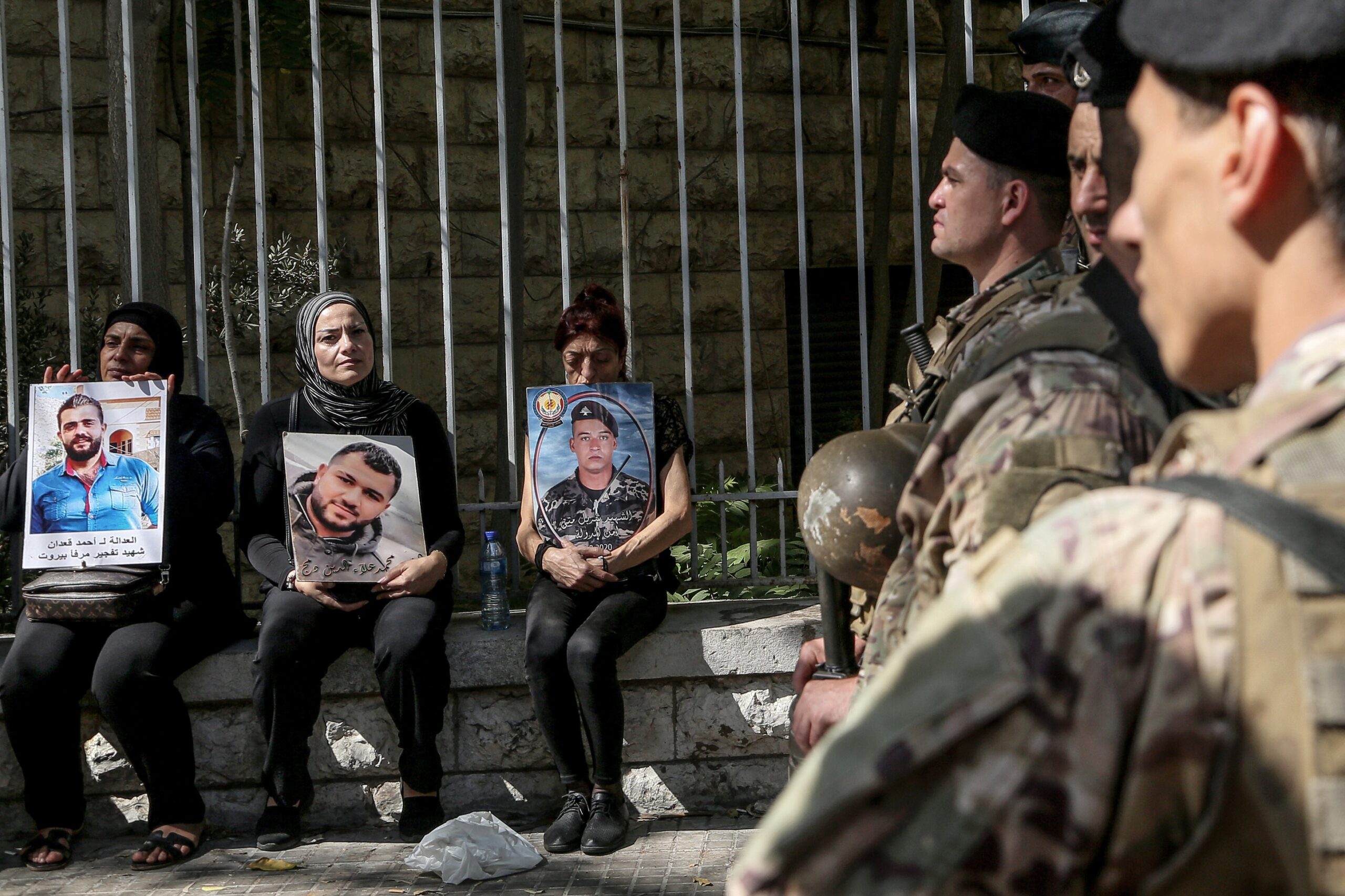
More than five years after the Beirut Port blast—the massive explosion that killed more than two hundred people, injured thousands, and devastated the capital on August 4, 2020—victims are still waiting to know the truth behind what happened, and hold those responsible to account.
While the investigation into the blast had been stalled for years, the case had regained some traction following the election of President Joseph Aoun and the appointment of Nawaf Salam as prime minister in January 2025, as both promised to work toward accountability for the victims of the blast. In March 2026, investigative Judge Tarek Bitar finally concluded the investigation, charging 70 people.
Resumption of investigations, delays in indictment
In the years following the blast, Prosecutor General Ghassan Oueidat, who was himself indicted in the case, reportedly on negligence charges, used his powers to systematically obstruct Bitar’s investigation, releasing suspects, banning law enforcement from executing his orders, and filing a lawsuit against Bitar for usurpation of power. Oueidat retired in 2024, and many of the obstacles he placed were removed in 2025. Jamal Hajjar, his successor, lifted the ban on cooperating with Bitar, allowing for the resumption of the investigation. The “usurpation of power” case was also dropped. Bitar was finally free to move forward with his investigation after years of political interference, and threats prohibiting him from carrying out his mission.
Despite these developments, Oueidat and other individuals charged did not respect Bitar’s investigations. Oueidat refused to be notified when Bitar summoned him for questioning. Ghazi Zaiter, a former minister of Public Works charged by Bitar, also refused to appear before the judge.
The case saw another major development in 2025. In September, Bulgarian police arrested Igor Grechushkin, the Russian owner of the Rhosus, the vessel that brought the ammonium nitrate that detonated in the port. Grechushkin had been placed on Interpol’s wanted list at the request of the Lebanese judicial authorities, who were looking to charge him with “bringing explosives into Lebanon, a terrorist act leading to the death of a large number of people, and disabling machinery in order to sink a ship.” Bulgarian authorities, who had refused to extradite the ship owner at the request of the Lebanese authorities as he risked the death penalty, allowed Bitar him in Bulgaria in December 2025, but Grechushkin refused to answer the judge’s questions.
The blast victims’ families continue to face pressure because of their push to seek accountability
Legal action was also taken against suspects actively obstructing the investigations. On January 16, 2025, the Beirut First Instance Court found former ministers Ali Hassan Khalil and Ghazi Zaiter guilty of abuse of right and ordered them to pay 10 billion Lebanese pounds (about $111,000) as reparation for the obstruction of justice. The two, who were reportedly implicated in the blast, had filed more than 10 recusal claims against Bitar and against judges assigned to rule on those claims.
On March 30, 2026, Bitar closed his investigation and sent the dossier to Prosecutor General Hajjar, who will review the file and comment on it before Bitar can officially indict the suspects and refer them to the Judicial Council for the actual trial.
Resisting efforts to turn the page
The blast victims’ families continue to face pressure because of their push to seek accountability. In August 2025, William Noun, brother of one of the killed firefighters and a spokesperson for the victims’ families, was summoned for questioning over his speech during the fifth commemoration of the blast. It was the eighth time Noun had been called in for interrogation, highlighting the sustained pressure faced by those demanding answers and accountability for the blast.
Despite the promises of accountability from the country’s president and prime minister, victims’ families have received less positive messages from Lebanese authorities. One example is the promotion of Gracia Azzi to head the Directorate of Customs in January 2026. Azzi was a member of the Supreme Customs Council at the time of the blast and had knowledge of the presence of ammonium nitrate in the port, and was being pursued by Bitar for negligence and failure to act, as well as for unrelated corruption charges. Her appointment was met with protests from victims’ families.
The government said that her appointment was legal since she was never convicted and that the investigation was ongoing. That justification did not satisfy the families, and many felt the decision undermined the president and prime minister’s promises of justice and accountability.
Ongoing investigations abroad
Facing obstacles in the domestic investigation, victims’ families and civil society turned to other forums to seek accountability. These efforts included calls for a UN fact-finding mission, as well as initiating legal action in foreign jurisdictions.
In the United Kingdom, the Beirut Bar Association and families of victims of the blast filed a civil lawsuit in 2021 against the British company Savaro, which owned the imported stockpile of ammonium nitrate that caused the blast. The lawsuit claimed that the company failed to ensure the proper storage of the explosive material at the port. In 2023, the High Court of Justice in London found the company liable for the deaths and damages resulting from the blast and awarded compensation to the claimants. However, Savaro was unable to pay, and the court ordered to wind up the company in December 2024.
What the investigation is showing so far is that public officials were at the very least aware that ammonium nitrate was stored at the port and failed to alert the public to its dangers
In 2022, lawyers representing nine victims of the blast also filed a civil lawsuit in the United States against the American-Norwegian geophysical group TGS, which owns the company Spectrum. The latter had chartered the ship Rhosus, which was already carrying the explosive cargo, to come to Beirut to load an additional 160 tons of seismic machinery beyond its capacity, despite knowing that the vessel was unseaworthy. The case is currently in the discovery phase, during which the parties must disclose all evidence and information they have to the court. The victims represented in the case are seeking $250 million in damages for their losses.
French prosecutors have also opened investigations into the explosion, as French and Lebanese-French citizens were among those impacted, according to Zena Wakim, international lawyer and board member at Accountability Now, which is representing victims in this case, providing them with legal aid, and seeking compensation for their losses.
Investigations in this case are still ongoing, and the French magistrature is coordinating with Bitar to advance mutual legal assistance between both countries with the aim of capturing the broader network of corruption that enabled the blast.
According to Wakim, Accountability Now also filed criminal complaints with German and Belgian prosecutors, encouraging them to investigate the case and paving the way for additional legal avenues for victims to pursue justice. These efforts aim to uncover the truth behind the blast by expanding investigations into the network of those responsible for it, holding them accountable, and challenging the entrenched culture of impunity in Lebanon.
Preventing recurrence
The full results of the investigation are essential to understand and identify the exact cause of the explosion. However, what the investigation is showing so far is that public officials were at the very least aware that ammonium nitrate was stored at the port and failed to alert the public to its dangers. Fighting corruption and incompetent political appointments at the port and other public institutions must be a priority to prevent future tragedies. The investigation itself was also undermined by procedural failures, including immunity granted to high-level politicians and failure to respect due process. These procedures must be reformed to reduce the possibility of future obstruction.
The repeated delays have not only prolonged the victims’ wait for justice, but have also compounded the injustice they have already suffered. Guaranteeing the independence of the judiciary and the effectiveness of its proceedings would go a long way toward protecting the rights of victims of crimes and criminal negligence.