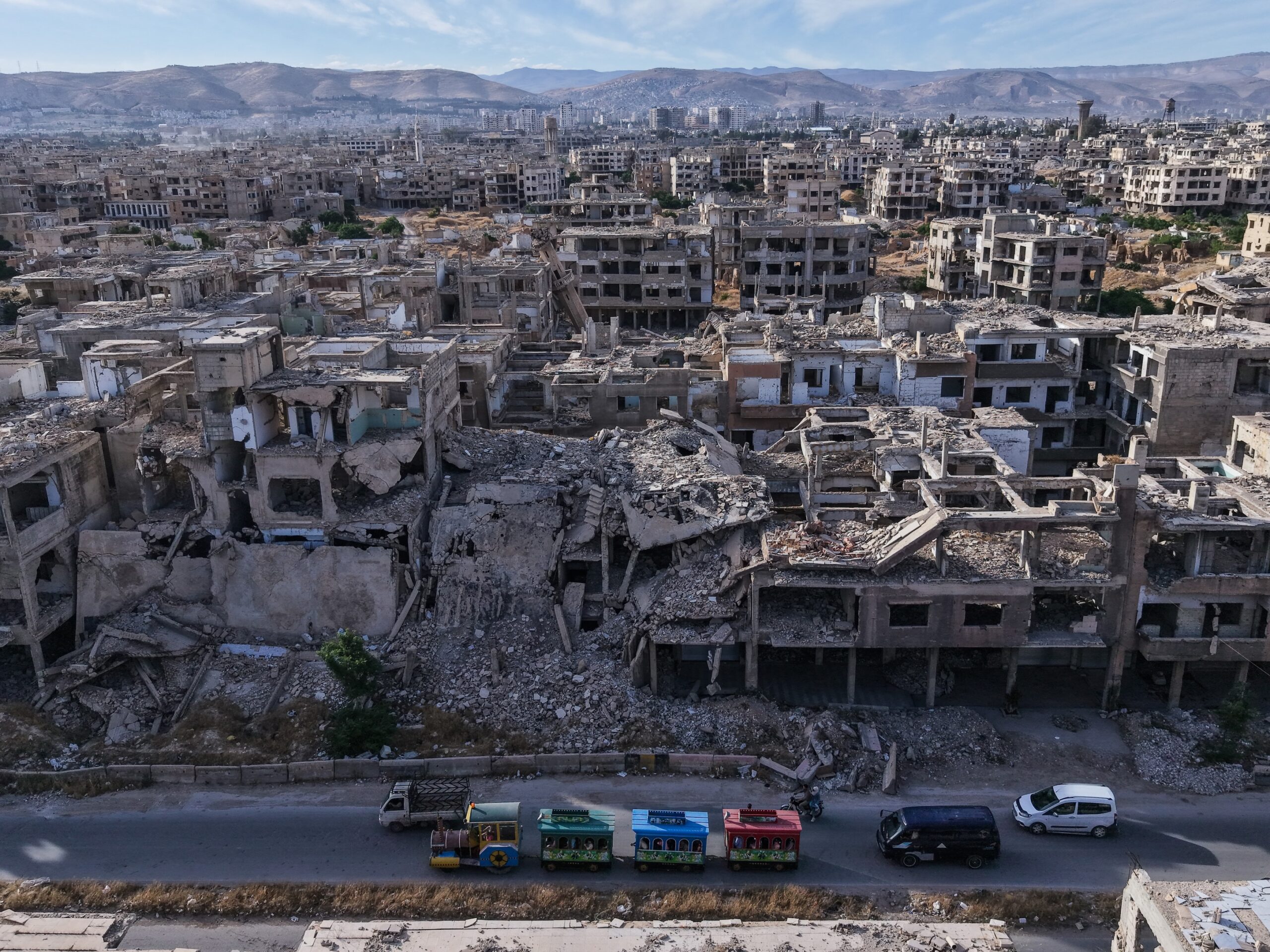
On the concrete floor of an unfinished building in Jobar, northeastern Damascus, amid the rubble left by years of war, residents gathered to discuss the future of their homes. More than a year and a half after the fall of the Assad regime, there is still no credible plan for rebuilding the neighborhood, and frustration is mounting.
The meeting was the latest attempt by residents to organize. They had formed committees of local engineers and contractors to assess reconstruction plans, resolved not to negotiate over proposals they had not seen in writing, and urged one another not to sell their land cheaply to private brokers. The gathering revealed much about where post-war reconstruction in Syria now stands.
Reconstruction is critical to Syria’s economic recovery and to whether transitional justice and social cohesion can take root after years of conflict. So far, the signs are not promising.
The transitional authorities have made the process dependent on private investment. Projects move through closed forums and opaque bilateral deals rather than a transparent national plan, while affected communities enter the conversation late, if at all, usually once the terms have already been settled.
Nowhere is this clearer than in Jobar and neighboring al-Qaboun, where residents are organizing against an investor-oriented reconstruction plan developed without their input. Their struggle reflects a wider question playing out across the country: Whose interests will Syria’s reconstruction ultimately serve?
Reconstruction as dispossession under Assad
Jobar and al-Qaboun sit on the northeastern edge of Damascus. Both were historically agricultural villages that rural migration turned into dense working-class neighborhoods. For decades, they grew under state neglect, with minimal public investment in services or infrastructure. Both were among the first districts in Damascus to join the uprising in 2011, and both paid heavily for that choice.
The [Assad] regime fell before its plans were realized, leaving the districts in ruins and unresolved questions over how, and for whom, they would be rebuilt
Al-Qaboun was besieged by the Assad regime from 2012 to 2017, with opposition factions holding the neighborhood through years of bombardment and deprivation until fighters were evacuated to Idlib. Jobar, which formed the western front line of the battle for Eastern Ghouta, endured six years of combat and regime bombardment that left at least 80 percent of the neighborhood in ruins with large-scale displacement. After retaking both areas in 2018, the Assad regime barred people from returning and recast the districts as objects for its reconstruction ambitions.
Reconstruction under Assad functioned as a continuation of the war through administrative means, with a legal architecture that enabled mass property seizures and awarded construction contracts to regime-aligned businessmen. The Detailed Urban Planning Plan No. 106 of 2022 permitted the state to expropriate up to 50 percent of private land without compensation. But the regime fell before its plans were realized, leaving the districts in ruins and unresolved questions over how, and for whom, they would be rebuilt.
An investor-first model
Reconstruction under the transitional authorities has been organized around the overriding priority of attracting investments. President Ahmad al-Sharaa made that choice explicit when he told an audience of businesspeople and financiers in Riyadh that Syria “chose the path of reconstruction through investment” rather than aid and assistance.
Authorities amended the Assad-era investment law of 2021, issuing Decree No. 114 of 2025 that provides stronger guarantees for investors. It prioritizes attracting capital and simplifies licensing, but does not include adequate protection or compensation for affected communities, nor does it guarantee their inclusion in investment decisions. The decree also concentrates institutional power, placing the Syrian Investment Authority and the newly formed Supreme Council for Economic Development under direct presidential control. This may reassure investors that decisions can be made quickly and at the highest level, but it comes at the expense of transparency and independent oversight.
In practice, reconstruction projects have taken shape through a stream of deals and memoranda announced at investment forums rather than through a comprehensive strategy
In practice, reconstruction projects have taken shape through a stream of deals and memoranda announced at investment forums rather than through a comprehensive strategy. The emphasis has fallen on real estate, tourism, and quick revenue rather than productive sectors capable of generating stable, long-term employment. Two megaprojects backed by a single investor account for roughly half the disclosed value of every agreement signed with foreign companies since the regime’s fall.
This approach neglects what reconstruction represents beyond physical rebuilding. In contexts like Syria, it means restoring rights, enabling return, and repairing the social fabric and trust damaged by over a decade of conflict. These dimensions are largely absent from official policy.
Jobar and al-Qaboun have become one of the clearest tests of this model. In March 2026, Damascus governorate officials presented a major reconstruction proposal at a private meeting of around 30 attendees, including neighborhood committee members, lawyers, engineers, and local dignitaries. According to the plan, a group of foreign companies would finance and implement the reconstruction of 1,100 hectares of eastern Damascus, covering Jobar, al-Qaboun, and Bab Sharqi, in exchange for roughly 50 percent of the project’s land.
Officials put the cost at $21 billion and promised some 200,000 jobs, but beyond these figures, very little was made clear. The investors remained unannounced, no contracts or zoning plans were published, and no valuation or compensation mechanisms were specified. Officials presented the investment model as the only realistic path forward, with Governor Maher Marwan Idlibi arguing at a dialogue session in April that grants were unavailable, foreign loans were blocked, and owner-led development was too slow and costly to deliver.
Under this plan, residents would receive only 50 percent of the area of zoned residential property and 30 percent of land classified as agricultural. These compensation rates would function as the project’s financing mechanism: investors provide capital for reconstruction and are paid in land, while owners finance that investment through the share deducted from their property, effectively shifting the cost of reconstruction onto them. The deduction thus operates as an in-kind levy on war-affected property owners, and a regressive one too, since the lowest rates apply to agricultural land, a classification which, despite its name, covers large areas of informal housing.
The March proposal was met with widespread anger across both neighborhoods, with many residents calling it theft and a continuation of the Assad-era policies that had dispossessed them. But residents had been building their own institutions and plans since shortly after Assad fell, it was that capacity that shaped their response.
Local organizing in eastern Damascus
In Jobar, residents formed a community body, the Board of Trustees, to coordinate with the Damascus governorate on reconstruction. By October 2025, the board had completed a master plan of its own, covering roughly 300 hectares, around half of which were informal settlements. It proposed reorganizing Jobar into five residential blocks and redistributing rights to owners as housing units, but on terms that diverged sharply from those the governorate would later offer.
Licensed and unlicensed (informal) housing would be treated equally with respect to owners’ rights, rather than sorted into separate compensation tiers, while a legal committee under the board would document individual rights and oversee allocation. With no proposed plan from the governorate at the time, residents protested in mid-October demanding a timeline for reconstruction and return.
In response to the governorate’s plan, al-Qaboun’s residents issued a statement signed by lawyers, professors, and community figures describing the project as “real estate expropriation.” They demanded fair valuations for their land and insisted that infrastructure be financed through the state budget rather than through deductions from owners’ shares, calling such deductions an illegal tax on residents. In Jobar, the Board of Trustees also rejected the compensation offered in the plan, and demanded that the new apartments be no smaller than the originals.
What both communities were contesting, then, was not investment altogether but their rights within the plans. They were demanding to enter the project as real partners, with the standing that investors already enjoy, able to negotiate terms, choose who builds on their land, and hold a larger share of the value generated.
Notably, the al-Qaboun signatories sought a return to Urban Planning and Development Law No. 23 of 2015 as the framework for reorganizing their neighborhood, arguing that while it is an Assad-era law, it at least offers them more rights on paper, including property valuation committees, recourse to the courts, and a ceiling on uncompensated deductions. Their final demand went further, calling for a new comprehensive law on reconstruction and transitional justice that would guarantee the right to return and fair compensation.
While the state’s reconstruction plans remain unconfirmed, the ambiguity and delays are being exploited by private actors. Reports indicate that traders and investors are pressuring owners who can no longer afford to wait to sell destroyed property cheaply, even as land prices in eastern Damascus rise. Local actors are organizing against this as well. Residents in al-Qaboun have warned owners against “crisis profiteers,” and in Jobar, a campaign against real-estate “mafias” urges owners to hold onto their property.
Reclaiming the terms of reconstruction
What is unfolding in Jobar and al-Qaboun is a contest over who pays for reconstruction, who decides its terms, and whose interests it ultimately serves. On each count, the process has so far favored investors over locals, and the same pattern is visible across the country, from the Boulevard al-Nasr project in Homs’ al-Qarabis, to a revived redevelopment plan in Aleppo’s Haydariyyah, to the Saudi-backed housing project in al-Baja’, where farmers are facing eviction notices.
What is unfolding in Jobar and al-Qaboun is a contest over who pays for reconstruction, who decides its terms, and whose interests it ultimately serves
Yet, Syria still has no comprehensive reconstruction plan and no binding standards on questions like valuation, compensation, tenure protection, and inclusive participation. Decisions instead rest on a patchwork of rulings on the governorate level, investment decrees, and case-by-case arrangements, which leave locals unable to establish what their rights are or whether any commitments made to them can be enforced. A rights-based framework would set these standards, empower an independent body to suspend projects that breach them, and tie reconstruction directly to transitional justice measures like restitution, the right of return, and accountability for what was taken.
The foundations for such a framework already exist. In Jobar, al-Qaboun, and other communities across Syria, local actors have organized, articulated their own priorities for reconstruction, and demanded a meaningful voice in the process. These efforts should continue pressing for a formal role in all stages of reconstruction, from project design and negotiation to implementation.
How reconstruction is managed in Syria will determine not only what gets rebuilt, but also whether past patterns of dispossession are confronted or quietly reproduced, and whether transitional justice and social cohesion can finally take root after years of conflict.
Jad Baghdadi is a Nonresident Fellow at TIMEP focusing on political economy issues in Syria and Lebanon.