*This article is part of “The Arab Uprisings 15 Years On: More Than a Moment” project.
In 2025, the Egyptian government’s Urban Development Fund aired a television ad promoting its new real estate projects. The protagonist navigates daily annoyances: nowhere to park, nosy neighbors, noisy nights, and burglaries. Things grow increasingly frustrating until a fully equipped residential compound appears, offering security, services, and privacy, under the slogan: “The Urban Development Fund…the largest real estate developer across Egypt’s governorates.”
This fund was established in 2021 to replace the Informal Settlements Development Fund, which had been created in the aftermath of the Duweika disaster in September 2008, when a rockslide from Cairo’s plateau destroyed more than 166 houses and killed 119 people. The fund was created as a tool for social intervention, and was tasked with identifying unsafe areas, developing them, and providing essential infrastructure. Eighteen years later, the body charged with protecting residents from these at-risk areas has turned into a real estate developer, marketing gated residential compounds as an escape from the chaos of Egyptian cities.
This transformation reflects the trajectory of Egypt’s urban policies following the 2011 uprising, President Abdel Fattah El-Sisi’s rise to prominence two years later, and Mostafa Madbouly’s appointment as Minister of Housing and Urban Utilities, and later as Prime Minister. During this period, the state adopted an urban model primarily geared toward profit and security control.
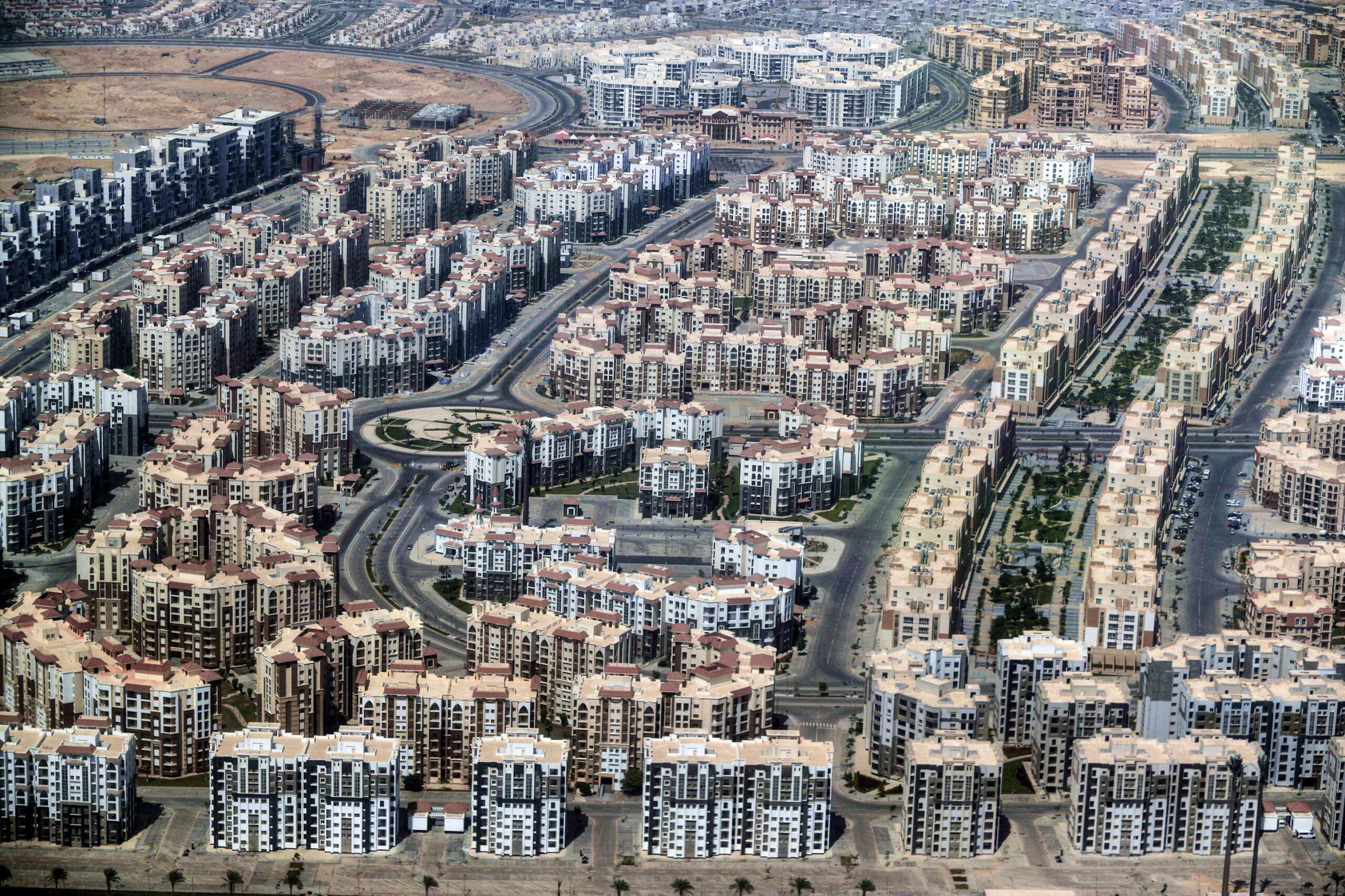
The country has millions of vacant housing units, while most Egyptians are unable to afford adequate housing
Urban development became a means of redistributing wealth and protecting those in power, rather than serving as a tool to organize urban space and provide adequate housing. This trajectory has contributed to the deterioration of Egyptian cities, growing segregation between social classes, and a distorted housing market. The country has millions of vacant housing units, while most Egyptians are unable to afford adequate housing as property prices have become detached from incomes. Meanwhile, new cities have absorbed public investments over the years, yet they accommodate only 1.7 percent of the population.
Current urban development policies serve several objectives. On the one hand, urban expansion and the construction of new cities and gated neighborhoods in the desert, such as the New Administrative Capital, provide a means of security and political control, following the pivotal role that public squares played in driving the revolution in 2011. On the other hand, construction provides an ideal political economy for a regime seeking quick results. The sector generates jobs at relatively low cost, accounting for about 13.4 percent of Egypt’s total workforce in 2024. It is also linked to several major industries and, together with real estate activities, the sector contributes to around 18 percent of the country’s GDP.
Construction also produces visible achievements that can be inaugurated in front of cameras, unlike investment in human capital, which can take years to yield results. Finally, large-scale real estate projects create a vast network of contracts, land, and concessions that can be distributed among government and military entities, as well as well-connected construction companies, turning urban development into a means of distributing wealth and securing political loyalty.
Control through urban redevelopment
The authorities’ crown jewel, and the clearest embodiment of its urban policies, is the New Administrative Capital. Spanning approximately 700 square kilometers, the city is owned by a company in which the Egyptian Armed Forces hold the largest share. The total cost of building the city, located 60 kilometers east of Cairo, is expected to reach around $60 billion. It not only serves as an administrative center, but is also the country’s largest real estate investment project and a political fortress.
The idea of building a new capital to centralize government institutions predates the revolution, but was revived after 2014. Ministries began relocating to the new capital in 2023, leaving their historical buildings in Cairo to be sold or repurposed for investment. The Egyptian authorities made sure to build an element of spectacle that could be felt in every corner of its new capital: It is home to the tallest tower in Africa, a chandelier said to be the largest in the world, a park planned to be several times the size of New York City’s Central Park, and an opera house described as the largest in the Middle East, among other grandiose projects.
These luxurious facilities serve a population of no more than 30,000 people, a direct result of the philosophy underpinning the city’s development as a project geared toward profit
These luxurious facilities serve a population of no more than 30,000 people, a direct result of the philosophy underpinning the city’s development as a project geared toward profit. Residential units are sold for prices that are astronomical for the overwhelming majority of Egyptians, turning the new capital into a haven built for the wealthy and senior government officials, allowing them to leave behind the “old” Cairo, with its dense population and accumulating problems. Lower-ranking government employees work in the new capital but do not reside there, as the government has built housing for them in nearby Badr City, where they can purchase units through affordable installment plans.
On the political level, the new capital’s security objective is no longer a matter of speculation. In July 2026, during the inauguration of the Strategic State Command Center, known as the Octagon—which houses the Ministry of Defense and is seven times the size of the Pentagon in the US—Sisi said that “the state had to move out of the capital” to prevent government headquarters from being blockaded again, as they were during and after the 2011 uprising.
The plans to move into the desert cannot be separated from the National Roads Project, which includes the construction of thousands of kilometers of roads and bridges. These roads serve as the arteries of the new urban model, connecting gated cities to existing centers and increasing the investment value of surrounding land. This expansion has been linked to a wave of land dispossession, rising transportation costs, and an increase in traffic accidents.
Alongside building a capital that is difficult for protestors to reach, the government has reshaped public space to reduce any opportunity for public gathering. Tahrir Square, one of the revolution’s most important symbols, has seen an amplified security presence. It has also been redesigned: an obelisk and ancient ram-headed sphinxes were placed at its center, surrounded by greenery, making it hard for large groups to gather in the square. Other public squares were transformed as well, including Rabaa al-Adawiya in Cairo and el-Shoun Square in El Mahalla El Kubra, where bridges were built to directly cut across them, making them easier to control and limiting the possibility of public gatherings.
The government as a real estate investor
Since Egypt’s economic liberalization in the 1970s, Egyptians have turned to buying real estate as a way to protect their savings. This tendency has been reinforced by a sharp devaluation of the Egyptian pound over the last decade, amid limited investment options and a widening wealth gap, with around one-tenth of the Egyptian population controlling two-thirds of the country’s wealth.
The state has turned from regulating the market to becoming its largest actor, selling housing units as investment assets to citizens. This shift is reflected in the financial growth of the New Urban Communities Authority, the government’s main arm for urban development and investment. Its revenues rose from around EGP 18 billion in 2014-2015 (around $2.2 million according to exchange rates at the time) to an estimated EGP 245 billion in the 2026-2027 budget (approximately $5 billion).
The state not only profits from selling housing units, but also from monopolizing the main resource behind them: land. As one of the largest holders of land in the desert in Egypt, the New Urban Communities Authority has consistently raised the prices of the land it puts on the market, and state-owned land has consequently become a main driver of rising property prices. Developers buy land at high prices, pass the additional cost onto buyers, and the value of existing properties rises alongside it.
Meanwhile, social spending has remained insufficient relative to the scale of needs. Since 2014, the state has made approximately one million social housing units available and introduced subsidized mortgage initiatives for low- and middle- income households, with interest rates starting at 3 percent. However, this is not enough to keep up with the rising number of households in need or the increases in land prices and construction costs. The cost of social housing units also remains unaffordable for many low-income people.
Forced eviction and expropriation
Government plans have often clashed with the communities already living on the land targeted for development, leaving residents among the primary victims of this process. The government has relied on two approaches, sometimes used at the same time: direct forced eviction and the use of legal tools to expropriate property in the name of “public interest.”
Under the first approach, forced eviction is implemented for the sake of “development.” This has been the case for the residents of the island of Warraq since 2017, who have been under siege in an attempt to force them to leave and make way for a luxury real estate project. Under the second approach, land is designated for public use, after which force and threats are used to enforce the decision. This was the case for residents of the villages of Al-Kharafin and Al-Muqata’a in North Sinai, who were given only 24 hours by authorities to vacate their homes. This was not an isolated event: Between January 2021 and December 2025, 525 property expropriations were carried out in the name of public interest. These affected more than 136,000 families, or approximately 546,000 individuals, and 110,537 housing units.
Alongside these two approaches is a third, smoother one: creating the market conditions to drive displacement
Alongside these two approaches is a third, smoother one: creating the market conditions to drive displacement. In 2025, the state passed legislation paving the way to end the “old rent” system and opening the door for significant rent increases for these houses, leaving millions of tenants at risk of eviction from homes they have lived in for decades. President Sisi justified the move to liberalize relationships between owners and tenants, stating that rent restrictions posed “a true obstacle in making use of two million units, worth 1 trillion Egyptian pounds.”
While property expropriation policies are used to build bridges, roads, and infrastructure at times, in other cases, the expropriated land is repurposed for large investment projects that target higher-income groups. This has happened in the area of Ras Al-Hikma on the Mediterranean coast, where inhabited land was expropriated and resold for immense profits after the original residents and owners were displaced or pressured to accept limited compensation.
No longer a space to live
In 2011, people took to the streets and called for bread, freedom, and social justice. However, 15 years later, the country has adopted urban development policies that have produced conditions opposite to the revolution’s demands. The city turned from a space for living into a site for redistributing population, wealth, and power, reflecting deeper changes in the relationship between state and society. While the policies mentioned earlier are presented as a path to “development” and modernization, their outcomes reveal widening social gaps, turning urban development into a mechanism for managing society rather than a means to improve living conditions. As such, understanding changes in urban development in Egypt after the 2011 uprising requires seeing it as part of a larger project, where public space and the urban economy are reshaped to serve the logic of control and profit.
Public debate in Egypt is not without proposals and ideas to reverse this trajectory. The government can implement a rigorous property tax policy aiming at repurposing vacant real estate assets, and can introduce measures to balance rents instead of leaving them entirely to supply and demand. Public policies should aim to direct greater support to social housing so unit prices align with the incomes of target groups. In parallel, the government must stop violating international law by using forced eviction to expedite development projects.
These solutions may seem complicated due to the cumulative effects of government policies over the last decade. But they are not impossible, provided there is the political will to prioritize citizens’ interests over pursuing profit or tightening security control.
Ibrahim Ezzeldin is an Egyptian architect and urban researcher. He is a co-founder of Diwan Al-Omranand a former fellow at the Tahrir Institute for Middle East Policy.