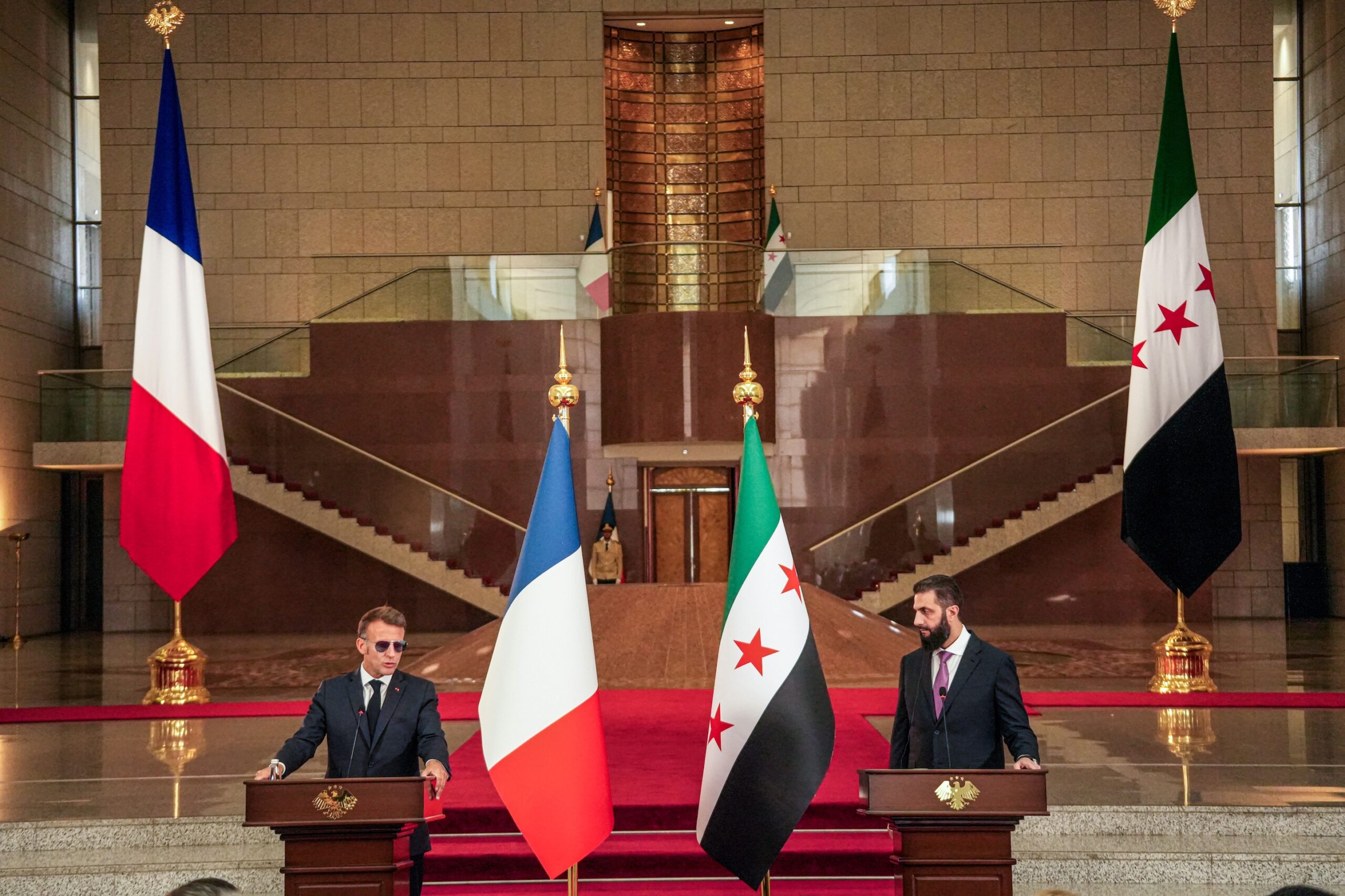
When Emmanuel Macron landed in Damascus on July 6, 2026, he became the first European Union head of state to visit Syria since Nicolas Sarkozy in 2009. During the two-day visit, Macron brought energy executives, signed memoranda with Syria’s Central Bank and Health Ministry, and agreed to exchange ambassadors. He also returned 23 historical artifacts that had been kept in Paris since the war began and visited the Umayyad Mosque.
These gestures signaled a renewed relationship after nearly a decade of limited engagement. However, the visit also highlights a broader dynamic: the most consequential moves are being made bilaterally by large member states, while the EU as an institution plays a more secondary role.
At the same time, there is real momentum on the European institutional level, as demonstrated by three developments. In May 2025, the EU lifted its economic sanctions. In November 2025, Syria returned to the Euro-Mediterranean cooperation arena. In May 2026, the Council restored the full application of the 1977 Cooperation Agreement, delisted interim Defense and Interior Ministries from sanctions lists, and held the first EU–Syria High-Level Political Dialogue. These developments could not have happened without a degree of mutual understanding.
Yet the European Commission itself described the Cooperation Agreement as “a formality” with “no specific effects on trade,” making it more valuable as a political signal rather than for its substantive impact. Tariff concessions were never suspended, which is why the Commission could characterize the restoration as a formality. Trade is heavily lopsided rather than absent: in 2025, the EU exported €392 million to Syria and imported €165 million, mostly agricultural produce entering under the same concessions. The gap between political signaling and substantive impact runs throughout the relationship.
What follows looks at the EU as an institution, and at member states, whose bilateral action often gives substance to European policy with its content.
Where interests converge
This is a relationship described by some in the EU as a “stop-and-go process”: five decades of openings interrupted by ruptures. The most important area of convergence is that both sides want a fresh start, away from Assad-era dynamics.
In practice, both sides want a cohesive state, a functioning economy, a viable investment environment, and regional stability. For the EU, Syria’s fragmentation raises the fear of increased displacement, Islamic State resurgence, and continued captagon trade. For Syria, fragmentation threatens the resumption of the civil war.
Even though both sides want stability and both have an interest in maintaining a working relationship, the reasons behind this alignment differ.
Similarly, migration management means different things to the two sides. Despite growing rhetoric around returns, even the Austrian interior minister has publicly admitted that mass refugee returns to Syria are “neither realistic nor reasonable,” regardless of domestic political demand. Syria also cannot absorb large numbers of returnees from Europe, given the scale of housing destruction and the prioritization of returns from Turkey and Lebanon.
Even though both sides want stability and both have an interest in maintaining a working relationship, the reasons behind this alignment differ.
What does the EU want from Syria?
There is no single European approach to Syria, in part because power is divided across EU institutions, each with different mandates and room to maneuver. In brief, the Commission manages the budget and oversees development spending as part of its Global Europe strategy, which can make its relationships seem transactional. The Council represents member state governments and holds significant power over foreign policy. Sanctions, for example, require unanimity among all 27 members, which can make decision-making slow. The Parliament has no decision-making authority over foreign policy, which allows it to take a more normative position: its resolutions on a just and inclusive transition are not binding.
Beneath these institutional differences, the EU effectively approaches Syria through a securitized lens, particularly when it comes to migration. Preventing renewed migration and enabling returns is the EU’s dominant driver, propelled by the radical right’s rise across Europe. The EU Agency for Asylum’s country guidance concluded that those persecuted solely by the Assad regime are generally no longer at risk, opening the door to limited returns. In practice, member states deploy different push methods to encourage departures framed as voluntary return.
There is no single European approach to Syria, in part because power is divided across EU institutions, each with different mandates and room to maneuver
Commercial and reconstruction interests come second. The EU, through both its institutions and member states, has committed nearly €2.5 billion for 2025–2026 at the Brussels IX Conference, including €15 million for a Team Europe Technical Assistance Hub, placing European expertise inside Syrian institutions.
The European Investment Bank is still waiting on the sidelines due to an ongoing arbitration case. Syria defaulted on pre-2011 development loans, and in late 2023, the General Court of the Court of Justice of the European Union issued judgments by default across at least eight parallel cases, ordering repayment of sums from under €2 million to over €50 million. Syria under Assad never filed a defense. What remains unresolved is enforcement: in January 2026, the Swiss Federal Supreme Court refused the EU’s request to seize Syrian funds in Swiss accounts, finding an insufficient connection between Switzerland and the contracts, given that the debtor is a state. A development bank cannot lend to a borrower still in default on its previous loans. The Ministry of Finance has established a committee to address the total debt, estimated around €640 million, covering loans dating from1979 to 2011.
Instead, the real engine is bilateral, led by Berlin and Paris. Germany’s KfW (Kreditanstalt für Wiederaufbau), the state-run development bank, holds a €674 million portfolio in Syria, all of it in grants targeting crisis prevention and civil recovery. France spends far less than Germany but leverages its historical ties with Syria to provide expertise to the Central Bank and Health Ministry through Expertise France and the Agence Française de Développement (the French development agency). Both member states have presented MoUs in the energy, aviation and transport, telecommunications, and health sectors.
The work with the Central Bank is more significant than it might initially appear: Syrian banks remain largely cut off from the international financial system and lifting sanctions did not resolve this. Their disconnection from international payment systems resulted both from sanctions legislation and from Syrian banks’ failure to meet anti-money-laundering standards. Syria remains on the FATF gray list, facing a mutual evaluation in 2027, and EU member states are assisting Syria in preparing for it.
Security is the third interest, and when it collides with the others, it tends to take precedence. The EU pursues counter-terrorism cooperation operationally while professing support for a “just and inclusive transition.” For example, delisting the Interior Ministry from sanctions allowed talks on police training and removed the last legal barrier to funding the Syrian security sector. The Syrian Network for Human Rights notes that this came without binding accountability or vetting conditions. The same logic is built into the Pact for the Mediterranean, the EU’s 2025 framework for its southern neighborhood, which places migration within a security pillar alongside border management and readmission.
What does Syria want from the EU?
While Syria has reemerged from diplomatic isolation, it is still suffering from the consequences of decades of oppression and mismanagement, reflected in a humanitarian, economic, and social collapse.
Reconstruction finance tops the list once sanctions are effectively lifted. With the World Bank estimating reconstruction needs at $216 billion, Damascus needs every available channel, and legitimacy matters almost as much: each visit and delisting serves as a form of political recognition. EU institutions and member states are significant development actors, and as humanitarian relief shrinks, it is being replaced with development funding. Brussels can also crowd in investment and provide microfinancing. Syria also wants greater connectivity and to become a transit hub, including through direct flights to Europe, which Germany restored in July 2026.
While Syria has reemerged from diplomatic isolation, it is still suffering from the consequences of decades of oppression and mismanagement, reflected in a humanitarian, economic, and social collapse
Damascus is not merely accepting European engagement but is also trying to shape its terms. At an informal summit of EU and regional leaders in Nicosia on April 24, 2026, convened by Cyprus as the fuel crunch resulting from the Iran war pushed Europe to seek energy routes bypassing the Strait of Hormuz, Syrian President Ahmed Al Sharaa pitched “the Four Seas” and “Nine Corridors” initiatives, positioning Syria as a secure artery between Central Asia, the Gulf, and Europe. “We know that Europe needs Syria as much as Syria needs Europe,” he told the summit, while urging EU leaders to press Israel over incursions into Syrian territory. Europe is useful partly because it is neither Turkey nor the Gulf, offering Damascus a counterweight to over-dependence on either.
Where interests diverge
Whether this “go” moment lasts depends on three points of friction.
First is conditionality. The EU normally attaches requirements to funding and market access such as governance benchmarks, human rights clauses, and reform milestones. With Syria, it has attached almost none. The restored Cooperation Agreement is a 1977 instrument containing no such clauses, and Syria has no multi-annual programming framework, so support flows through annual special measures with no broader framework to anchor benchmarks on.
This is not mere oversight. Damascus reads conditionality as interference, and Europe’s leverage is limited enough that pressing conditions risks pushing Syria toward partners that attach none. The result, however, is a risk of mismatched expectations. The EU wants to move away from Assad-era sanctions and toward targeted sanctions against transition “spoilers”; yet, the criteria for defining spoilers is unclear and could lead to misunderstandings.
Second is migration. Europe’s asylum systems are revoking protection statuses faster than actual returns. In Germany, about 23 percent of 8,320 completed protection reviews ended in revocation in the first half of 2026, compared with single-digit deportations. The result is legal limbo, not departure. Moreover, member states penalize exploratory visits that could make informed return possible: Germany ruled in October 2025 that “look-and-see” trips jeopardize protection status, and the Dutch scheme designed to permit them was proposed but never implemented. Syria, meanwhile, prefers circular migration rather than mass return: Syrians coming and going, investing, sending remittances, and eventually returning by choice, rather than arriving all at once as permanent returnees that the state cannot house nor employ.
Third is the question of whether European engagement is worth the bureaucratic burden. A 1982 Commission–EIB mission report, as researcher Benjamin Fève has documented, found that European funds were available but barely disbursed: procedures were hard to navigate, Syrian coordination was weak, and competitors offered cheaper, simpler financing. All three constraints remain, and the competition has intensified. Syria’s options are widening as Europe’s leverage is fragmented across competing member state interests.
A new chapter in the making
The paradox of EU-Syria relations is that there is more European engagement in Syria than at any point since 2011, yet arguably less clarity about the influence that engagement can achieve. This raises the question: does Europe still matter in Syria?
The honest answer is that it can, but not by repeating old approaches. For the EU, the problem is coherence rather than power. The most useful immediate step would be to reframe the returns debate as it fuels mistrust: implement EU-level “go-and-see” schemes rather than pressing for returns that create legal limbo, and fund the infrastructure that makes return physically possible. In parallel, the EU should rebuild leverage where it is genuinely strong, while coordinating rather than competing with member state investments.
For Syria, investing in transitional justice is a long-term investment in stability that would build on the one area where EU support is already funded and politically established. The EU has demonstrated experience in addressing war-time atrocities and can become an invaluable partner to Syria’s recovery. Similarly, greater transparency around economic discussions would give investors and citizens the information they need to assess risk, currently the largest deterrent to serious investment. Lastly, institutionalizing a dialogue on circular-migration would give both diaspora Syrians and European governments greater clarity than either currently has.
The new chapter of EU-Syria relations is being written in gestures, delistings, and memoranda. Whether it becomes something more durable depends on both sides being clearer about what they want from the relationship.
Zakaria Al Shmaly is a Nonresident Fellow at TIMEP focusing on EU-Syria relations. His mandate examines how Europe’s evolving diplomatic, economic, and political engagement with Syria is impacting the country’s governance, accountability, and reconstruction outcomes.