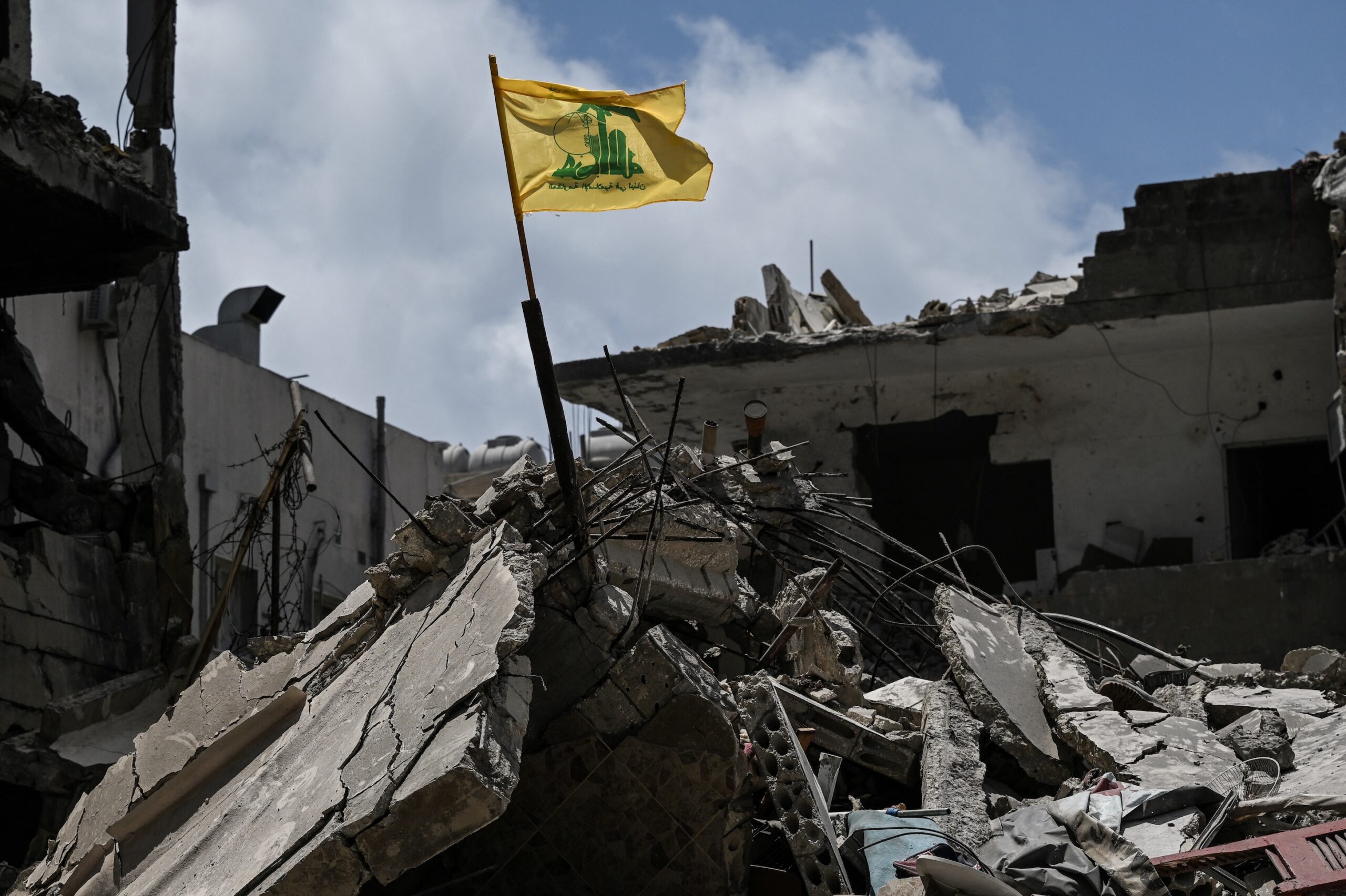
Rising tensions between the US, Israel, and Iran as well as the sustained rise in Israeli military activity in South Lebanon since early September suggest a gradual return to the high levels of Israeli aggression in Lebanon. As matters worsen on the ground, Lebanese, American, and Israeli government officials have focused on the US-led Israeli-Lebanese negotiation track which has prioritized Hezbollah’s disarmament, while being ambiguous on the question of Israeli withdrawal from the land it occupies.
This track culminated in the 14-point Trilateral Framework signed in June between the US, Lebanon, and Israel, aimed at ending the conflict and disarming Hezbollah. The implementation of “pilot zones”—areas where Hezbollah’s armed presence would end and the Israelis would cede the land to the Lebanese army—has stalled as Israel muddles and slows its withdrawal, and continues its strikes on Lebanon. As a result, the Trilateral Framework has not resulted in a meaningful reduction in Hezbollah’s military capabilities, or an end to the Israeli occupation of South Lebanon.
Attempting to disarm Hezbollah solely through military means is unlikely to succeed, and will not result in the kind of stability and prosperity that would ensure sustainable peace in Lebanon and the region. Specifically, military intervention cannot advance an alternative for the economic and social role Hezbollah played in its areas.
What is needed is a domestic approach through which the state reasserts its authority over the whole of Lebanon. That includes tightening control of financial channels and ports through digitalized customs and cross-state cooperation over smuggling networks. The domestic approach needs to be coupled with the gradual return of the state’s presence in Beirut’s southern suburbs, the south, and the Beqaa through government-led reconstruction and the provision of essential services and credit.
Hezbollah runs essential social infrastructures, from informal financial networks to municipal patronage and local service provision, that cannot be dismantled without creating severe social crises. A “military only” approach to disarmament focuses on restricting and erasing these systems, while a domestic approach looks into how other institutions, governmental and otherwise, could provide credit, compensation, reconstruction, and basic services to secure the consent and approval of an increasingly alienated constituency of people.
Weakened but not dismantled
There is major political and popular support in Israel for a continued military presence in South Lebanon. Nevertheless, this has not translated to a concrete plan on how to really disarm Hezbollah. Israel’s current military campaign can weaken Hezbollah but cannot dismantle it.
Israel’s assassinations of military commanders, the pagers attacks, the recapturing of key Hezbollah bases in South Lebanon, and the increased restrictions on the Syrian, Lebanese, and Iraqi borders pose real material and arguably existential challenges for Hezbollah. However, the militant group has found creative ways to integrate itself into a digital currency market, upgraded its domestic flexibility and agility, and has historically built a base of thousands of followers ready to fight even if at a high cost. Hence, full dismantlement would require a far more costly intervention that Israel is unlikely to, and arguably cannot, pursue.
The Israeli military itself has recognized back in April that dismantling Hezbollah would require a full-scale invasion of the entire country. The byproduct of this is an indefinite war without a clear theory of change: Hezbollah’s military capacity is reduced, but its political and ideological core remain strong amid increased Israeli violence, with just enough institutional preparedness to renew its capacity and revise its tactics. More importantly, with Israel’s renewed edge in the Trilateral Framework Agreement, Hezbollah’s primary narrative has been resurrected as a force of legitimacy among Lebanese Shia, despite the many questions they have on the group’s performance.
And while Lebanon has received varying levels of attention from the Trump administration, Washington’s objective should center on how it can play a proactive and constructive role in strengthening the institutions most critical to the recovery of the Lebanese state, particularly its military and financial foundations.
Such an approach would require a significant reordering of priorities and a far more substantial investment in the Lebanese Armed Forces than the current model, which largely confines the institution to the role of a domestic security provider. It would also require a more serious engagement with the causes and consequences of Lebanon’s financial collapse, including the politically contentious question of banking sector restructuring.
Buy time, accept weakness, and contain the crisis
Lebanese President Joseph Aoun’s inauguration speech in January 2025 advanced, for the first time in a long while, the idea that the Lebanese state can become a bold, proactive actor with an ambitious roadmap centered on mobilizing resources toward genuine statecraft and recovery. The state initially approached the moment after the end of the war in November 2024 as an opportunity for systemic reform, with a strong focus on reasserting control over borders, ports, airports, and financial flows; addressing reconstruction and economic restructuring; and strengthening state institutions. The fall of the Assad regime and the weakening of Hezbollah’s military infrastructure also provided a window in that direction.
Over time, however, and partly in response to Hezbollah’s own disruptive and coercive tactics, the government’s resolve gradually waned. Policymakers themselves remain divided over how Hezbollah should be approached, further contributing to paralysis on the question politically.
Political actors cannot afford to “fail” on the issue of Hezbollah: the potential costs are exceptionally high
Political actors cannot afford to “fail” on the issue of Hezbollah: the potential costs are exceptionally high. This is, in large part, a consequence of Hezbollah’s longstanding threats that efforts toward disarmament could trigger civil strife. The absence of a broad political consensus on disarmament reflects these constraints. While a Gallup poll released last December indicates that a majority of Lebanese support disarmament, this majority remains fragile and politically difficult to mobilize. The challenge lies not only in the question of Hezbollah’s weapons, but also in the absence of a cohesive national vision capable of persuading citizens of what the state, and the country itself, can meaningfully offer in their place.
Instead of being decisive on the issues of disarmament and seeking robust international policy of accountability for Israeli violence, much of the ruling class have deflected attention to petty domestic issues that tightly revolve around the question of sectarian representation. And while some procedural progress has been made concerning Hezbollah’s border and airport smuggling, most elites have accepted the government’s domestic and regional weakness as a de facto reality. In this context, focusing on the politics of pleasing a particular constituency amid a climate of intense polarization, as opposed to the politics of determining the right policies, becomes the easiest and most profitable next step.
The political economy of disarmament
Hezbollah is an organization with deep roots in the very social and economic structure of Dahieh, the country’s south, and the Beqaa. It owns key enterprises that provide major financial and health-related services. It also engages in major local communal efforts via its units in different villages and cities of influence. It would be unwise to assume that these institutions can be effectively sanctioned or bombed until they dissolve. Very few policymakers are asking the most urgent and practical questions: How do these institutions operate? With what resources? And how can we make sure those relying on these institutions do not face major economic strain following sanctions, which can in turn further alienate the Shia community and reinforce support for Hezbollah?
With regard to the first two questions, it is now unambiguously clear that a domestic disarmament process must address the systems that allow parallel sovereignty to function: Border economies and smuggling networks; informal financial flows and cash-based systems; control over reconstruction and compensation mechanisms; and patronage networks connected to municipalities and local institutions. The Lebanese state has made serious procedural, albeit not necessarily structural, progress in this direction. These include a security partnership with the Syrian government over border smuggling, in addition to partial controls over reconstruction cash flow.
Politics, not war, remains decisive in the final instance
The last question is more ambiguous, however. If Hezbollah-linked economic structures, most notably Al-Qard Al-Hassan Association, which provides micro-loans to the group’s constituency, are dismantled overnight, thousands of beneficiaries could face severe long-term consequences. Since the collapse of Lebanon’s banking sector in 2019, poorer Shia communities have relied on the institution for their banking needs. The institution provides interest-free and gold-backed loans to households unable to secure credit elsewhere; it also offers savings accounts and provides emergency assistance for those in need. The immediate effect of dismantling the institution would likely be reduced access to affordable credit, delays in compensation and reconstruction assistance, and greater reliance on informal lenders, remittances, or other unregulated financial networks.
Similarly, in a conversation with this author, political economist Joseph Daher argued that a pure focus on the security dimension of border control is “essentially a recipe for failure” in the long run if not accompanied by policies that promote social and economic development in neglected regions. He noted that the lack of socioeconomic development has pushed some residents in border towns with Syria to depend on illegal cross-border trade to meet basic needs, including food, building materials, medicine, and fuel.
Integrating a more holistic and comprehensive dimension to disarmament is the first step to ensuring that the process, as it is pursued today, does not backfire and put Lebanese institutions in an even weaker position. It is also an acknowledgement that Hezbollah cannot be defeated through military attrition. Politics, not war, remains decisive in the final instance. The critical question is whether alternative institutional actors can replace the economic, social, and functions through which Hezbollah remains present in everyday life. The group’s influence is sustained through relationships with hundreds of neighborhoods and countless local stakeholders. These networks shape access to electricity through generator systems, facilitate compensation and limited grants for destroyed homes, provide water and essential services, and help farmers whose livelihoods have been devastated by war secure material support and alternatives. Top-down policymaking will not be sufficient, nor will coercion alone. Any post-Hezbollah political order must secure the consent of communities that continue to hold onto elements of its fractured legacy.
Karim Safieddine is a Nonresident Fellow at TIMEP focusing on politics and reform in Lebanon.