The month of May 2024 presented a series of concerning developments over the question of migration in Tunisia. Incidents included “mass desert dumping” in the borders of Algeria and Libya and a wave of arrests of journalists and human rights defenders. At the same time, the regime of President Kais Saied solidified its tough stance on migration, framing it as a high-risk issue impacting national security, the freedom of speech, and the upcoming presidential elections in October 2024.
President Saied’s power grab on July 25, 2021, precipitated a series of judicial, institutional, and sociopolitical developments. The promulgation of a new constitution in 2022 signaled an alarming authoritarian shift, alongside the overhaul of democratic institutions and a crackdown on the political class. The current landscape remains ambiguous over the redrawing of the country’s political map and the extent of popular support for these developments, not least given the consistently low turnout in successive local and national elections. This turnout, averaging at around 11 percent, may reflect disinterest in the political project of President Saied. Indeed, the already weakened and fragmented political class has now been largely replaced with a parliament lacking essential checks on presidential power.
These developments have, nonetheless, tightened the grip of the regime and strengthened the government’s ability to expound political discourse targeting migrants amid Tunisia’s economic crisis. The country’s worsening socioeconomic conditions have notably cast doubt on Saied’s leadership: amid high unemployment, a chronic deficit, and the president’s rejection of the “diktats” of a $2 billion International Monetary Fund (IMF) rescue program in 2022, Tunisians have seen economic conditions worsen considerably under Saied’s presidency.
For some time, it seemed that the post-25 July leadership was absolved from popular dissent, due in large part to the unpopularity of the previous political class. The president in the meantime redrew the country’s political map, focusing on institutional, political, and economic issues, and blaming both the previous political class for the country’s woes and unnamed foreign enemies purportedly seeking to destabilize the country.
This dynamic persisted until his racist speech introduced new culprits: Sub-Saharan migrants and asylum seekers. The timing of the rhetoric proliferation coincided directly with the worsening of living standards in Tunisia, while helping the state to re-assert its dominance by controlling the narrative.
Racialized discourse
The introduction of the “Great Replacement” theory in the Tunisian social zeitgeist was not instantaneous, but rather the result of rapid and consecutive developments. Recontextualized from French right-wing talking points, it claims that immigration from Sub-Saharan African countries is aimed at changing Tunisia’s demographic composition to turn it into an “African” country, detached from its Arab and Islamic roots.
Social media pages began a disinformation campaign circulating false videos and narratives. One such video showed a group of men running in a protest, with captions that Tunisia was under “occupation” by migrants. In reality, the original content took place in Senegal. Other viral videos and posts were circulated and amplified by local actors such as the anti-immigration and government-allied Tunisian Nationalist Party (TNP). The TNP has affirmed that it submitted reports to national and regional governmental authorities with data and testimonies testifying to Sub-Saharan migrants threatening to expel Tunisians from the country.
On February 21, 2023, President Saied officially engaged in the growing racist discourse by declaring that Tunisia was being subjected to “hordes” of irregular migrants “with all the violence, crime, and unacceptable practices that entails.” He described the situation as “unnatural” and positioned it at the heart of a conspiratorial plan to “change the country’s demographic makeup.”
His words acted as a signal to disseminate racist discourse and encourage violence against Sub-Saharan migrants and asylum seekers. Various pro-Saied social media pages started encouraging mob violence against “criminal” migrants, and pro-regime media outlets acquiesced to the narrative, despite the fact that, according to local NGOs, there were between 30,000 to 50,000 Sub-Saharan migrants in the country in 2023, within a wider Tunisian population of 12 million.
Saied’s remarks sparked international condemnation. The World Bank halted its partnership with the country at the time and the African Union expressed its “deep shock” and criticized Tunisia for the “racialized hate speech,” a sentiment echoed by the European Union. Tunisia’s Foreign Affairs Ministry rejected these statements from international actors, and claimed that the president’s remarks were not merely rhetoric but had evolved into state-level policy.
Rising violence and crackdowns
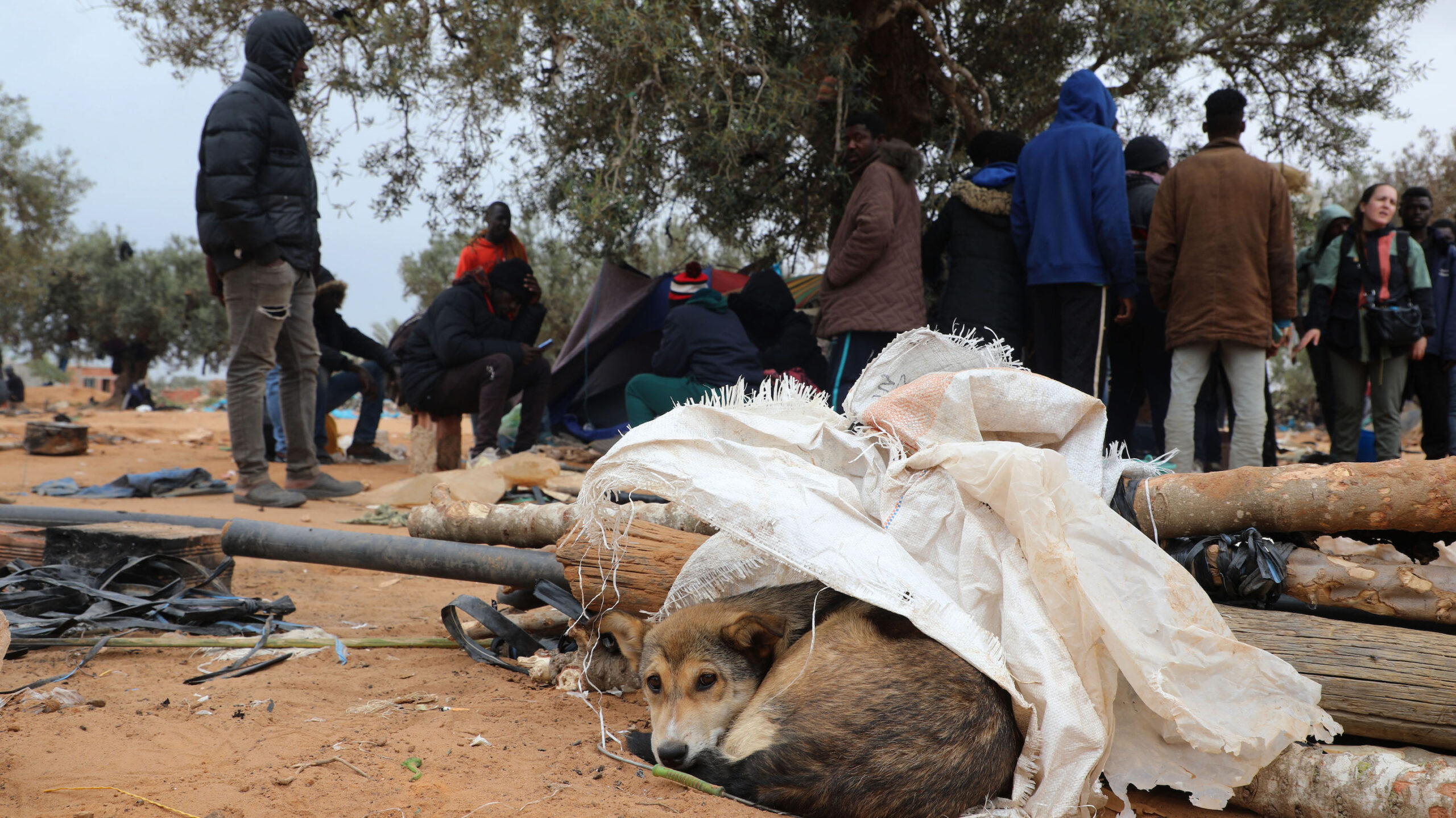
The racist discourse expounded on a government level further fueled the mistreatment of and discrimination against Sub-Saharan Africans, refugees, and black Tunisians. Social media documented instances of migrants being beaten and harassed, with many expelled from their homes by local landlords and living in encampments.
Many Sub-Saharan students who had been residents for years in Tunisia reported being exposed to violence and avoiding leaving their houses after 5 PM in fear of rampant physical violence. Native black Tunisians, who make up about 15 percent of the population, also expressed concern over the emboldened and legitimized societal racism, which compelled them to assert their “Tunisianness” to avoid becoming targets of violence.
These incidents escalated into full-scale violence in some instances. Stone-throwing clashes erupted between migrants and local residents in July 2023 in the city of Sfax, Tunisia’s second biggest and a transit hub for migration to Italy. Authorities attempted to quell residents’ growing anger by arresting a number of migrants.
From its end, the official presidency page shared a statement on the events in Sfax in 2023, in which President Saied reiterated that Tunisia “does not accept to be a transit or settlement zone for people arriving from multiple African countries.” Human rights defenders called out this official statement and interpreted it as a signal to Tunisians to continue their actions against migrants.
The crackdown on migrants has since spread to other cities in Tunisia. An official news channel shared a video on May 10, 2024 of citizens helping police forces arrest migrants in Sousse, the country’s third largest city, resulting in the arrest of 58 individuals. Another video on the same day showed raids by police going house to house searching for black Sub-Saharan migrants. These arrests are part of a new wave of crackdowns launched after the president convened the National Security Council on May 6 to discuss the issue of migration. In the meeting, the president claimed that civil society groups that defend migrants’ rights were “traitors” benefiting from foreign funds.
The situation of Sub-Saharan Africans in Tunisia continued to deteriorate as many have found themselves stranded in remote areas following expulsion from cities. Following the Sfax clashes, there were reports of Tunisian authorities rounding up and sending men, women, and children to a demilitarized zone in the desert between Tunisia and Libya under extremely inhumane conditions with no water or food and amid a heatwave. Those who were in encampments on the outskirts of cities were also unsafe, with news of police raids, burning of tents and boats, violence, and arrests of migrants and asylum seekers. The El-Amra camp, about 25 kilometers from Sfax and a departure point to Europe, was surrounded by security forces who enacted a lockdown after expelling migrants from the center of Sfax in September 2023.
Rights at risk
The Tunisian state’s handling of migration has now incorporated broader restrictions on freedom of speech, even targeting simple discussions on the subject.
In May 2024, authorities escalated their arrest campaigns on popular activists, accusing them of financial crimes and conspiracies to provide aid to migrants through civil society channels. Amnesty International reported that executives and staff from at least 12 organizations in Tunisia were summoned or investigated for their involvement in supporting migrants and asylum seekers. Several of these organizations were in direct partnership with official and state-approved entities such as the United Nations Refugee Agency (UNHCR). In light of these developments, Tunis’ prosecutor claimed that civil society organizations were “abusing their mandate to provide financial support to illegal immigrants” and would be investigated.
One of those arrested was Saadia Mosbah, a prominent anti-racism activist and head of the non-governmental organization M’nemty (My Dream) which focuses on challenging anti-black racism. She was arrested on May 6 for alleged “financial crimes,” and is still currently in pretrial detention. Other figures arrested under the prolonged campaign include the lawyer and media personality, Sonia Dahmani, who was detained by authorities on May 11 2024 after her remarks on television mocking the prospect that Sub-Saharan Africans have ulterior motives to stay in Tunisia given the country’s economic crisis. Dahmani was arrested under Decree-law No. 2022-54, signed by President Saied in 2022, outlawing the spread of “false news,” harming “national security,” inciting “hate speech,” and was sentenced to one year in prison on July 6. Fellow lawyer Mehdi Zagrouba was detained on May 13 after protesting against the arrest of Dahmani. He later showed signs of physical injuries at the Tunis Court of First Instance and claimed he had been physically assaulted.
Notably, the targeted individuals are not traditional opposition figures but public media personalities. Their arrests are viewed as part of a campaign to stifle freedom of expression more widely.
The consistent and growing effort to suffocate civil society actors and to quell dissent has been aided by the existing legal instruments. More than 60 journalists have been arrested under Decree 54, according to the National Syndicate of Tunisian Journalists. A foreign journalist, working and living in Tunisia for years, has expressed concern over the state’s tightening grip and its monopolization of national discourse over migration.
“For one reason or another, migration seems to be the most major and provocative issue for the state. It got to a point where we are not using our names when covering these developments,” she told TIMEP.
Different groups and organizations have been pushing back, despite the crackdown. On May 13, 2024, lawyers went on a nationwide strike, and congregated in front of the Court of First Instance. They were joined by activists and human rights defenders and chanted “What a great country with torture and authoritarianism,” mentioning the comment that resulted in Dahmani’s imprisonment.
International response
International organizations have raised alarm bells over the crackdown on activists and human rights defenders. The European Union (EU) criticized the Tunisian government for undermining freedom of expression and the press. However, policy analysts and civil society groups have criticized the EU for its glaring double standards. In July 2023, the EU signed a Memorandum of Understanding with the Tunisian government which included an aid package offering €105 million to support the Tunisian coast guard and border management. In exchange, Tunisia committed to cooperate in tackling smuggling and trafficking of migrants and to readmit its own nationals irregularly present in the EU.
The migrant deal arguably legitimized Saied’s authoritarianism, undermined the EU’s advocacy for democratization in Tunisia, and demonstrated that Europe’s concerns over migration outweighed considerations of human rights.
As Tunisians gear up for the upcoming presidential elections scheduled for October 2024, concerns are mounting over the impact of these developments on the country’s social and political fabric, exacerbated by fears of a democratic crisis. The intertwined issues of migration and the economic crisis are set to dominate the electoral landscape. President Saied is likely to step up his rhetoric vilifying migrants in Tunisia in an attempt to deflect attention from the country’s escalating economic woes. Amid fears of an impending democratic crisis, whether this electoral strategy will prove effective remains to be seen.