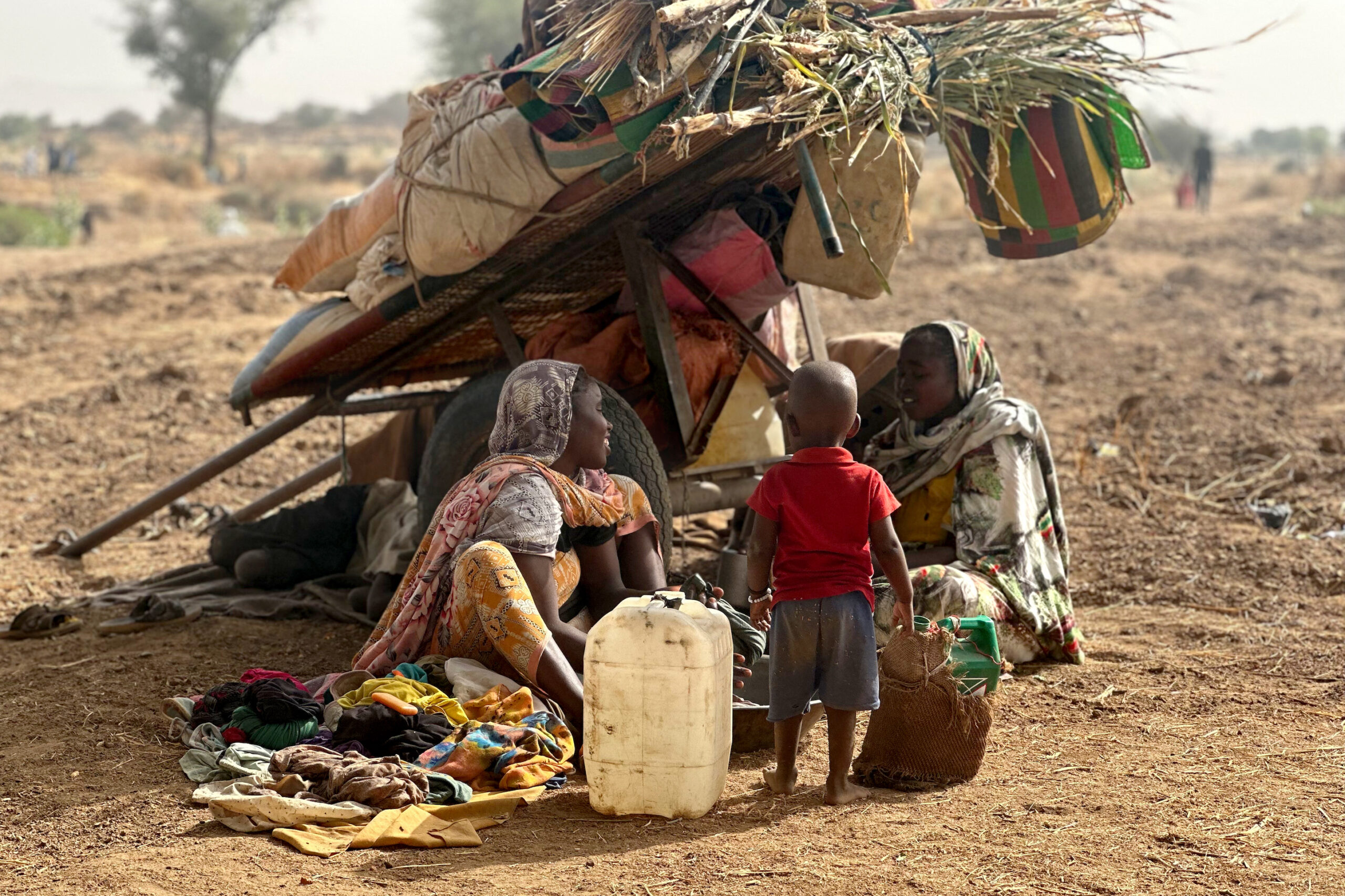
The two-year anniversary of the war in Sudan was marked by a fresh wave of unspeakable atrocities. An attack on famine-stricken refugee camps in North Darfur left hundreds of civilians dead or wounded, and displaced nearly 400,000 people. The assault served as a stark reminder of the war’s brutal nature and of Sudan’s descent into becoming the world’s largest humanitarian crisis.
The Rapid Support Forces (RSF) said on April 14 that it had taken full control of Zamzam and Abu Shouk camps for internally displaced people (IDPs), which host some 750,000 people on the peripheries of the city of El-Fasher, following three days of heavy fighting. The RSF claimed it was attacking militias allied to the Sudanese Armed Forces (SAF), which retains control of El-Fasher as its last stronghold in Darfur, the vast strategic region west of Sudan.
The attack on El-Fasher comes as the RSF faces setbacks elsewhere in the country, most notably its recent retreat from Khartoum, the country’s capital it seized in the early days of the war. Determined to consolidate control over Darfur, the RSF laid siege to El-Fasher last year, causing a severe deterioration in humanitarian conditions as supplies of food and medicine dwindled.
These next few sections answer the main questions regarding the significance and implications of the assault on Zamzam and Abu Shouk, and the essential steps needed to address the ongoing bloodshed in Sudan.
What do we know so far about what is happening in Zamzam and Abu Shouk camps?
Three days of heavy fighting in Zamzam and Abu Shouk camps killed at least 300 people, among which at least 23 were children. Medical staff were also targeted during the assault: on April 12, Relief International, the last remaining international aid organization in Zamzam, confirmed that nine of its staff, including doctors, were killed in the attack.
Video footage and images shared by social media users show the scale of the devastation. In one video, a little girl is seen anxiously holding the body of her mother, asking if she was now gone just like her father. In another, a large number of families with crying children stand in the open desert, with no trees or tents in sight. In other videos, civilians were made to say slogans supporting the RSF and against the opposing force. Others show smoke rising from burnt houses, confirming the satellite imagery pointing to active fires in the area.
What is the importance of El-Fasher, and how has the current conflict affected the city?
El-Fasher, the capital city of North Darfur and capital of the region, is located 1,000 kilometers south west of Khartoum. It was once regarded as a cosmopolitan hub: a capital of the Keira dynasty for almost 300 hundred years, a caravan center, and a pivotal stop on the trade route between western and northern Africa. It has been engulfed in war for the past two years, marking a new episode of violence in the city’s modern history.
The latest attack, and the many stories and images emerging from the Zamzam camp, bring back some of the darkest memories from the 2003 genocide in Darfur. Back then, the Sudanese government and the Janjaweed militia (the precursor to the RSF), killed at least 200,000 people and displaced around 2,000,000.
The latest attack, and the many stories and images emerging from the Zamzam camp, bring back some of the darkest memories from the 2003 genocide in Darfur
Located some 15 kilometers south of El-Fasher, Zamzam is one of the largest camps for IDPs in Sudan and was established during the 2003 genocide. In the past two years, 150,000 to 200,000 people are believed to have been displaced to Zamzam from El-Fasher, its surrounding villages, and other Darfur states.
Zamzam’s infrastructure remains poor with limited access to basic services like clean water and electricity, though the camp had been established over 20 years ago. The majority of the houses in the camp are made of straw and clay. Some of those who arrived at the camp after 2023 remained in tents or without shelter.
Access to El-Fasher became increasingly difficult for humanitarian aid providers after the RSF besieged the city in May 2024, with all routes in and out of the city closed. Civilians fleeing the war have also been unable to access safe routes. In July 2024, the Integrated Food Security Phase Classification concluded that famine conditions were prevalent in parts of North Darfur, including the Zamzam camp. The United Nations Security Council adopted in June 2024 Resolution 2736 which demanded that the RSF end its siege, and called “for an immediate cessation of hostilities and de-escalation in and around El-Fasher.”
Many were already sounding the alarm on the living conditions in Zamzam and El-Fasher, prior to the latest attack. At the end of February, the World Food Program had to pause its food distribution in Zamzam camp due to safety concerns while the United Nations issued a warning about the food and medicine shortages a month later. In early April 2025, activists warned about how critical living conditions were, with food prices skyrocketing: one kilo of wheat flour cost $4 (compared to $1 in Bahri, North of Khartoum), and three onions $2. All these are devastating prices for a besieged community. According to the United Nations Office for the Coordination of Humanitarian Affairs, almost six in 10 people in El-Fasher are projected to face acute food insecurity by May 2025.
Why is this attack significant in the context of the war? Why has Zamzam become a target?
The attack could be a turning point in the battles in El-Fasher and the Darfur region. El-Fasher is the last remaining major city in Darfur that is still under SAF control. Yet, the attacks by RSF from different directions mean that the area controlled by SAF and its allies is shrinking. Losing Zamzam puts more pressure on SAF, particularly on the headquarters of the sixth infantry division, located at the heart of El-Fasher. The RSF’s control over Zamzam could pave the way for the takeover of the entire city. In this scenario SAF’s ability to regain control in Sudan’s western region will be extremely challenged, despite its recent military advancements in the country’s central regions.
RSF’s full control of Darfur means that it would hold Sudan’s borders with the Central African Republic, Chad, and Libya, an advantage that not only secures sustained supply routes but also raises the risk of cross-border offensives on Sudan’s northern regions, which SAF controls. In fact, drone attacks targeting SAF’s strategic locations have been reported in recent weeks in Atbara in the River Nile state, and in Dongola and Meroe in the Northern state.
What’s the humanitarian impact of the latest developments?
Before the latest attack, most of the battles were taking part in the eastern and northern parts of El-Fasher. This meant that the population was mainly pushed southward toward Zamzam and the surrounding area, which increased the population of the camp, and with that, their vulnerability.
Now, people fleeing the fighting in Zamzam can only either go to Tawila in Central Darfur, 70 kilometers southwest of El-Fasher, or head deeper into El-Fasher city. Tawila, a small town with limited resources, is already overwhelmed with the arrival of IDPs fleeing Zamzam. El-Fasher, on the other hand, is still besieged with dwindling resources, and continues to be a battleground between the RSF and SAF and its allies. Activists also fear that the area could witness ethnic based killings—which were already reported in previous violent episodes—as well as rape and increased violence against children.
The Emergency Response Rooms, the grassroot coalitions that have been providing essential aid over the course of the war, have also expressed grave concerns concerning the situation. Their capacity has already been severely hit by the suspension of US foreign assistance, with at least 80 percent of the soup kitchens they operate impacted. But even if the necessary funds are provided, access to basic goods in local markets remains extremely limited due to the ongoing siege. Additionally, humanitarian aid providers are particularly at risk, as they have been directly targeted by the violence.
What needs to be done right now to protect civilians?
For now, measures of civilian protection, safe routes and safe zones, and an immediate cessation of hostilities between the warring parties remain priorities for putting an end to this violence. The end of the war in Sudan, more than ever, needs an immediate peaceful solution; one that places the protection of civilians, rather than immunity for generals, at its core.
Impunity and the absence of effective local and international accountability measures are some of the main reasons behind the recurring violence. In Zamzam, those who were displaced back in 2003 have aged in the camp, and many of those born there have never seen life outside of it. All, with no exception, are still awaiting justice, 22 years later. And here we are, again.
As violence unfolds in plain sight, we should push for a just resolution. Regional and international actors have a critical role to play, both in the short and long term. This includes the documentation of the ongoing atrocities while ensuring recognition and protection for frontline aid workers and human rights defenders. For two years, the voices of victims of the war in Sudan have been absent from global media, surfacing only in the aftermath of horrific events. If we want to protect civilians, their voices need to be amplified and their narratives need to be centered in the international discourse around Sudan.
Jawhratelkmal Kanu is Nonresident Fellow at TIMEP focusing on the economy and conflict in Sudan.