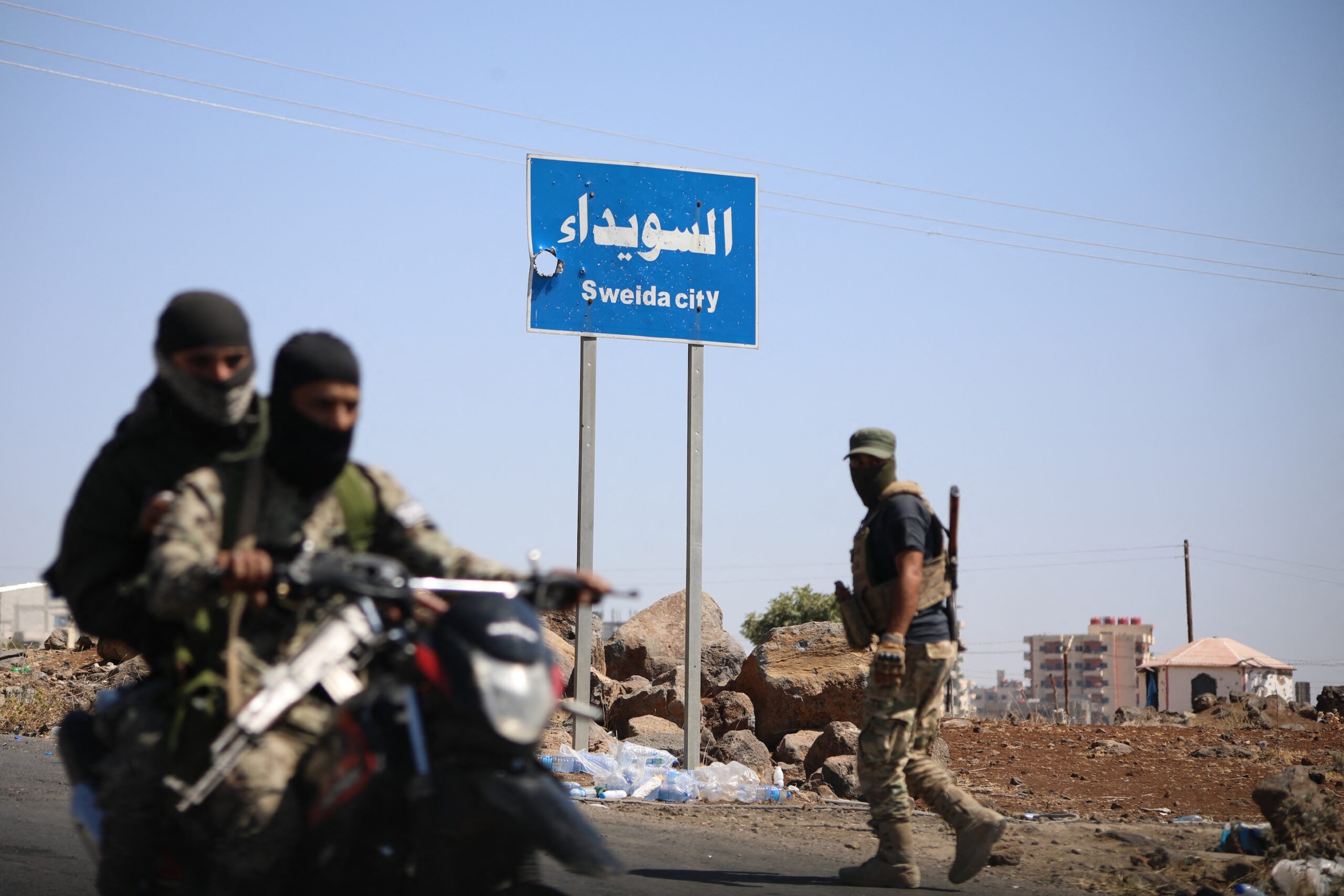
Since July 13, the governorate of Suwayda in southern Syria, whose population is overwhelmingly Druze, has emerged as a flashpoint for sectarian violence, between local militias on the one hand, and Bedouin tribes backed by government authorities on the other, posing a serious threat to the country’s already fragile political transition. What followed were days of violence which left at least 1,000 civilians and combatants dead according to the Syrian Network for Human Rights (SNHR) and displaced more than 93,000. There were also reports of sectarian and ethnically‑motivated summary executions and other grave abuses carried out by all sides. A string of shaky ceasefires broke down until a July 21 agreement largely halted the violence. While fighting has largely subsided, much of the governorate remains under a de facto siege, with telecommunications and internet blackouts reported across the province. According to the United Nations Office for the Coordination of Humanitarian Affairs, roadblocks, insecurity, and other obstacles continue to constrain humanitarian access to Suwayda, making aid deliveries sporadic and intensifying shortages that deepen the crisis.
The fallout of the violence in Suwayda was a blow for the transitional authorities in Damascus and exposed the weaknesses shaping Syria’s fragile transition. First, the Syrian authorities overestimated its ability to fold peripheral regions outside of its direct control without a professional, disciplined army behind it, resulting in renewed human rights violations and abuses. Second, it misread the regional climate and Israel’s readiness to openly intervene, stumbling into a confrontation that triggered punishing airstrikes, which only exacerbated the situation. Third, the developments in Suwayda underscored the authorities’ unwillingness—or inability—to articulate a national vision beyond short‑term security fixes; together with the factors above, it has only deepened the country’s divisions.
Increased tensions after the fall of Assad
Immediately to the north and northwest of Suwayda lie the Sunni Arab Bedouin tribes of al-Lajat and the western plain. Historically, Druze and Bedouin communities in Suwayda generally maintained cordial relations. Both groups shared water wells, grazing corridors and local markets, though competition over scarce resources—especially water during summer droughts—and occasional disagreements over livestock grazing occasionally boiled over into small-scale clashes or property disputes. These incidents were typically resolved through tribal mediation or local councils and rarely threatened wider stability. However, in recent months, tensions have been simmering between both communities.
After the fall of the Assad regime on December 8, Druze factions tied to Rijal al-Karama (Men of Dignity), a grassroots Druze militia formed in 2014 under Sheikh Wahid al-Balous to protect remote villages from forced conscription and cross-border incursions, moved into several peripheral areas around the province, setting up checkpoints and taking over trade. Bedouin tribes—long reliant on fuel and smuggling routes—saw revenues collapse and accused Druze units of blocking grazing corridors. Kidnappings and raids followed, resulting in a marked increase in criminal activity along the Damascus-Suwayda highway.
Moreover, after assuming power, the transitional government has been politically at odds with key Druze figures, led by Hikmat al-Hijri and backed by several local factions including the Men of Dignity and the Suwayda Military Council, a coalition of Druze militias formed in early 2025 to oversee local defense and negotiate security arrangements with the authorities. Al-Hijri is a veteran member of the Druze spiritual council, and had supported the Assad regime during the early stages of the Syrian conflict, until he emerged as a leading voice during the 2023 Suwayda protests that were against corruption and for the release of political detainees. Al-Hijri remains a polarizing figure within Syrian politics—viewed by some supporters as a needed counterweight to Damascus, and by others as a former Assad regime loyalist with alleged ties to Israel. Moreover, reports implicated some Druze militias to abuses such as abductions, unlawful detentions, and reprisal killings in wake of the recent clashes in Suwayda.
Following Ahmed al-Sharaa’s ascent, al-Hijri rejected government proposals to fully integrate Suwayda into Damascus’s administration and to disband local Druze militias. Instead, he insisted on a civil, decentralized state as a prerequisite, with minority representation and local governance. Damascus, by contrast, maintained that only a centralized, top-down system could steer Syria through its transition.
Hostilities in the province reached a breaking point on July 13 when clashes broke out between the Druze factions and Bedouin tribes following the assault and kidnapping of a Druze merchant, clashes that quickly spread across the rest of the governorate. The transitional government, which had sought to retake the semi-autonomous governorate, used this opportunity to intervene militarily but was promptly forced to retreat following heavy Israeli airstrikes against its armed forces, the Ministry of Defense building, and the vicinity of the Presidential palace. Bedouin tribal fighters mobilized nationwide and, under Damascus’s guarantees of safe passage, spearheaded military operations, acting as shock troops, laying siege to multiple villages on the province’s outskirts.
Military miscalculation
The military campaign was a major miscalculation by the al-Sharaa government, one that may have lasting implications for the country’s political and social fabric if left unaddressed. Despite the truce, key differences remain unresolved.
Since taking power last December, the al-Sharaa government has adopted a security‑first approach toward areas beyond its formal control, such as in rural Latakia and parts of Homs and Hama, where state service provision remains patchy and pro-Assad elements remain prevalent. This approach was first evident after the March 2025 coastal massacres targeting predominantly Syrian Alawites, which came in response to attacks by pro‑Assad remnants on transitional‑government security forces. In retaliation, the authorities launched a counteroffensive that left at least 1,460 people—mostly civilians—dead at the hands of its security forces. Although the fact‑finding mission, commissioned by Damascus, concluded that Syrian army commanders did not order the attacks, its report still raises serious doubts about discipline within the ranks and about the army’s ability to conduct large‑scale operations in minority‑populated areas. The coastal killings convinced members of the Druze community that disbanding could leave them exposed to similar violence.
The coastal killings convinced members of the Druze community that disbanding could leave them exposed to similar violence
One of the main arguments made by supporters of al-Sharaa’s is his purported ability to rein in the rival factions that now constitute the bulk of the approximately 100,000-man Syrian army—much of it made up of inexperienced new recruits alongside former Syrian National Army (SNA) brigades, Islamist-leaning units once part of Hay’at Tahrir al-Sham’s (HTS) military wing, and some 3,500 foreign ex-jihadist fighters. Yet, following the violence in the Syrian coast and Suwayda, it has become clear that the current security-driven approach is failing, not least due to the fragile nature of the armed forces. Even in territory nominally under government authority—northern Aleppo included—day‑to‑day control rests with the same former SNA factions that held it before Assad’s fall, still drawing salaries, logistics, and training from Turkey. Parallel chains of command, lack of standard training oversight, and the absence of minorities within the security architecture have all contributed to a severe lack of professionalism and discipline within the army establishment. As a result, the reliance on brute force only delivered repeated human rights violations and severely undermined the al-Sharaa government’s credibility—both internationally and among Syrians increasingly wary of his rule.
The Israeli connection
Invoking the need to protect Syria’s Druze following days of clashes between local factions and Bedouin forces, IDF strikes targeted Syrian armor and infantry, forcing a pullback from Suwayda. The intervention stemmed from a supposed misunderstanding. On the eve of the Suwayda clashes, Israeli and Syrian officials met on the sidelines in Baku for talks centered around Israel’s military presence in southern Syria. The transitional authorities asked Tel Aviv to match Damascus’s confidence‑building steps—most notably approving Suwayda’s integration into state structures—and Israel reportedly agreed. Around the same time, the US envoy to Syria, Tom Barrack, stated that Syria should be governed as a centralized state. This is when the Syrian authorities decided to retake the province by force—a crucial misread. Israel reportedly had only agreed to restore state services and a limited, locally-staffed security presence. The chaos prolonged the bloodshed and left al-Sharaa weakened in the eyes of HTS hardliners. To save face and stem further losses, Damascus quietly let Bedouin fighters from across Syria mobilize and move unimpeded, using them as a de facto proxy to besiege villages on Suwayda’s outskirts.
Damascus ended up pitting two Syrian constituencies against one another
Damascus ended up pitting two Syrian constituencies against one another, rallying al-Sharaa’s Sunni Arab base and fueling sectarian rhetoric and disinformation—pushed along by loosely affiliated media figures and officials tied to the transitional government. In doing so, it played straight into Israel’s hands, which seeks a weak and socially divided Syria.
Beyond societal divisions, the recent discourse around Israel’s engagement in the Syrian file highlights another important shift. Contacts between some Druze factions and parts of the Syrian leadership with Israel underscore the collapse of old ideological red lines; Israel is now treated as a key actor in Syrian affairs, with both sides of the Suwayda violent events directly or indirectly vying for its support and backing. Yet supporters of Hikmat al‑Hijri, and by extension Syrian Druze as a whole, were branded “traitors” by some pro-Damascus officials and their media personalities for urging international—even Israeli—protection for the Druze, despite the interim government itself holding talks with Tel Aviv, including floating the idea of joining the Abraham Accords.
Meanwhile, since October 7, 2023, Tel Aviv has taken a heavily securitized foreign policy in the region. By hitting military infrastructure and leaning on communal fractures, Israel aims to limit Damascus’s ability to establish a unified political order and pressure Damascus to capitulate and drop its claim to the Golan in return for tacit Israeli tolerance of al-Sharaa’s rule. While shortsighted, al-Sharaa’s miscalculation and tacit weaponization of the situation in Suwayda have helped Israel partially achieve this objective—namely to deepen inter‑Syrian divisions.
Absence of a coherent nation building agenda
Over the past eight months, the government of Ahmed al-Sharaa has failed to adequately present a unifying vision for the country beyond advocating for sanctions removal and reintegrating Syria back to the regional and international arena. It rushed processes that usually take months, if not years, to yield any tangible outcome. The Day of National Dialogue, a two day conference aimed at setting the foundations of the new Syrian state, held in February, is one such example. Pushed through just three months after the regime’s fall and crammed into two days, it looked to many Syrians less like an inclusive effort to draft a new social contract than a photo op with no follow‑up, to give the administration a veneer of legitimacy.
[Syria’s transitional government] rushed processes that usually take months, if not years, to yield any tangible outcome
Another example was the Constitutional Declaration announced shortly thereafter. The interim constitution, while necessary, heavily centralizes power in the hands of the presidency, even by Syrian standards. Not only does it vest the president with direct authority over every branch of government from day one of the transition, but it also eliminates institutional mediators, including the role of prime minister and an independently elected parliament. This risks entrenching authoritarian control rather than facilitating a genuine transition.
Similarly, the formation of the interim-cabinet, while somewhat technocratic in nature, lacked any genuine representation or transparency in the selection process. Only four of the transitional government’s 23 ministries are led by non-Sunni Arab, and nine appointees, including key posts in foreign affairs, defense, interior, and justice, are now held by figures linked to HTS and its Idlib-based Salvation Government. Furthermore, al-Sharaa’s brothers also hold influential positions with Maher al-Sharaa serving as the presidency’s secretary general, while Hazem al-Sharaa is tasked with overseeing economic policies.
Additionally, the adoption of the new visual identity in early July has failed to live up to expectations. Besides contradicting Article 5 of the interim constitution which mandates that “the state emblem and national anthem are determined by law” rather than by presidential decree—there is little evidence that the committee responsible for designing the new emblem sought meaningful public input before its adoption. This was echoed by some civil society groups who criticized the top down approach. Nonetheless, the emblem was quickly promoted by supporters of Damascus as a rallying symbol—fueling division rather than unity in wake of the clashes in Suwayda and drawing a clear line between government backers and opponents.
By rushing these delicate yet essential nation-building measures, Syrian authorities have effectively undermined the transition process by making it seem performative rather than genuine and inclusive. This, coupled with the absence of a unifying and reconciliatory discourse, has deepened fragmentation along ethnic and sectarian lines which risks collapsing the “idea of Syria as a single political project.”
Instead of attempting to strong-arm Syrian minorities, the interim government needs to engage in a genuine dialogue that enshrines the roles of all of Syria’s ethnic and religious segments in the political and military establishment
Instead of attempting to strong-arm Syrian minorities, the interim government needs to engage in a genuine dialogue that enshrines the roles of all of Syria’s ethnic and religious segments in the political and military establishment. This can be done by reconvening a genuine and serious dialogue with all components of Syrian society that goes beyond the rushed two-day conference. Moreover, Damascus needs to take responsibility for what happened in Suwayda. This must include tangible steps that go beyond acknowledging violations. The authorities’ establishment of a new fact-finding mission is a step in the right direction. However, its findings need to be published and perpetrators must be held accountable, irrespective of their rank or position within the current government. To this end, the UN Special Envoy Geir Pederson and his team need to step up their engagement with Security Council members to condemn Israeli violations of Syria’s sovereignty and press Damascus on continuing a genuine and inclusive political transition in the spirit of UNSC resolution 2254.
Reforming Syria’s security sector is an essential prerequisite for the transitional period to succeed. This is by no means an easy task given the factionalism of the defense establishment. As such, a clear strategy is required, one that necessitates international backing and technical expertise. Damascus must clearly define the mandate and role of the new army in post-Assad Syria to ensure it serves national defense and public security rather than acting as a coup-proofing instrument for the leadership. This can only be achieved by diversifying the pool of applicants to incorporate all segments of Syrian society. Additionally, disarmament cannot be selective: all organized armed groups—Bedouin units, the SDF, and former SNA factions included—must be part of the process.
While humanitarian assistance must remain unhindered, governments should structure broader financial support to Syria’s transitional authorities on verifiable progress toward an inclusive, rights-respecting political transition and credible accountability for abuses by all parties since Assad’s fall. Damascus needs to address the growing humanitarian crisis in Suwayda. It needs to ensure immediate relief reaches the province. More importantly, Syrian authorities must treat its Druze population as equal citizens in the eyes of the state by engaging in substantive political dialogue and inclusion, and it must do it now. Failure to do so risks deepening societal fractures, reigniting violence, and ultimately undermining Syria’s transition.
Samy Akil is a Nonresident Fellow at TIMEP focusing on politics and security in Syria. He is a political analyst specializing in Middle Eastern affairs with a focus on Syria and a particular interest in political transition, diplomacy, and security.