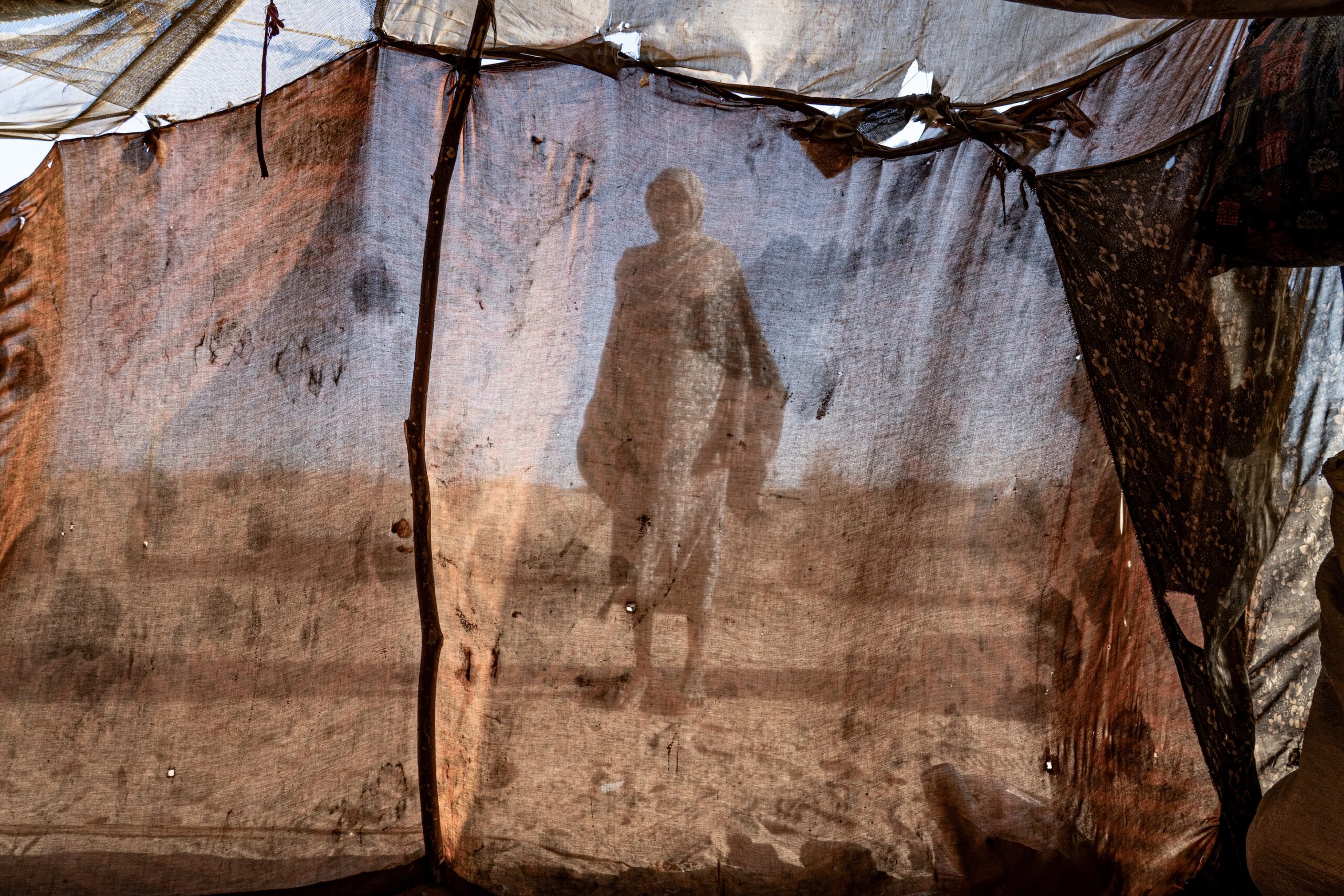
Adila, 49, does not speak much about the years she has lived through, but they are visible in her hands: cracked skin and deep lines that seem to mirror the land on which she has spent her life.
She grew up near the town of Tawila, in Sudan’s North Darfur State, on the edge of a seasonal watercourse, where her earliest memories were shaped by the rhythm of rain-fed agriculture. There was little room for planning, only the anxious wait for what the skies might bring. Her family relied on the land, planting sorghum and millet when the rains allowed, and storing enough to last for months.
When Adila remembers life before the Darfur war that started in 2003, she describes her village as a shared space governed by custom, where seasonal land use was distributed between farmers and herders. Relations were not without tension, but they endured, with local leaders settling disputes, and everyone knowing their survival depended on each other.
However, the years that preceded that war brought a slow erosion. Drought became increasingly severe, the soil’s fertility gradually declined, and pressure on scarce resources mounted. Distrust crept into everyday relations, and talk of land and water became fraught.
This competition over land and water was linked to the region’s diverse demography. Located in western Sudan, Darfur (meaning “home of the Fur” after its largest non-Arab group) is home to dozens of groups, broadly divided between communities that identify as non-Arab African—most notably the Fur, Masalit, and Zaghawa—and others that identify as Arab, such as the Rezeigat, Salamat, and Bani Hussein. The government and militias instrumentalized these distinctions in mobilization and violence—the same divide that lay dormant beneath the delicate balance between farmers and herders in Adila’s village.
Consequently, what is happening in Darfur during the current war cannot be understood in isolation. It is the product of decades of interlocking pressures, in which climate change and local ethnic relations are linked to political developments in Khartoum, neighboring African countries, and beyond.
The 2003 war changed Adila’s life forever. Her village became hostile ground, and displacement became a part of everyday life. She would flee with her family to safer areas, stay in camps or with relatives, then return to find razed houses and neighbors gone for good.
The Abuja Agreement in 2006 ended the war’s most violent phase, but lower-level violence continued among tribes, clans, and armed groups, as the government continued to stoke conflict and supply weapons. The conflict in the region, which makes up nearly a quarter of Sudan’s landmass, remained largely forgotten until the current war erupted in April 2023.
Darfur lies at the center of the ongoing crisis, witnessing some of the most intense fighting between the Rapid Support Forces (RSF) and the Sudanese Armed Forces (SAF). The violence has killed and displaced hundreds of thousands amidst massacres, rape, starvation, ethnic targeting, and systematic devastation that has been described as genocide.
The 1980s offer a useful starting point for understanding how this devastated region reached its present state.
Weapons flow, rains recede
Between 1987 and 1989, just before the coup that brought Omar al-Bashir to power, Darfur witnessed one of its largest waves of inter-communal violence, against a backdrop of severe drought and a central government that was both weak and complicit. Weapons began flowing into the region in a greater volume, driven in part by the war Chad-Libya conflict as the western border became an open crossing for arms and displaced Chadian tribes, some of whom formed alliances with the government.
Weapons were no longer the exclusive domain of the state but increasingly became tools in the hands of local actors. This gradually eroded the Native Administration’s capacity to enforce its rulings, particularly in the absence of institutional backing capable of implementing customary law or deterring those who violated it.
At the same time, successive seasons of low rainfall shrank the region’s farmland and pasture. Resources that once sustained everyone grew so scarce that the old resource-sharing arrangements could not hold, and the hakura system, long the cornerstone of customary land tenure, began to break down. (A hakura is a socio-spatial unit historically tied to a group, usually a tribe or one of its branches, granting it rights to farm and settle there.)
Friction intensified between farmers and herders as pastoral corridors shrank or disappeared. As seasons became unpredictable, herds moved into fields earlier than expected and farmers held their plots longer than custom allowed. Disputes once settled by customary law escalated into more severe conflicts.
With Bashir’s rise to power, Darfur entered a new phase in which the relationship between the state and local communities was reshaped. Unwilling to make political concessions or widen local participation, the government adopted security policies based on arming local groups, such as the so-called Border Guard Force, which emerged under the leadership of Musa Hilal who would later play a central role in the 2003 genocide.
This approach was accompanied by the increasing politicization of the Native Administration, with local leaders appointed or promoted for their political allegiance rather than their standing in their communities. Undermined by the spread of arms and stripped of their autonomy, Omdas and Nazirs saw their authority steadily decay, reducing them in the eyes of many to mere extensions of the central government.
By the late 1990s, conditions became increasingly volatile, culminating in the outbreak of the Darfur war in 2003. During that time, the government fully supported the Janjaweed militias—the future nucleus of the RSF— against other armed groups. The government fought alongside them and gave them military and political cover, leaving a number of regime and army figures wanted by the International Criminal Court for war crimes and crimes against humanity.
The war was accompanied with state policies that redistributed land and power along new fault lines. Armed and government-aligned groups were given influence over lands they had no historical claim to, while other communities were displaced and lost their hakura domains. Land stopped being a resource governed by custom and became a prize decided by force.
The establishment of the Rapid Support Forces in 2013 continued that trajectory. Members of the Janjaweed were folded into a more formal structure, but the group retained its relative autonomy, operating parallel to traditional state institutions. This shift entrenched the logic of militarization. Power now rested on coercion rather than customary legitimacy with no alternative framework in place to manage the intense competition over resources.
The weaponization of tribal identity
Repeated conflict-driven displacement reshaped Darfur’s social fabric, putting entire areas under sudden demographic pressures. The influx of newcomers reshaped local relationships with the land, as displaced groups settled in traditional hakura territories to which they held no historical claim.
This social transformation was fueled politically and militarily through the weaponization of tribal identity for mobilization and recruitment, linking identity to land rights, protection, and security. Disputes were no longer managed between individuals or neighboring communities with a shared history of interdependence, but framed as a confrontation between ‘us’ and ‘them’, reducing a long history of social coexistence and shared life to stark, simplified narratives of conflict.
This fracture is most visible between non-Arab groups like the Fur, Zaghawa, and Masalit and Arab ones such as the Rezeigat and Missieriya. These communities once shared the makharif and masayef (wet- and dry-season grazing corridors, respectively) and built networks of intermarriage and trade in the markets of Tawila and Kutum. These relationships have since ruptured, and what remains of them is marred by pervasive distrust.
The hakura stopped being the shared space Adila remembered from her childhood. Mass displacement and the seizure of villages created a new demographic reality built on exclusion, turning collective memory from a record of coexistence into a repository of grievances and demands for retribution passed down the generations.
This politicization did not remain confined to rhetoric. It produced systematic violence and a new class of actors. The rise of leaders such as Musa Hilal and Mohamed Hamdan Dagalo (Hemedti), commander of the RSF, is the culmination of a long strategy of delegating violence to particular ethnic groups to protect the regime’s interests and impose a new status quo.
At the same time, armed movements like the Sudan Liberation Army (Abdul Wahid al-Nur faction) gained legitimacy not only from military strength but also as ‘protectors of identity’ and defenders of communities that had suffered grievances and displacement, such as Adila’s.
All of these actors are products of the collapse of customary governance and the rule that the “gun grants the land.” This transformed disputes over resources that could once be addressed through negotiation into symbolic and existential conflicts that are far more difficult to resolve without fundamentally rebuilding a sense of coexistence and trust between communities.
The war that erupted in April 2023 was the earthquake that shattered the last fragile remnants of Darfur’s social fabric, transforming the region into a theater of widespread massacres that transcend military engagement and amount to systematic genocide.
The RSF’s assault on El Fasher in October 2025, which killed and wounded thousands of civilians; its massacres at the Zamzam camp in April 2025, which claimed over a thousand lives; and, before those, the army’s aerial strike on the market in Tura, north of El Fasher, are not simply figures in a war’s casualty ledger. They reflect a culture of dehumanization, entrenched over years of militarization.
In these massacres and the many others like them, violence targeted identity rather than combatants. Displaced civilians were treated not as unarmed individuals but as a human reserve for the enemy, or a demographic obstacle to be removed to control the land.
The armed parties, chief among them the RSF, have systematically exploited tribal identity, recasting resource competition into a matter of ‘existential vengeance.’ Current leaders—nurtured in an ethos that exalts the gun and disdains consensus—weaponize an inherited culture of revenge to drive their fighters. A soldier perpetrating a massacre in Zamzam is fueled by stories of historic grievances suffered by his own people, trapping the region in an infinite loop of retaliation.
This historical investment in local grievance has made the current war in Darfur the most ferocious yet. It does not only shatter the present; it poisons the future by seeding cross-generational hostility. No settlement imposed from above can repair that rupture unless it addresses dehumanization directly and restores the value of the individual outside tribal identity.
Not by arms alone
Examining the Darfur conflict through these interconnected layers—from ecological decline and resource scarcity to the breakdown of traditional social structures and the politicization of identity—inevitably leads to the realization that a new reality cannot be built by arms alone.
Previous peace processes—from the Abuja Agreement (2006) and the Doha Document (2010) to the Juba Agreement (2020)—have demonstrated a recurring structural failure. Anchored in the logic of ‘elite peacemaking’ and the distribution of political spoils, these pacts were consumed by the task of carving up posts in Khartoum, while leaving the core issues affecting Darfurians, like Adila, completely unresolved. Peace became a commodity that rewarded armed actors and left civilians at the mercy of militias that were never dismantled.
No settlement will hold unless it moves out of hotel conference rooms and reaches the soil Adila walks on. The July 2020 Nertiti sit-in is a model: thousands of Central Darfurians rallied around demands that cut across the usual dichotomies (armed movements versus the RSF, Arab versus Zurga and so on). Farmers, herders, and displaced people protested peacefully for security, disarmament, and protection of the hakura domains. Nertiti showed a third actor at work, and proved that communities can protect themselves through cross-tribal solidarity instead of sheltering behind militias.
This underscores the need to work with civic bodies such as the General Coordination for Displaced Persons and Refugees in Darfur and women-led networks, toward developing a new social contract that dismantles the culture of vengeance, restores customary law, and provides justice for everyone and a safe life for displaced people in their lands.
Today, Adila sits at the edge of her camp, looking toward Tawila. She does not ask who will occupy the seat of power in Khartoum; instead, she asks when her neighbor’s hand will stop pulling the trigger. For Adila, peace does not mean grand speeches or agreements signed in distant capitals. It means the day she can return to her land and plant her seeds without fear that gunfire will harvest what the rain has sown.
What she wants is not impossible, yet it is profoundly simple and complex all at once: for her cracked hands to reclaim their innate bond with the land, and for customary law, rather than tanks, to once again govern the boundaries between fields and pastures. She dreams of a day when displacement is no longer her fate, when the ‘shared space’ of coexistence returns, and when trust becomes more than a distant memory. She still holds on to the hope that the land which once bore the seeds of war can, through truth and justice, yield a lasting peace.
Hassan Al-Nasser: Sudanese journalist and researcher