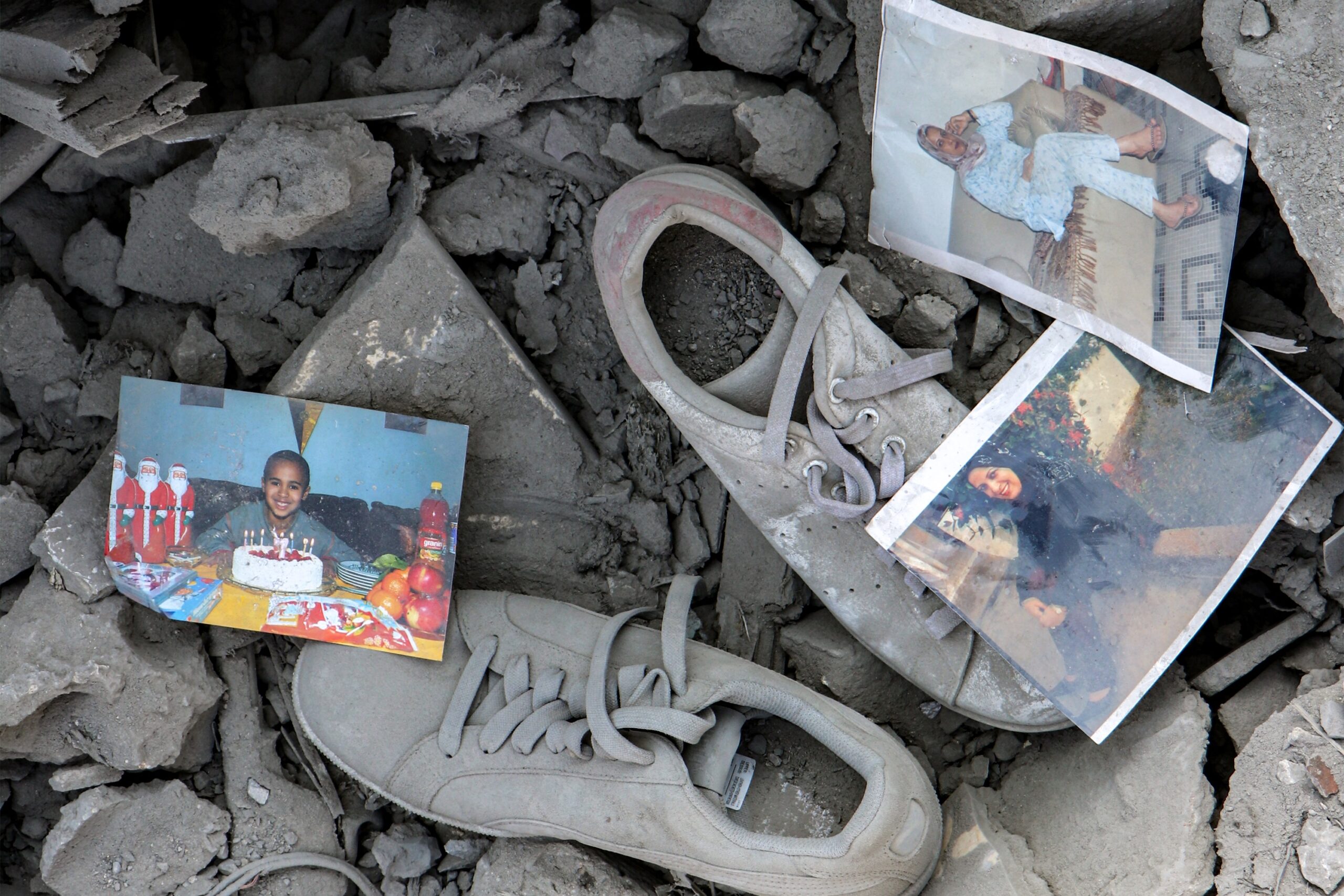
Fourteen months after the ceasefire, large parts of South Lebanon remain in ruins, with entire towns and villages across the border devastated by Israeli aggression. Hassan*, a retired officer of Lebanon’s Internal Security Forces returned to Khiam after the war, about two miles from the southern border, only to see his life’s work reduced to rubble. The house that took him decades to build and his farm were gone. He wasn’t alone. Israel made the town uninhabitable by destroying healthcare facilities, businesses, tourist establishments, churches, roads, water stations, telecom towers, and the municipal building.
The destruction in Khiam reflects the broader devastation across South Lebanon. Between October 2023 and January 2026, Israel damaged or destroyed tens of thousands of structures in the south, with most of the destruction incurred after the ceasefire was announced on November 27, 2024, according to Amnesty International. Residential areas, public spaces, and the economic, social, and environmental systems that sustained civilian life were among the structures systematically destroyed.
These destroyed structures are often overlooked in a narrow depiction of the region as a “Hezbollah military outpost,” due to the group’s deep social and political roots and military infrastructure in the area. This framing reduces an entire civilian territory to an abstract militarized zone and blurs the conversation about what is being destroyed and what reconstruction should look like. A holistic understanding of the destruction in South Lebanon is therefore imperative to any discussion of recovery.
The anatomy of destruction
Destruction in South Lebanon began on October 8, 2023, after Hezbollah attacked Israeli military targets in the Shebaa Farms, triggering cross-border exchanges of fire. From that point onward, bombardment in the south became sustained, expanded in scope and intensity, and increasingly devastated civilian areas. The Council for the South, a state body responsible for development and compensation in South Lebanon, estimated that by May 2024, over the span of only seven months, the damage amounted to around $500 million. This comprised 1,700 houses that were completely destroyed and 14,000 that were damaged, in addition to public infrastructure—such as water systems, electricity networks, roads, schools, and health centers—and agricultural land.
The destruction escalated dramatically on September 23, 2024, when Israel launched an intensive air campaign and a ground invasion against Lebanon that would not be contained until November 27, 2024 when the United States brokered a ceasefire between both countries.
Between October 2023 and November 2024, Israel killed more than 3,961 people across the country and destroyed more than 40,000 structures in South Lebanon—about 25 percent of buildings. The loss of human life and destruction continued after the ceasefire: Between the November 2024 ceasefire and November 2025, the United Nations’ Human Rights Office reported that at least 127 civilians had been killed in Israeli military strikes on Lebanese territory. And between October 2024 and January 2025, Israel “heavily damaged or destroyed” 10,000 structures in the south.
The World Bank estimates that the damage inflicted in the country’s southern area amounts to $4.76 billion. The broader footprint of the war, smaller yet still significant, includes an estimated $1.08 billion worth of damage in Mount Lebanon (including Dahieh, the capital’s southern suburbs) and around $884 million in Baalbek-Hermel and the Bekaa.
Given the scale and multidimensional nature of the destruction, the numbers alone do not tell the full story
Given the scale and multidimensional nature of the destruction, the numbers alone do not tell the full story. The damage extends far beyond residential buildings. Businesses and workshops that sustained local economies and forged the region’s social fabric were also destroyed: Across the country, 9,194 establishments in the tourism, commerce, and industry sectors were either destroyed or partially damaged. In the city of Nabatieh, Israel destroyed the historic market, an integral part of the city’s heritage and culture, which dates back to 1250–1517 AD. Comprising 40 shops, the market functioned as a daily economic and social hub. The loss of these businesses has long-lasting impacts, undermining the local economy and the social networks embedded in everyday commercial activity.
“A few hours before the ceasefire, I got a call telling me that they destroyed the house and the warehouse,” says Abu Jamil*, the owner of a key dairy and poultry plant in Nabatieh. On November 27, 2024, two Israeli missiles destroyed the building where he, his brother, and his father lived with their families, along with the adjacent dairy-processing warehouse. Earlier in the war, Israel had also destroyed his supermarket in the Hay al-Bayad neighborhood as well as his sister’s house, killing her and her husband.
Churches, mosques, religious and historical monuments, cemeteries, community spaces, and educational facilities—all anchors of social life and collective memory—were also repeatedly destroyed. Critical service provision systems, including water pumping stations, water pipeline networks, electricity infrastructure, telecommunications networks, and 67 hospitals, were damaged or put out of service.
Relatedly, agriculture, a central pillar of South Lebanon’s economy, was also deeply affected. Orchards, farmland, irrigation networks, poultry facilities, and fishing infrastructure were damaged or made inaccessible.
Inaccurate depiction vs. lived reality
Despite the targeting of civilian infrastructure, South Lebanon continues to be widely framed as a Hezbollah military outpost in IDF statements, media rhetoric, policy discourse, and reconstruction debates. This framing relies on an expansive and loosely defined understanding of what constitutes a “military target”; the term includes homes, markets, and civilian infrastructure repeatedly described as “weapons storage facilities” belonging to Hezbollah. It implies a politically and socially homogeneous population and treats the territory as a permanent source of threat rather than an area shaped by diverse livelihoods, institutions, political realities, and social structures.
The south, as a living, breathing ecosystem, remains largely absent from the main discourse
As a result, discussions in diplomatic, security, and policy circles more often than not focus on what a demilitarized South Lebanon would look like, with little attention paid to planning for civilian recovery like housing rehabilitation, livelihood restoration, and the rebuilding of local institutions. The south, as a living, breathing ecosystem, remains largely absent from the main discourse.
Before the war, South Lebanon functioned as an interconnected civilian environment. The region has thousands of years old olive trees which account for 38 percent of all olives harvested in the country. Its economy is built on small businesses, with residents turning to souks not only for commerce, but also to socialize and share news, reinforcing the communal nature of regional cultural traditions. Diverse religious communities including Muslims, Christians, and Druze coexist, schools and hospitals operated despite strain, municipal work maintained normalcy, and domestic tourism was common. This contrast between inaccurate depictions and lived realities shapes how destruction is understood and how recovery priorities are defined.
Coexisting with death
Today, the collapse of agriculture, trade, and all kinds of infrastructure, has effectively killed the pre-war economic and social life in South Lebanon, also leaving public services and local activity in ruins. With few alternatives, residents have adapted to the situation in order to survive.
People work around damaged infrastructure and have grown accustomed to the absence or scarcity of services, scraping by in an economy that has largely collapsed. In Nabatieh, for example, the Monday Market has been replaced with temporary kiosks through private initiatives. In the border town of Mais al-Jabal, students have resumed studies in temporary prefabricated rooms.
“I’m renting an apartment for $550 per month,” Hassan* who lost his home in Khiam, told TIMEP. In a country where the minimum wage is $312, and in a town that has been overwhelmingly destroyed, this financial strain has further exacerbated already harsh life conditions. Similarly, Abu Jamil* in Nabatieh reports feeling financially suffocated by the cost of renting both a new apartment and a new grocery store.
A call for a holistic framework amidst challenges
Understanding the nature of destruction in South Lebanon beyond a military lens requires approaching reconstruction as part of a systematic, decentralized, social, economic, and environmental recovery plan—one that does not merely restore pre-war lifestyle, but improves it to effectively rebuild the social contract in the south.
Commenting on this, Yara Abdelkhalek, Researcher and Advocacy Coordinator at Public Works Studio, says: “There are social ties in the south that have been severed as a result of displacement and destruction. The conversation around reconstruction should prioritize the social aspect of restoring connections between people and between their land.”
“After the port explosion [in 2020], the government swiftly passed Law No. 194 of 2020, which protected affected areas and residents from real estate speculation and preserved cultural sites. Hence, this is something the government is able to do.”
In parallel, the United States, Saudi Arabia, and Qatar have shown unwillingness to contribute to reconstruction efforts before the full disarmament of Hezbollah. This marks a shift from their roles following the 2006 Lebanon-Israel war, after which Qatar fully rebuilt the town of Bint Jbeil, and Saudi Arabia spent $500 million to help with reconstruction. Their unwillingness this time around complicates the recovery process further, given that the Lebanese government lacks the funds to engage in reconstruction independently.
The first phase of the state-sponsored reconstruction plan in South Lebanon will target infrastructure, including energy, water, education facilities, and municipal and public services, but will exclude agriculture. The phase, which will be funded by a $250 million World Bank loan, is expected to start soon and forms part of a larger reconstruction framework approved by the Lebanese government on January 30, 2026. According to the framework, in later phases, the government will adopt policies aimed at supporting southerners’ return, such as opening funding applications for rebuilding that will be assessed by technical teams. However, these policies remain commitments on paper and depend on the availability of funds.
Major obstacles, mainly political and security-related, still exist. More than a year into the ceasefire, Israel still conducts near-daily military operations causing further destruction. These include airstrikes, artillery shelling, drone attacks, controlled detonations, quadcopter activities, and mortar flares. In parallel, Israel has been waging a systematic campaign targeting reconstruction efforts in South Lebanon, especially across the border. In the last week of December 2025, Israel conducted six demolition operations across border villages.
According to Human Rights Watch, between August and October 2025, more than 350 machines and equipment used for reconstruction—such as bulldozers and excavators—were destroyed. Prefabricated buildings and factories were also destroyed. Israel usually justifies these attacks by claiming that this equipment is used by Hezbollah to rebuild its “military infrastructure.”
Furthermore, on February 1, 2026, Israel sprayed a carcinogenic herbicide on agricultural land in the south, which is expected to heavily damage vegetation and agriculture in the area, making it even more uninhabitable. This follows the heavy use of white phosphorus during the war, known to cause serious environmental harm. All these operations point to a larger Israeli effort to create a buffer zone across the Lebanese-Israeli border by causing enough destruction to prevent a return to normal life.
Beyond the rubble: The path forward
The future of South Lebanon’s recovery will depend on the actions of the Lebanese government and the nature of international support. As a prerequisite, the government must adopt public messaging that treats Southerners as civilians with rights, livelihoods, and social ties, inseparable from the rest of the population. Doing so would counter narratives that reduce the South to a permanent military outpost. In this vein, the Lebanese Prime Minister’s visit to several cities and towns such as Bint Jbeil, Nabatieh, Kfarkila, Tayr Harfa, and Khiam among others, on February 7 and 8 is a positive step in ensuring equal citizenship for the region’s residents.
During such a volatile period, how reconstruction is approached will determine whether South Lebanon will emerge with renewed stability or remain trapped in prolonged fragility
Making civilian life, institutions, and economic systems visible again and supporting small businesses will help reframe the south as a civilian space. Restoring water, energy, healthcare, education, municipal services, and local economic networks will reduce the structural conditions that sustain insecurity and dependency on non-state actors. Undoubtedly, such efforts also require the full protection of reconstruction efforts from Israeli aggression, as every maneuver delays reconstruction further and reinforces inaccurate narratives about the south.
Lastly, effective reconstruction needs to be accompanied by transparency measures adopted by the Council for the South, the Council for Development and Reconstruction—an autonomous institution accountable to the government tasked with reconstruction in Lebanon—and relevant ministries. These include publishing implementation timelines, funding flows, and oversight procedures.
During such a volatile period, how reconstruction is approached will determine whether South Lebanon will emerge with renewed stability or remain trapped in prolonged fragility.
* Names have been changed to protect the identity of individuals.
Jad El Dilati is TIMEP’s tenth Bassem Sabry Democracy Fellow, where his mandate focuses on governance, politics, and narrative in Lebanon.