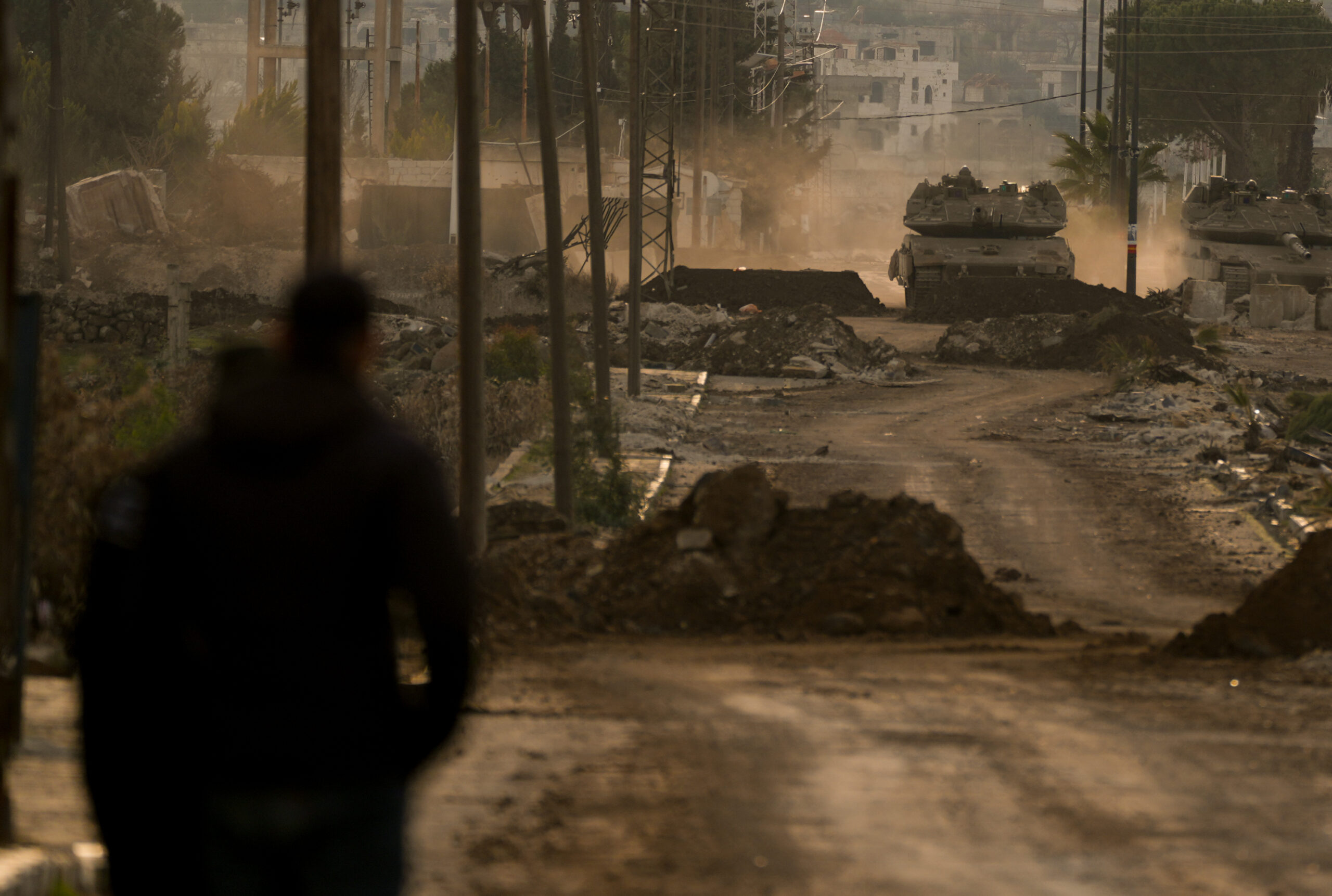
The morning after the Assad regime fell, many Syrians spoke of a long-deferred relief. In Quneitra and the western reaches of Daraa, both with borders with the demilitarized area that separates Syria from the Israeli-occupied Golan Heights, the mood was different.
“We didn’t feel victory,” a resident told TIMEP. “Assad was gone, but we woke to the rumble of armor near our villages.”
Checkpoints were set up and Israeli army patrols began to criss-cross fields that, until then, had been places of work and memory. In homes overlooking orchards and grazing land, parents weighed the school run against the sound of drones. The shift also unfolded in the shadow of a wider regional war, which sharpened Israeli security calculations and deepened the vulnerability of Syria’s southern border communities.
This article explores the changes in southern Syria after December 8, 2024, the day that many locals now cite as a turning point, as the Assad regime fell and Israel expanded its military activities into Syria. It explains how Israeli incursions intensified, documents what this has meant for movement, livelihoods, and basic dignity in Daraa and Quneitra, and sets out what Syrian authorities and international actors should do now. The analysis draws on interviews conducted with residents and local activists in both governorates and is complemented by open-source reporting for context and verification.
The turning point
Residents describe December 8 as the day the Assad regime fell but also the day that Israel moved troops into the UN-monitored buffer zone, expanded strikes on Syrian military assets, and signaled a broader push to demilitarize southern Syria. It was also the date when occasional incidents gave way to a more assertive pattern by the Israeli army: deeper patrols, temporary checkpoints, night-time raids, and visible fortification of positions on the Syrian side of the separation area.
In the months that followed, local reporting documented repeated ground entries or patrols in rural Quneitra—including Ain Ziwan, Kudna, Suwaysah, and Tal al-Ahmar—with detentions, searches, and restriction on movement. Artillery strikes and incursions also affected Koya, in far-western Daraa, and nearby farmland in the Yarmouk Basin, the river valley that forms Daraa’s western edge.
Internationally, this period drew formal concern from the UN Disengagement Observer Force (UNDOF)—which has monitored the 1974 demilitarized separation area between Syria and the Israeli-occupied Golan Heights—and statements at the UN Security Council.
Under the 1974 Disengagement Agreement, only UN peacekeepers are authorized within the separation area; military construction, fortification, or patrols by either party are prohibited. In recent cycles, UNDOF has publicly protested construction and movement it says breach the agreement, while the UN Security Council has reiterated the central importance of the mandate.
Locals, however, judge the system primarily by outcomes: Can children reach school? Can farmers reach water? Can families avoid night-time raids? The widening gap between those outcomes and the agreement is what fuels the current crisis of trust.
Why the increase of military activity?
Two dynamics converged to drive the shift in southern Syria after Assad’s fall. First, Israel intensified its military posture on the Syrian side of the border moving beyond sporadic strikes to a more visible pattern of ground activity, checkpoints, and fortified positions. By late 2025, the shift had become clear enough on the ground that local and regional reporting described it not simply as border monitoring, but as a deeper encroachment into daily civilian life in Quneitra. Latest developments in early 2026 suggest that this pattern did not stabilize: renewed security talks between Damascus and Israel took place while there were further reported incursions in Quneitra and western Daraa, underlining that the south remains unsettled rather than contained.
Second, the fall of Assad left southern Syria politically fragile and administratively exposed. As authority in Damascus shifted and local chains of command remained unsettled, communities in Quneitra and western Daraa felt that decisions about their security were being made without them. In that vacuum, the incursions and new military positions multiplied, reshaping residents’ movement, livelihoods, and increasing their fear. UN Security Council deliberations on the post-Assad transition and on UNDOF’s mandate reflected how sensitive the area had become. At the same time, local reporting from Quneitra showed how that instability translated into concrete breaches of movement and sovereignty on the ground.
Orchards and trenches
In Koya, located in the Yarmouk Basin in Daraa, residents say the agricultural season now depends less on rain and more on whether they are allowed to reach the water and the trees. “When access to the orchards is cut, it also cuts access to water,” a farmer told TIMEP, describing crop losses when routes to fields were blocked for days by the Israeli forces.
Beekeepers in nearby villages tell a similar story. They described leaving hives unmoved for entire cycles, ranging between six weeks and four months, because, as one beekeeper put it, “the bees will not wait for politics.” The result has been losses measured in kilograms of honey and damaged equipment. Beekeeping once provided a reliable source of income for many families along the border. Today, another Daraa resident said, “it has become a gamble you lose by staying put.”
The experiences described by residents mirror patterns documented throughout 2025, when local reporting recorded raids, patrols, and road closures affecting agricultural access across the Yarmouk Basin, including villages such as Ma’riya, Jamla, and Abidin, with farmers and herders saying that reaching fields and grazing routes has become increasingly unpredictable.
In Quneitra, shepherds spoke of grazing routes that now end at improvised mounds or razor-straight tracks cut into the earth. Several interviewees described Israeli troops digging trenches and building raised mounds of soil along the line, and points set above villages such as al-Hamidiyah and al-Hurriya, where movement is screened. “We used to take the ridge and drop down with the flock,” one man said. “Now we detour in the open.”
Going to school becomes a risk
Parents in Quneitra and western Daraa said the school run has become the day’s first risk calculation. One resident described children staying home “whenever we hear the drone for long,” and others spoke of “quiet arrangements” to move at particular times or in small groups.
These narratives echo documented sightings of Israeli patrols and surprise checkpoints in Quneitra, and reinforce the sense, repeated across interviews, that what appears as a contained situation on paper translates into a high-stress routine in daily life. Access has also been affected near Tal al-Ahmar.
A mother in Quneitra described the school run as a daily wager she no longer wants to make. “Tell them we are still here,” she said, “but don’t make us prove it every morning.”
Detentions and the fear of vanishing
Families in both governorates recounted Israeli detentions during or after patrols. One Daraa resident pointed to an instance when two young men were reportedly taken in rural Quneitra during the first week of January 2025. Public reporting since late November 2024 has likewise recorded arrests of civilians in Quneitra and nearby areas, including the case of a family in Suwaysah, in rural Quneitra, whose two sons Ahmad and Adnan Krayyan were reportedly detained by Israeli forces during a house raid. Their father suffered a heart attack in the aftermath and later died.
Ahmad had recently been released from the notorious Sednaya prison before he was taken by the Israeli forces. At the time of writing, neither brother has returned, and their fate remains unknown.
What local authorities say, and what people see
Residents repeatedly distinguish between rhetoric and relief. Official statements about sovereignty and protection sit uneasily beside an everyday reality of scarce government services, thin state presence, and slow or absent mitigation measures. In Quneitra, several people voiced frustration that senior officials are rarely present on the ground and that basic services such as road maintenance, employment plans, and predictable service delivery are not being used to help people stay.
Independent reporting through 2025 similarly portrays life in many southern localities as a form of managed instability: highly controlled at points of contact, yet under-governed in the everyday tasks that allow communities to function and endure.
What Syrian authorities and the international community can do
Syrian authorities and international actors must make halting Israeli incursions, attacks, fortification works, and other breaches of the separation area an immediate priority. “Hold everyone to the 1974 rules, and roll back the earthworks that cut us off,” one resident said. For people living in the south, international law is judged not by statements but by outcomes—whether roads reopen, raids stop, checkpoints are removed, and fields remain reachable. That requires sustained pressure on Israel to halt further violations of the separation area and dismantle fortifications and positions that expose civilians to harm or deepen the risk of lasting dispossession.
“We need someone accountable here, not mere symbolic authority from the capital.” Residents in Quneitra repeatedly described an authority gap on all fronts: senior officials are largely absent on the ground, leaving issues such as blocked roads, stalled infrastructure repairs, and residents’ complaints that remain unresolved for weeks. Designating an empowered local lead—such as a governor or acting governor—with weekly field visits and a public contact channel would turn promises into time-bound fixes people can see.
Parents said that taking their children to school has become riskier, and that clinic visits have become planned like major events. Where possible, Syrian authorities should work with local communities to create predictable movement arrangements that keep roads to schools and clinics open, and international actors should support deescalation measures that protect civilian movement rather than treating it as secondary to military considerations.
“People will stay if their work is protected.” Farmers, beekeepers, and shepherds stressed that orchards they cannot access, hives that are left for too long periods of time, and lost grazing routes are pushing households under the poverty line. Prioritized micro-grants; subsidized fuel, feed, saplings and hive equipment; and the rapid maintenance of agricultural infrastructure would help stabilize income. Mapping and preserving access to water points are also essential to help the region’s agricultural sector survive.
Interviewees described arrests during patrols and the anguish of not knowing where detainees are held. Local authorities should standardize incident recording, support families administratively, and escalate cases through UN reporting cycles and to states that have some leverage. Recording all the arrest cases and focusing on transparency—through tracing the place, date, and case number of each detainee—helps build trust and enables advocacy.
“We’re not abstractions: say our village names in your briefings.” Residents expressed deep frustration with generic statements by Syrian authorities that never mention their localities. International actors should expand independent and public reporting on all ground incursions, restrictions of movements, and harm in general so that residents can see their reality acknowledged and officials can be held to concrete facts.
“We didn’t choose to be a buffer”
In one village on the Yarmouk Basin, a farmer looked across, at an area he can no longer reach. “My father planted those trees. We didn’t choose to be a buffer,” he said. “We chose to live from this land.”
The situation in southern Syria is stark: Will security be rebuilt through law, dignity, and local agency, or through permanent pressure that turns families into bargaining chips? For now, the answer is written in closed roads and empty orchards. Changing that reality will take political courage to put people—not lines on a map—at the center of any decision.
Kholoud Helmi is a gender and media expert and co-founder and board member of Enab Baladi, an independent Syrian newspaper established in 2011.