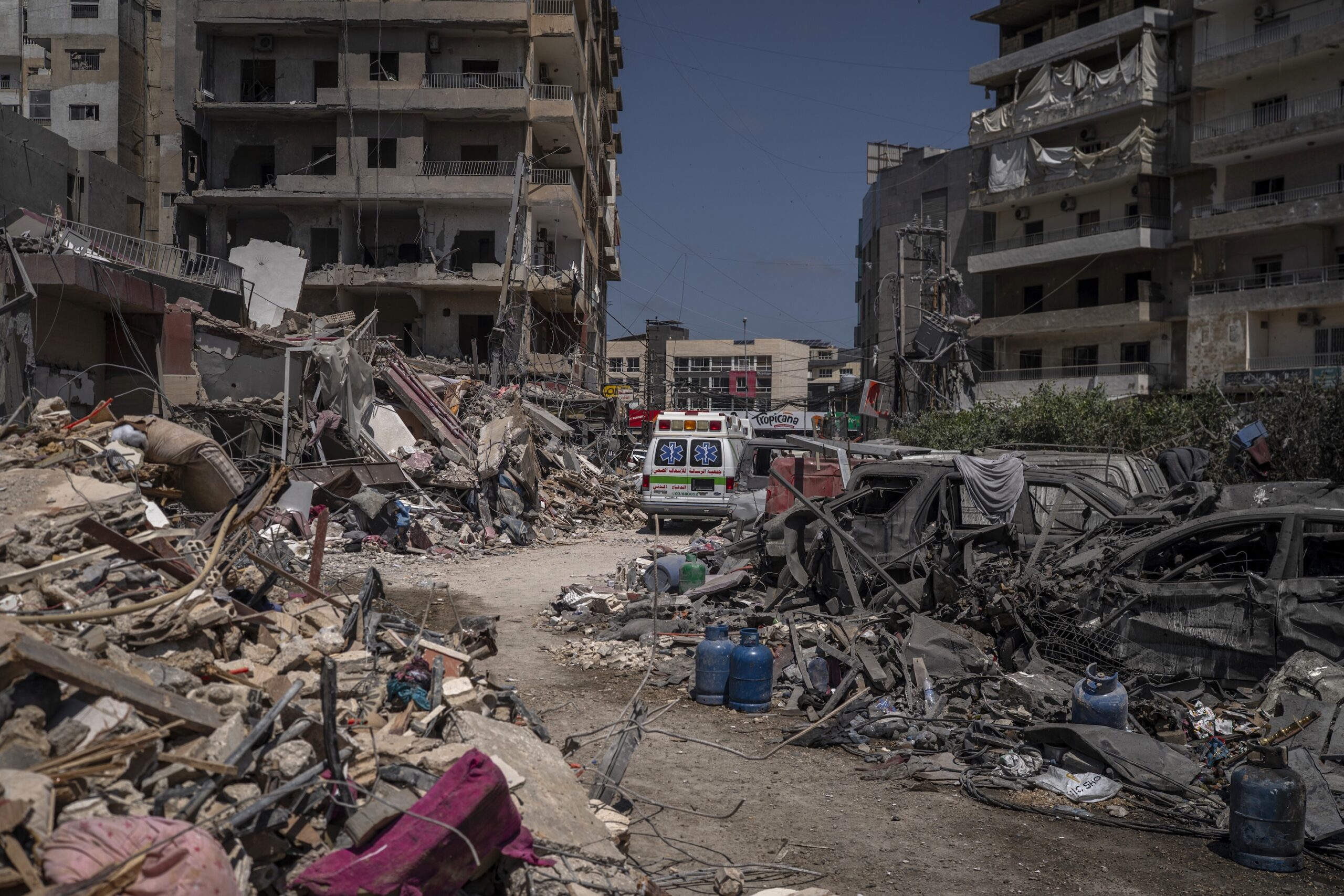
Israel’s expanded war on Lebanon may prove to be the war from which Lebanon cannot recover. Both its territorial integrity and its power-sharing system are at serious risk, and with them the country’s survival as a unified state.
The latest US-brokered ceasefire agreement between Lebanon and Israel, signed on June 3, did not survive 24 hours. The agreement required Hezbollah to cease all attacks and withdraw from the south, but did not guarantee Israel’s withdrawal from occupied Lebanese territory, further weakening the Lebanese government’s credibility and leverage. Hezbollah and Iran rejected the agreement and, hours later, Israel resumed its bombing and evacuation orders in South Lebanon while Hezbollah attacked Israeli troops. On June 6, Israel killed three Lebanese soldiers including an army general, even though the Lebanese army is set to deploy in “pilot zones,” where it would be the only armed group to operate. On June 7, Israel struck Beirut’s southern suburb, prompting a retaliation from Iran, which attacked northern Israel for the first time in two months.
The Lebanese state’s leadership had opted for politically costly direct negotiations with Israel despite clear and strong internal opposition to avoid further territorial losses. What happened was the opposite: Since the first US-brokered ceasefire on April 16, Israel imposed a de facto buffer zone along the border, occupied at least 55 Lebanese villages, dynamited many others, increased its strikes in South Lebanon, and killed more than 600 people.
The US’ inability to guarantee the implementation of a sustainable ceasefire exposes Lebanon’s government to the worst case scenario: unpopular negotiations with Israel, with no territorial or security guarantees. The immediate beneficiary of this failure is Iran, which now appears to many in the country as the only actor capable of weighing in the negotiation for Lebanon, further entrenching its regional leverage at the expense of Lebanese state sovereignty.
The weakening of the Lebanese state’s leverage both internationally and domestically unfolds against a backdrop of deepening polarization over Hezbollah’s weapons, which is pushing the country toward implosion
The weakening of the Lebanese state’s leverage both internationally and domestically unfolds against a backdrop of deepening polarization over Hezbollah’s weapons, which is pushing the country toward implosion. The prolonged Israeli occupation of the south will further undermine the Lebanese state and could give Hezbollah a renewed pretext to keep its weapons and reassert its dominance within the Shia community. A permanent displacement of southern communities, with no tangible prospect of reconstruction or return, risks intensifying sectarian tensions across the country.
How we reached an impasse: Sabotaging the post-2024 war transition
The Lebanese authorities are caught between two fires: on the one hand, Israeli aggression is killing thousands of civilians, destroying Lebanon’s infrastructure and entire villages, and jeopardizing its territorial integrity; on the other, there is the risk of an internal clash among sectarian communities or between Hezbollah and the Lebanese army tasked with disarming it, given the group’s defiance and the increased pressure from some parties for the government and the army to take bolder moves against it.
The Lebanese government has, in fact, taken serious steps to consolidate the monopoly of arms under state authority before the current war started, formally committing to doing so in a historic decision on August 5, 2025. Yet, these efforts were greatly undermined by Israeli action.
Prior to the current war, the Lebanese army deployed in South Lebanon and expanded its presence in coordination with international actors. Arms stocks, missile launchers belonging to Hezbollah were seized, with minimal friction with the party. These efforts were even acknowledged by former US envoy Morgan Ortagus, who noted that Lebanon had made more progress on this issue than in the previous 15 years.
Israeli attacks, however, did not stop during that time. Between the November 2024 ceasefire and end of February 2026, the United Nations Interim Force in Lebanon (UNIFIL) reported over 10,000 Israeli violations to the ceasefire, with over 300 people killed in Lebanon, without significant retaliation from Hezbollah. This asymmetry weakened the Lebanese state’s—and international actors’—credibility in the eyes of the Lebanese population in securing and sustaining a ceasefire. Israel’s lack of reciprocity also undermined the state’s efforts to provide Hezbollah with a transition path, starting with the separation between the political and military wings of the party, following Hezbollah’s participation in Nawaf Salam’s government, and the partial disarmament of the party south of the Litani River.
Meanwhile, no meaningful progress was made by the government on reconstruction or on enabling the return of more than 82,000 people who had been displaced from border areas following the 2024 war. The government did not take substantial steps to kick-start reconstruction, which deepened the mistrust of southerners toward the state and left it without a credible political offering to communities threatened by Israeli expansionism.
Finally, the government was also weakened on the socioeconomic front. The US, which had initially supported a dual track of economic reform and Hezbollah’s disarmament, gradually shifted its focus almost exclusively toward the latter. This narrowing of focus eased pressure on the banking sector and other interest groups, allowing them to further resist accountability, and leaving the government unable to sustain its push for economic reform on its own.
The implications of a permanent occupation of the south
In addition to the growing internal tensions between the government, Hezbollah, the Lebanese army, and the anti-Hezbollah camp, a reality imposed by Israel’s occupation of South Lebanon is further complicating the equation. Together, these dynamics are pushing the country deeper into the unknown, making any viable exit plan and the prospect of durable stability increasingly out of reach.
A long-term Israeli occupation may actually help Hezbollah renew its legitimacy, instead of leading to its disbanding. The group could reposition itself as a resistance movement once again if Israel continues occupying large parts of Lebanese territory, targeting and killing civilians indiscriminately, while the Lebanese armed forces remain incapable in its role in defending the land.
Together, these dynamics are pushing the country deeper into the unknown, making any viable exit plan and the prospect of durable stability increasingly out of reach
An occupation would also lead to a prolonged displacement of over a million people from South Lebanon and Beirut’s southern suburbs, placing immense pressure on host communities. Polarization around Hezbollah, and Israeli strikes on civilian areas in predominantly Christian and Sunni neighborhoods during the current war deepened fear and suspicion across communities. In fact, some displaced people have faced evictions by their hosts over security concerns.
This dynamic is further aggravated by escalating political rhetoric. Hezbollah officials have issued explicit threats to topple the government, raising the specter of internal confrontation. In parallel, parts of the opposing camp, led by the Lebanese Forces, are not shying away from framing the current moment as a “historic opportunity” to dismantle Hezbollah by force, even if it comes at the cost of internal stability.
In fact, Hezbollah is a deeply embedded component of Lebanese society. Any attempt to eradicate it through force risks triggering large-scale internal conflict and reproducing long-standing cycles of grievance and sectarian entrenchment.
Reinforcing the state’s legitimacy: The only sustainable strategy
Reinforcing the Lebanese state’s defense and service-delivery capacities remains the only sustainable path forward to stabilize Lebanon.
The confidence between the Lebanese government and the people of the south cannot be rebuilt through mere rhetoric. For residents in Lebanon’s south, a capable national army and a functioning state remain the only plausible source of long-term security. While this path may appear unrealistic in the current context, it is ultimately driven by the failure of all alternative scenarios. The Lebanese government must be given the means to get out of the impasse, and regain some credibility with its own people.
The government has already missed the opportunity to restore trust with southerners prior to the start of the current war on March 2. It has, to date, not pursued serious international legal action over Israeli violations and has failed to advance meaningful reconstruction efforts. Instead, it deferred to the prevailing balance of power, prioritizing the fulfillment of its international obligations to disarm Hezbollah, attempting to remove the pretext for a broader Israeli offensive. Meanwhile it neglected the urgent task of reasserting the state’s authority and offering a credible political alternative to Hezbollah for those threatened by Israel in South Lebanon.
The Lebanese government must be given the means to get out of the impasse, and regain some credibility with its own people
Any prospect of restoring the Lebanese state’s credibility depends on sustained US pressure for a real ceasefire, one that actually halts Israeli attacks, matched by tangible support for the Lebanese armed forces, the only cross-sectarian institution capable of embodying state authority.
Greater aid is also needed to equip the Lebanese state to support displaced populations, particularly in the event of prolonged displacement. A credible, state-led relief response is essential not only to address urgent humanitarian needs, but to reduce reliance on clientelist networks and limit the space for Hezbollah to entrench itself further.
International actors cannot further pressure Lebanon’s authorities to engage in a direct confrontation with Hezbollah under Israeli bombs, as this could put Lebanon at risk of an internal conflict. Instead, a gradual path to restore state sovereignty should be prioritized. This requires empowering Lebanon’s armed forces, through military and institutional capacity-building, to gradually take over border control, under international guarantees of an Israeli withdrawal from newly occupied territories.
Without a functioning Lebanese state capable of halting Israel’s expansionism, delivering services, rebuilding trust, and asserting authority over all of Lebanon, no durable resolution to Hezbollah’s question can be envisioned.
Jean Kassir is a former Nonresident Fellow at TIMEP focusing on governance, politics, and economy in Lebanon.