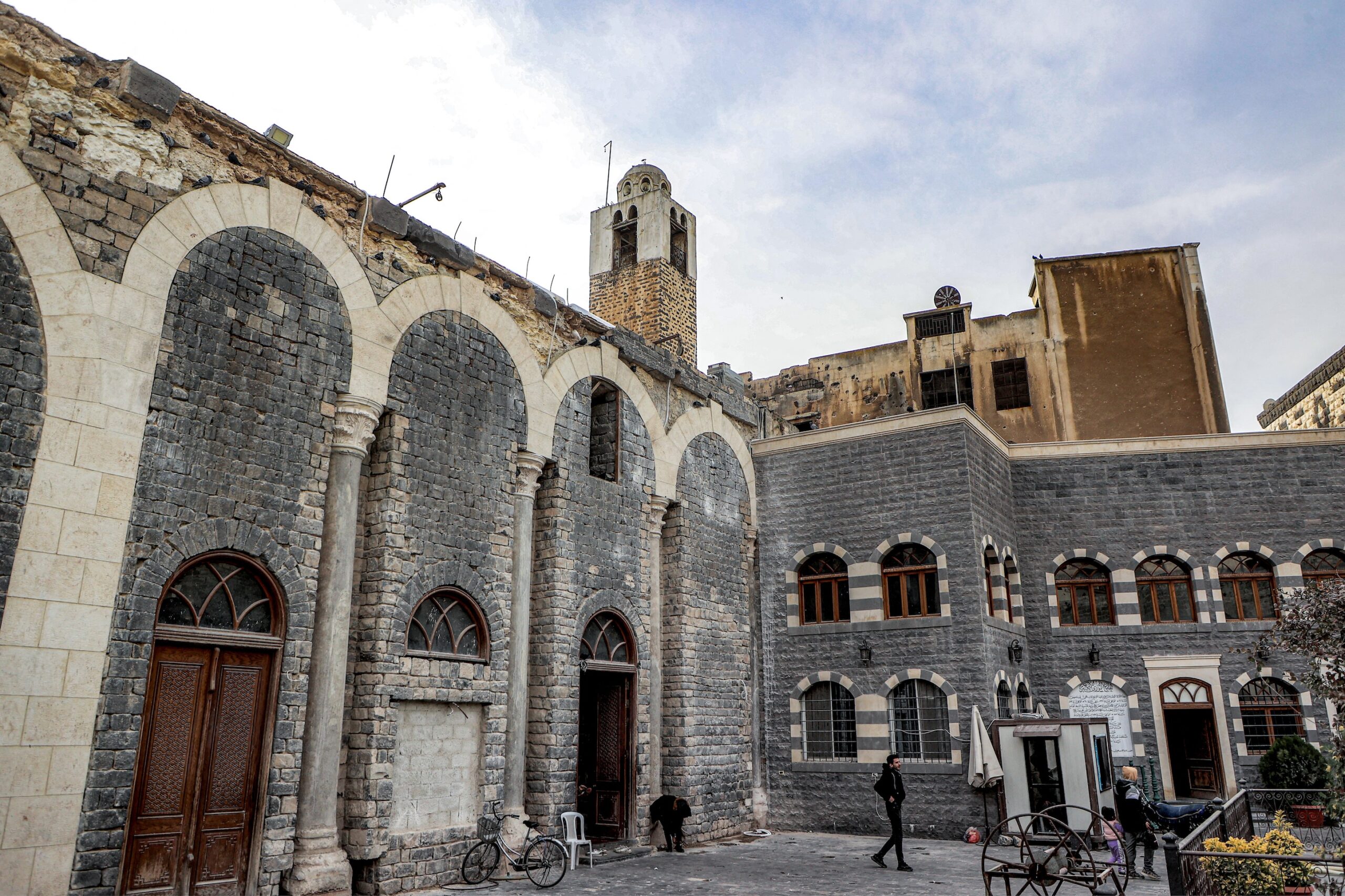
Homs is a city that many in Syria have only visited when they are on the way to somewhere else. Located between Aleppo, Damascus, Tartus, and Palmyra, its central location has long placed it as a crossroad of cities, but rarely as a destination. Before the war, Syrians and tourists stopped there to have a break or to buy some of the city’s famous sweets before continuing on to Krak des Chevaliers, Deir Mar Musa el-Habashi, or other destinations. The history of Homs and its story had remained unknown to many.
Everything changed with the start of the Syrian Revolution in 2011. The city became the site of news headlines. It turned from a quiet city into the city of rebellion, gaining the label of “capital of the Revolution.”
Before the war, nearly 156,000 residents had lived in Homs’ Old City, mostly from Christian and Sunni Muslim communities. Similar to other cities in Syria, Homs’ Old City had been surrounded by a historical wall, with seven gates, two of which still remained before the start of the war. Comprising nine neighborhoods, the Old City had been buzzing with life, with many different historical layers mirroring the richness and depth of the city’s history, which could be seen through its sites such as the citadel, churches, mosques, palaces, covered markets, hammams, and traditional houses. Often built with black basalt stones, the city was known as the City of the Black Stones.
The destruction of the Old City
Due to its rebellion during the revolution, Homs was targeted, besieged, divided, bombed, and destroyed by the Assad regime, leaving entire neighborhoods, including the Old City, damaged or in ruins.
Cultural heritage sites in the Old City were bombed and wiped out by the Assad regime. The siege of the Old City and its destruction meant that most of the pre-war residents had been displaced from their homes. Some residents had left to Wadi Al Nasara (the Valley of the Christians) in the western outskirts of Homs, while others moved to different parts of Homs, relocated to other areas in Syria, or left the country altogether.
Though some residents returned after the end of the siege in 2014, the complete and heavy destruction of many residential areas of the city made it impossible for people to return. Residents who opposed the Assad regime feared returning too, having faced threats of forced disappearance, killing, and imprisonment.
Most destroyed residential areas remain in ruins, with only a small number of families able to afford repairing partially destroyed homes
Years after the end of the battles and over a year after the Assad regime fell, very few reconstruction projects have taken place. The existing projects have specifically focused on religious landmarks, such as the Jesuit Monastery, parts of the Al Zawiya Mosque, and Khalid ibn al-Walid Mosque, as well as some leisure and commercial sites, including parts of the Covered Market, the Ottoman Hammam, the Julia Palace Restaurant, and Beit Al Agha Restaurant. Most destroyed residential areas remain in ruins, with only a small number of families able to afford repairing partially destroyed homes, while heavily destroyed homes remain largely untouched.
The reconstruction and reopening of these religious and leisure projects are undoubtedly crucial in drawing people back to the Old City. They give hope, encouraging people to return, especially as some actively organize or host events such as choir performances, film clubs, writing workshops, and festivals. But there are undoubtedly several challenges in focusing only on such landmarks.
First, many of the reconstruction projects focus on religious sites, restaurants, or cafes, and not residential homes. Secondly, these projects mostly target buildings rather than communal urban spaces such as streets and public spaces that bring people together. ُُThirdly, there is little help for families who lost their homes, which is one of the most important factors in bringing life back to the Old City.
In order to properly support the recovery of Homs’ Old City, public spaces in different neighborhoods should be rebuilt, through an integrated urban approach that would look at the Old City as a set of neighborhoods. This will help improve the city’s urban space and infrastructure and bring residents back.
Rethinking public space in the Old City
There are several locations that could be treated as nodes for rehabilitation and urban recovery, in order to improve urban life in the Old City. The diversification of rehabilitated locations within the Old City would help create a more inclusive reconstruction process and establish a vibrant public realm. For example, rehabilitating the squares near Al Nuri Mosque and near Al Arbaeen Complex (on the northwest side of the Old City) would be beneficial. Both of these squares are currently used as car parks, but could be turned into inclusive public spaces: They could host cultural and social events, but more importantly, function as everyday urban spaces with seating, green areas, and public art.
As the Old City and its community await reconstruction, fears are growing over new losses to Homs’ cultural and architectural identity
Other squares could also be rehabilitated, such as the Vegetable Souk Square, which buzzed with life before the war. With the multiple sieges of Homs, vegetable stalls emerged across neighborhoods as the central vegetable market gradually emptied. Encouraging shop owners to return to the square could help revive pre-war urban memory and hopefully draw people back to live in and visit the Old City again. It would also reduce the Old City’s isolation from the rest of Homs, and help reconnect the residents of Homs and their Old City. This, however, would not be possible if surrounding residential areas are not rebuilt as well.
As the Old City and its community await reconstruction, fears are growing over new losses to Homs’ cultural and architectural identity. An architect in Homs pointed out a building façade that had some of its architectural elements looted this year, while another informed us of the nighttime looting of historical façades and basalt stones from abandoned homes. Furthermore, since there is little support for restoration, some residents have been rebuilding themselves without necessarily respecting the city’s historic architectural style and heritage.
Homs as an urban lab of imagination
After over a year since the collapse of the Assad regime, there is no meaningful, inclusive, and impactful reconstruction project yet in Homs.
The challenges for reconstruction in the city are enormous. There are fears of violent and destructive reconstruction projects that are driven by investors who are rushing to make money out of the people’s suffering, as well as worries that these projects will only benefit the country’s elite, foreigners, or upper class Syrian diaspora, rather than the people whose homes are in ruins. One of the projects that was proposed last year, outside the Old City, had suggested demolishing the residential neighborhood of Al-Qarabis, which had been only partially damaged during the war. The project has led to protests by local residents, who ultimately succeeded in halting part of it.
In addition to this, many residents of Homs still have little knowledge about the Old City’s history and the significance of its cultural heritage sites. Before the war, many of the city’s cultural heritage sites had been destroyed in the name of urban development and modernization, and there was a shortage of community-led approaches that celebrated the richness of the Old City. This isolation naturally increased after the 2011 siege, as many people remained within their own neighborhoods for their safety. But there has been a newly growing interest across different generations in understanding the history of the city.
Reconstruction is not about stones only; it is about bringing life back to ruined areas
Community engagement could be improved through the creation of education and research programs that connect people with their heritage and their past, distant and more recent. Homs has many historians, architects, and passionate lovers of the Old City who could have a significant role in creating community engagement and awareness raising programs. The Jesuit Monastery is already opening its doors for cultural and social events, bringing people together from different parts of the city, and the project Harmony is also working on peace-building through art and culture. These are some of the great initiatives in Homs that are contributing to bringing life back to the Old City, and they are highly needed.
As a very diverse city, Homs is also divided across sectarian lines. There are still fears of instability, despite the end of the war. Homs’ diversity requires a special consideration, including in its reconstruction projects. Reconstruction is not about stones only; it is about bringing life back to ruined areas. It is about the quest for justice, and about understanding what trauma-informed and community-led reconstruction could look like. Homs cannot be rebuilt in a sustainable way without dealing with its open wounds and without finding justice for the families who lost so much in this war. The road to recovery is there, but still long.
Ammar Azzouz is a Lecturer in Human Geography at the University of Oxford.
Abdalhamid al Masri is a Lecturer in Architecture in Homs University.