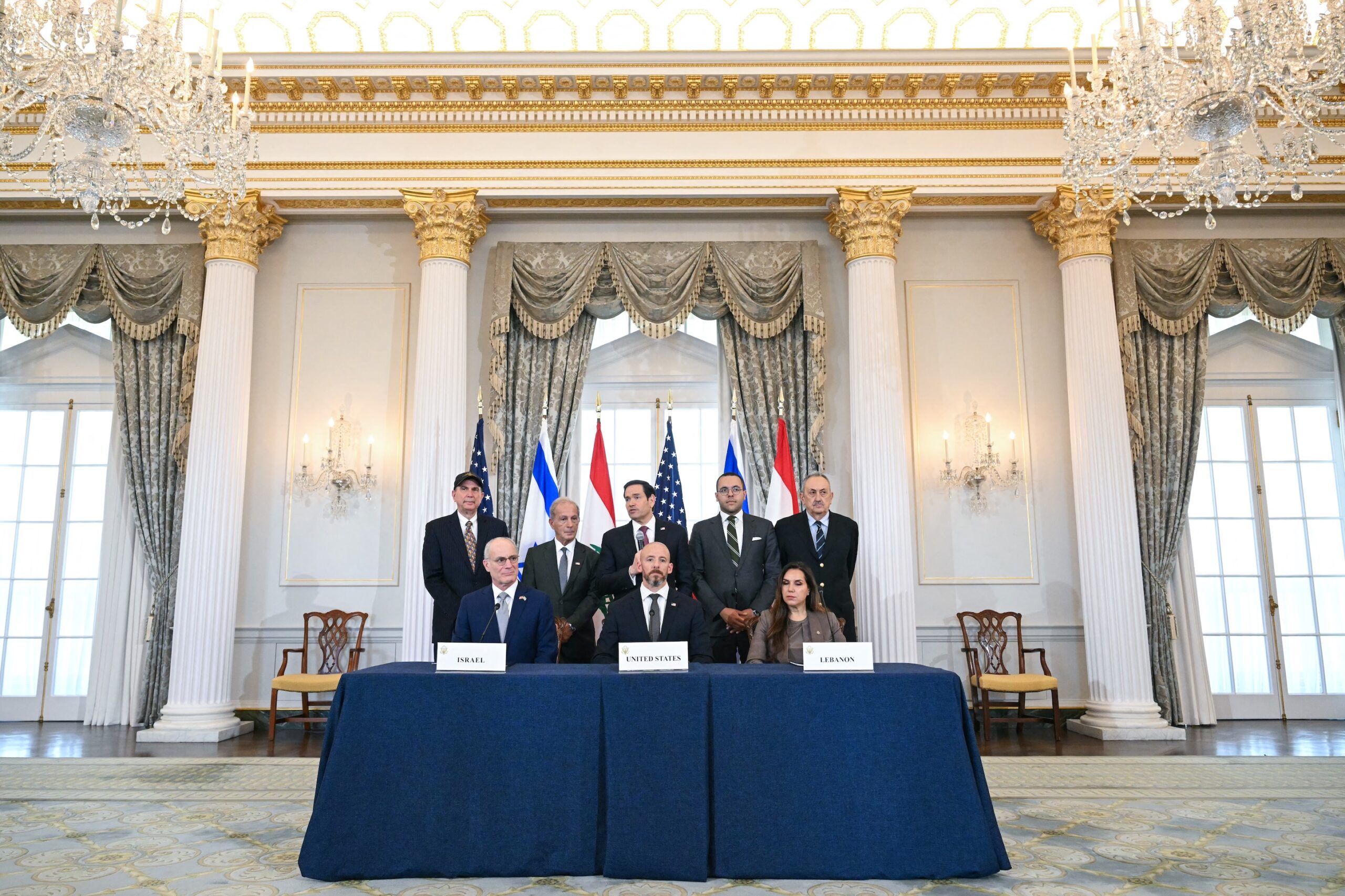
Following five rounds of direct talks, on June 26, 2026, the governments of Lebanon, Israel, and the United States signed a US-brokered Trilateral Framework. The Framework, which references a Security Annex that has not been officially published but has been leaked, comes on the heels of a devastating period of violence in Lebanon that has plunged the country into yet another crisis.
In this explainer, we document the political, legal, and security context in which this Framework has been signed, highlight key takeaways from the agreement, and unpack the expected implications, alluding to what may be next.
How did we get here?
Lebanon has been in a precarious security situation since the US-brokered ceasefire between Israel and Lebanon in November 2024, which pressed for the disarmament of Hezbollah, the deployment of the Lebanese Armed Forces (LAF) across South Lebanon, and a phased withdrawal of Israeli forces from Lebanon within 60 days of the agreement. Rather than adhering to the agreement, Israel committed more than 10,000 air and ground ceasefire violations and occupied five hilltops in South Lebanon. For its part, the LAF made progress in disarming Hezbollah after the Lebanese government launched a historic plan to do so in August 2025 and announced the completion of Phase 1 of the plan in early 2026, covering the area between the Litani River and the Israeli border; and the LAF was praised by US Central Command (CENTCOM) for its efforts in October.
This precarious situation escalated on March 2, 2026, when Lebanon was pulled into the regional war. Hezbollah launched a drone and military attack in Haifa in what they described as retaliation for the killing of Iran’s Supreme Leader Ayatollah Ali Khamenei. Following this attack, which marked the first time Hezbollah had attacked Israel since the 2024 ceasefire, Israel launched a devastating war on Lebanon, killing 4,278 people since March 2 and injuring an additional 12,196. More than 1 million people (nearly one fifth of the country’s population) have been displaced, as Israel has used mass evacuation orders to displace the population of the south and Beirut’s southern suburbs. Indiscriminate Israeli attacks amounting to war crimes have targeted both civilians and civilian infrastructure, and at least 132 healthcare workers have been killed.
In the time since the first cessation of hostilities on April 16 and the writing of this explainer, the death toll in Lebanon has nearly doubled
Israel has also used this war as pretext to encroach further into Lebanese sovereign land, invading and occupying significant portions of South Lebanon since March. In April, the Israeli Defense Forces (IDF) established a “Yellow Line,” and with it, occupied 6 percent of sovereign Lebanese territory. In May, the Yellow Line was expanded to a newly-established “combat zone,” through an Israeli military order forcibly evacuating all residents south of the Zahrani River. Israel’s incursions have been coupled with a mass demolition and detonation campaign across South Lebanon, resulting in the destruction of civilian infrastructure, including entire villages, homes, schools, hospitals, agricultural land, and government offices.
After the first US-Iran ceasefire was announced on April 8, which Pakistani mediators confirmed included a ceasefire in Lebanon, Israel violated the ceasefire and launched more than 100 strikes in a single 10 minute period in an attack known as “Black Wednesday.” On April 16, the United States brokered a cessation of hostilities between Lebanon and Israel, which later evolved into a ceasefire on June 3. Since April 14, the US has hosted five rounds of direct talks between both countries. Across this period of time, Israel has continued its aggression, prompting Hezbollah to resume its attacks as well. In the time since the first cessation of hostilities on April 16 and the writing of this explainer, the death toll in Lebanon has nearly doubled.
The most recent round of talks which concluded on June 26 resulted in the Trilateral Framework. Importantly, the Framework follows the US-Iran Memorandum of Understanding (MoU) which was signed on June 17. The MoU declares “the immediate and permanent termination of military operations on all fronts, including in Lebanon,” and ensures “the territorial integrity and sovereignty of Lebanon.” How and if the new Framework and MoU interact has been a point of debate and discussion among analysts.
What does the agreement say?
Taken together, the Trilateral Framework and Security Annex adopt a general approach in which the onus of the disarmament of Hezbollah and all non-state armed groups falls on the LAF and the Lebanese state. More specifically, the agreement designates pilot zones in which a four-step model is adopted. First, the model begins with clearance, which involves the destruction of all infrastructure (including weapons, tunnels, and command centers) and the taking of legal measures against non-state armed actors partaking in unauthorized activity; second, verification that clearance has been completed is conducted; third, the LAF assumes sole operational control of the pilot zone; and fourth, the Lebanese state begins reconstruction efforts. According to initial reports, two pilot zones have been agreed to; the first zone is Zawtar, which is north of the Litani River and the second is south of the Litani River and includes the towns of Froun and Ghandourieh. Observers have noted that when the agreement was signed Israel was not occupying the second pilot zone, raising questions on its selection.
The documents never once mention the term “Israeli withdrawal,” instead opting for the language “Israeli redeployment,” a vague phrasing which muddies the fact that Israel continues to occupy Lebanese sovereign land in violation of international law
Though the LAF is assigned responsibility of implementing this four-step model, the Security Annex stipulates the creation of a Military Coordination Group for Lebanon (MCG4L) by Israel and Lebanon, which reports to both governments and which manages deconfliction, verification, and overall implementation. Notably, the documents never once mention the term “Israeli withdrawal,” instead opting for the language “Israeli redeployment,” a vague phrasing which muddies the fact that Israel continues to occupy Lebanese sovereign land in violation of international law. Only after completion of a “verifiable disarmament and dismantlement process,” will Israel commit to a “phased, conditions-based, progressive reduction and eventual redeployment of its forces from Lebanese territory, planned and sequenced through the MCG4L, to coincide with LAF deployment.”
Worryingly, the agreement does not explicitly address who will determine whether disarmament in a particular area has been completed and what will occur if disagreement on this point ensues. The Security Annex states that “verifiable implementation of the disarmament and dismantlement process [will] be agreed upon within this negotiation framework.” It is fair to anticipate that given prior disagreements between Israel and Lebanon on whether particular phases of disarmament were completed, serious disagreements may arise once more. The fact that Israeli withdrawal is made entirely contingent on disarmament and LAF deployment raises serious concern that we may soon find ourselves stuck in a loop in which a unified assessment of whether disarmament has been sufficiently completed cannot be achieved by all parties and accordingly, in which Israel continues to maintain a long-term occupation in the country. The Security Annex stipulates that periodic reviews of the agreement will be facilitated by the US and states that “any disputes regarding interpretation or execution will be resolved through trilateral discussions.”
Experts emphasize that disarmament is a daunting task in and of itself that will require a context-specific and sensitive Lebanese-led approach that takes into account the fact that Hezbollah derives a significant portion of its raison d’être from challenging Israeli encroachment, its role in providing social services for an underserved portion of the country, and its dual nature as a political party currently represented within the government. Though the LAF completed phase one of a prior disarmament plan in January 2026, the army continues to be under-resourced in a manner that makes this work challenging. Even US Special Envoy Tom Barrack notes that Hezbollah cannot be disarmed militarily; in fact, Israel has been unable to do so. The complexity of disarmament as a task and the fact that it will likely take time cannot be overstated; tying Israeli withdrawal to disarmament thus complicates the situation on the ground and threatens to keep the pretense for Hezbollah’s presence fueled.
An agreement that would have wanted to position Lebanon for success on the ground and with its people would have established any restoration of sovereignty as a starting point
In addition to these expected challenges around implementation, critics of the agreement have raised concerns around two key additional areas: sovereignty and accountability.
Though the agreement commits all parties to “a secure, rebuilt Lebanon, under full Lebanese state sovereignty,” experts have noted that the Framework and Security Annex problematically treat Lebanese sovereignty as something that the LAF and Lebanese state have to work for and that may take years to regain, rather than as a starting point in line with what international relations and international law necessitate. Given that Lebanon is already suffering from a sovereignty crisis made worse by Hezbollah’s actions that have invited undue Iranian influence and interference and by Israel’s occupation of Lebanese sovereign land, the government is operating at a sovereignty deficit. An agreement that would have wanted to position Lebanon for success on the ground and with its people would have established any restoration of sovereignty as a starting point.
The Framework also signs away Lebanon and Israel’s rights to pursue adverse actions in the international political and legal stage as a demonstration of “positive intent,” a provision that has been widely critiqued by victims, impacted persons, and justice advocates in Lebanon. Prior to the signing of the agreement, advocates had been calling on Lebanese authorities to sign onto the Rome Statute, opening up the possibility of prosecution before the International Criminal Court (ICC). Lebanon’s signature on the document is perceived not solely as giving up leverage that it had given Israel’s long rap sheet of violations, but also as prioritizing a temporary peace over long-term justice. In a country in which the choice to offer amnesty to implicated parties after the civil war has resulted in an accountability crisis that has not been surmounted and that has resulted in even financial abuses, observers have been angered that a government led by a former International Court of Justice (ICJ) judge has made this calculus.
What could come next?
While a number of foreign policy makers and experts have welcomed the historic nature of the Framework given the parties involved, others have raised concerns on the many questions that it leaves unanswered regarding timeline, the selection of pilot zones, and verification, and the context in which it has been agreed to. Even the text itself recognizes that there are still many details to coalesce around. The Framework notes that the two countries will work to establish working groups to draft a “full comprehensive peace and security agreement” and that “complementary tracks of ongoing direct engagement” will continue.
Shortly after the Framework was announced, protesters took to the streets in Beirut to express their dissatisfaction with the deal. Though some critics of the Framework do align with Hezbollah, many do not. Some are victims of Israeli wars in the country and others are Lebanese citizens deeply concerned about the implications of the deal for Lebanese sovereignty and negotiating power. Critics argue that disarmament cannot occur at the expense of ripping the country apart.
In a country in which the potential for civil strife is at an all-time high, Lebanese authorities have not taken the necessary steps to communicate clearly and for a domestic audience about the agreement, why it was signed, and how it will deliver on the needs of the Lebanese people. Particularly because the agreement is widely perceived as obligating the Lebanese government to a number of complex, time-intensive, and high-risk steps in order to regain their own land, all the while using vague and non-committal language when it comes to what is expected of Israel, Lebanon is considered the loser here. Israel’s Defense Minister Israel Katz has in fact confirmed that the country will not withdraw “a millimeter” until Hezbollah is disarmed. Lebanon’s extremely weak position going into the negotiations partially explains this outcome, but there is little clarity on why Lebanese authorities opted to sign at the time they did, rather than continue negotiating.
Time alone will tell whether the choice to take this path was the right one.
Mai El-Sadany is the Executive Director at TIMEP.
Douglas Christensen is the Advocacy Manager at TIMEP.